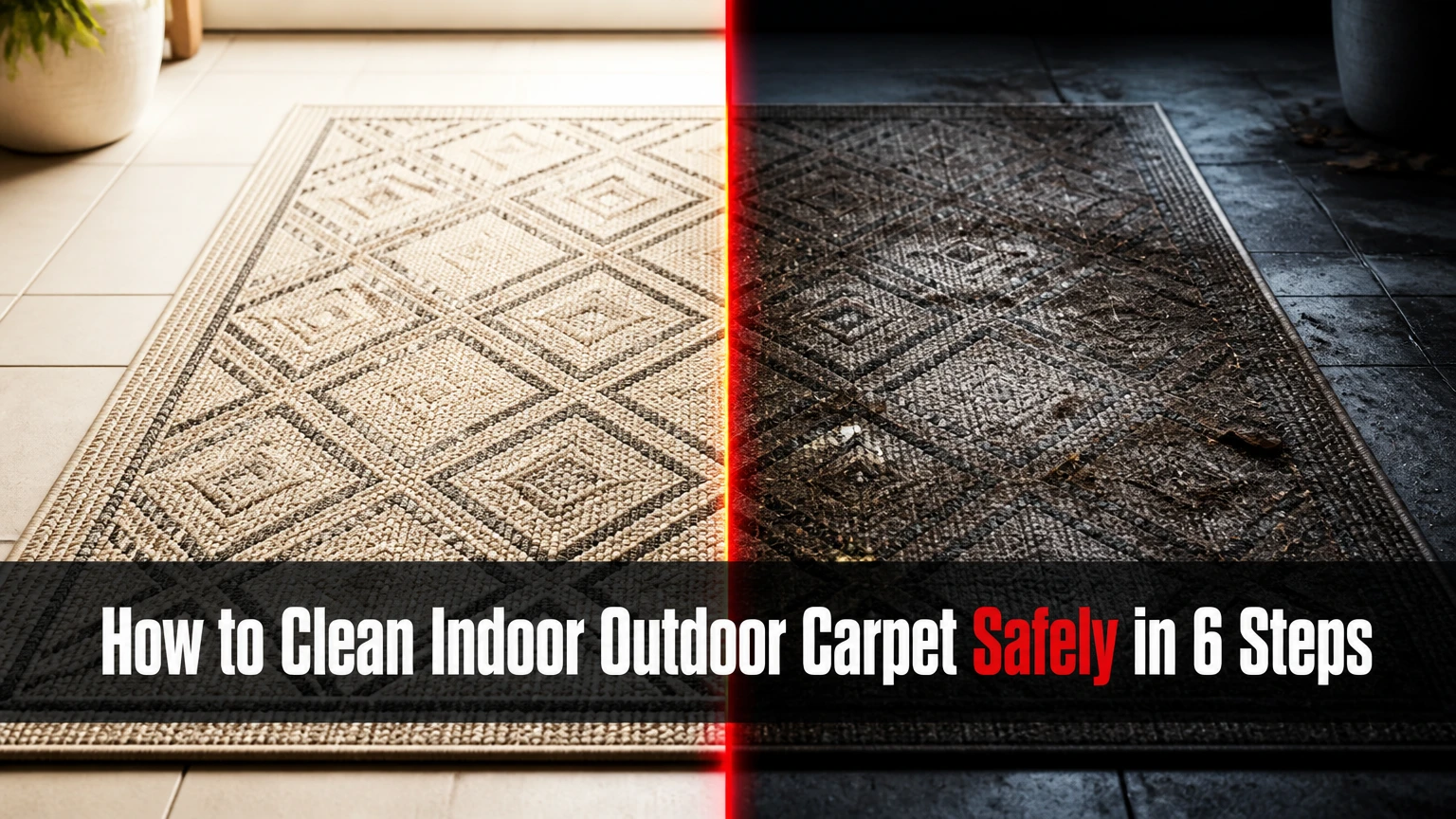
To clean indoor outdoor carpet, remove dry soil, treat stains, apply a low-residue detergent, agitate gently, rinse thoroughly, and dry the carpet and subfloor completely. The safest method depends on whether the carpet is loose or glued, whether it sits over wood or concrete, and whether the fibers are polypropylene, polyester, or artificial turf.
Key Facts at a Glance
Vacuum indoor-outdoor carpet before adding water, because wet grit becomes harder to remove.
Use about 1 teaspoon of low-sudsing neutral detergent per quart of lukewarm water, then rinse until no foam remains.
Keep water below approximately 120°F (49°C), unless the carpet manufacturer specifies a lower limit.
Use a garden hose for most removable outdoor carpet; pressure washing is unnecessary for many installations and can damage backing.
Indoor carpet requires extraction rather than flooding, especially over wood, laminate, or finished subfloors.
Carpet, adhesive, and the surface underneath must dry fully, usually within 4-24 hours, to prevent odor and microbial growth.
What Indoor-Outdoor Carpet Is
Indoor-outdoor carpet is a low-pile synthetic floor covering made for exposure to moisture, sunlight, and heavy traffic. Most products use polypropylene or polyester face fibers with a latex, rubber, polyurethane, or thermoplastic backing, but water resistance does not make every backing waterproof or every installation flood-safe.
The low pile contains less soil than plush carpet, so vacuuming and rinsing work efficiently. Needle-punched marine carpet often has dense, short fibers, while looped polypropylene resembles conventional carpet and needs protection from a rotating brush.
Indoor-outdoor carpet is resistant to many water-based stains, ultraviolet exposure, mold growth, and rot. It is not automatically resistant to cooking oil, sunscreen, automotive fluids, adhesive failure, alkaline cleaners, prolonged ponding, or moisture trapped below the backing.
The U.S. Environmental Protection Agency summarizes the moisture issue plainly: “The key to mold control is moisture control.” That principle applies to the carpet and to the wood, concrete, adhesive, or composite decking beneath it.
How Carpet Construction Changes Cleaning
Polypropylene fibers absorb very little water, but the carpet backing and seams can retain moisture. Polyester generally tolerates water-based staining well, while heat and aggressive solvents can still alter color, texture, or adhesive.
Drainage holes help removable exterior carpet dry faster. They do not solve a blocked drain, an unventilated balcony, or carpet glued continuously to damp decking. Inspect the underside when possible, because a clean face can conceal wet backing, rotting wood, or failed adhesive.
Which Carpet Type Do You Have?
The carpet material determines how much heat, agitation, and chemical exposure the surface can tolerate. Check the product label, installation paperwork, or manufacturer website before using bleach, solvent, high heat, or a pressure washer.
| Carpet type | Identification and behavior | Safest routine method | Main restriction |
|---|---|---|---|
| Polypropylene, or olefin | Matte synthetic fiber; resists water-based stains; common in patios and boats | Vacuum, mild detergent, cool or lukewarm rinse | Sensitive to heat, oil, and some solvents |
| Polyester, or PET | Often bright-colored; resists many water-based spills | Vacuum, mild detergent, low-moisture extraction | Test dyes before bleach or strong oxidizers |
| Marine needle-punch | Dense short olefin fibers; often has drainage holes | Hose rinse, nylon brush, wet vacuum | Check backing and adhesive before pressure washing |
| Artificial turf | Upright polyethylene or polypropylene blades with infill | Remove debris, rinse, brush against pile | Do not compact infill or force water beneath seams |
| Adhesive-backed carpet | Fixed to wood, concrete, fiberglass, or composite | Low-moisture extraction and controlled rinse | Flooding can loosen adhesive and trap water |
Before You Start
Prepare the work area before wet cleaning. Remove furniture, sweep nearby hard surfaces, and confirm that runoff will not enter a basement, electrical outlet, storm drain, or neighboring property.
Typical time: 1-3 hours of active work, plus 4-24 hours of drying.
Difficulty: Moderate for a removable rug, moderate to high for glued carpet.
Typical DIY cost: $10-$45 if you already own a vacuum and hose; $40-$90 for an extractor rental.
Materials: vacuum, white cloths, soft or medium nylon brush, spray bottle, bucket, low-sudsing detergent, wet-dry vacuum or carpet extractor, floor squeegee, and fans.
Use gloves and eye protection when handling pet urine, sewage, unknown residues, or mold-contaminated material. Never mix bleach with vinegar, ammonia, acidic cleaners, or enzyme products.
How to Clean Indoor Outdoor Carpet: Six Steps
The six-step process takes roughly 30-60 minutes per 100 square feet, excluding drying. Cleaning succeeds when the carpet receives enough rinsing to remove detergent but not so much water that the backing or subfloor remains wet.
Step 1: Remove Dry Soil
Vacuum the entire carpet slowly in two directions, then inspect traffic lanes, edges, seams, and furniture footprints. Raise or disable the rotating brush on looped, needle-punched, or loosely tufted carpet so the vacuum cannot pull loops or distort the backing.
For removable outdoor rugs, shake or lift the rug only where doing so will not spread contaminated dust. Sweep sand, leaves, and gravel from the surrounding deck before rinsing, since loose grit can migrate under the carpet.
You will know this step worked when the vacuum collects little visible grit on a second pass and the carpet pile returns without a damp, gritty feel. The common mistake is wetting embedded soil before vacuuming, which turns loose particles into paste and increases resoiling.
Step 2: Identify and Pre-Treat Stains
Blot fresh liquid with a white towel, working from the outside of the mark toward its center. Remove solids with a spoon or dull scraper, then test every cleaner on a hidden edge for color transfer, texture change, and backing reaction.
For ordinary food or dirt, use a small amount of neutral detergent solution. For grease, first absorb the surface oil with cornstarch, then vacuum the powder and treat the remaining film. Do not spread automotive fluid, tar, sunscreen, or cooking oil with a wet brush.
You will know pre-treatment is complete when the stain edge is contained and the towel no longer lifts loose pigment. The common mistake is scrubbing immediately, which pushes contamination deeper and can create a fuzzy, lighter patch.
Step 3: Apply a Low-Residue Cleaning Solution
Mix approximately 1 teaspoon of low-sudsing, neutral detergent in 1 quart of lukewarm water, or follow the carpet manufacturer’s dilution. This is substantially less soap than a general-purpose dishwashing mixture, and the lower concentration reduces sticky residue that attracts soil.
Mist the carpet in manageable sections instead of pouring solution directly onto it. The surface should become evenly damp, not saturated. Allow 5-10 minutes of dwell time, but do not let the detergent dry on the fibers.
Use a neutral product near pH 7 when possible. A carpet extraction detergent designed for synthetic fibers is preferable to heavily perfumed dish soap because it produces less foam and is easier to rinse.
You will know the application is controlled when the carpet is damp beneath the tips but no water pools at seams or edges. The common mistake is creating thick foam, which makes rinsing slow and leaves surfactant behind.
Step 4: Agitate Without Damaging the Pile
Work in sections of approximately 4 by 4 feet with a clean nylon brush or a soft deck brush. Push the brush in the direction of the pile first, then make a short crosswise pass over heavily trafficked areas; avoid aggressive circular scrubbing on looped carpet.
Use extra agitation at doorways, grill areas, pool entrances, and the lower edge of outdoor furniture. Keep the brush moving so one spot does not receive concentrated friction.
You will know agitation worked when gray or brown soil appears in the foam or rinse water and the pile looks consistent after brushing. The common mistake is using a stiff wire brush, which can cut polypropylene, pull loops, and expose backing.
Step 5: Rinse and Extract the Dirty Water
Rinse removable outdoor carpet with a garden hose from the high side toward the drainage side. A wide fan nozzle is usually sufficient. Continue until runoff loses visible foam, then use a wet-dry vacuum or squeegee to remove standing water.
Use a carpet extractor indoors. Make one controlled wet pass followed by two or more slow extraction passes, adjusting the number according to how much water the carpet releases. Do not use a hose indoors, and do not flood carpet installed over wood or moisture-sensitive flooring.
Pressure washing is acceptable only when the product and installation permit it. If used, select a wide fan pattern, hold the wand at least 12 inches away, keep the pressure conservative, and test a hidden area first. A 1,500 PSI ceiling is a cautious upper limit for some removable outdoor products, not a universal manufacturer specification.
You will know rinsing is complete when the extracted water has little foam and the carpet no longer feels slick. The common mistake is stopping after the first clear-looking rinse, because transparent detergent residue can still remain in the backing.
Step 6: Accelerate Drying and Check the Subfloor
Push water toward a drain with a floor squeegee, lift removable carpet at the edges, and place fans so air moves across and beneath the backing. Indoors, combine air movers with a dehumidifier and keep doors or windows positioned to support, rather than interrupt, ventilation.
Measure indoor relative humidity if possible. A practical drying target is below 60% relative humidity, with no cool, damp feel beneath the backing. Outdoor carpet may dry in 4-8 hours in warm sun with airflow, while shaded, humid, or tightly glued installations can require 24 hours or longer.
Press a dry white towel firmly against the pile and underside. The towel should remain dry, and the carpet should not smell sour or musty. The common mistake is replacing furniture or rolling the rug before the backing dries, which traps moisture and creates odor.
What Cleaning Method Is Best?
The best method is a garden hose and controlled brush for a removable outdoor carpet, an extractor for indoor carpet, and low-moisture cleaning for glued installations. Pressure washing removes embedded grit quickly, but it carries more risk of backing damage, seam failure, and water intrusion than ordinary rinsing.
| Method | Water and equipment | Typical time per 100 sq. ft. | Best setting and principal risk |
|---|---|---|---|
| Vacuum only | Dry vacuum; no added water | 10-20 minutes | Weekly maintenance; does not remove oily film |
| Hose and brush | Garden hose, nylon brush, wet vacuum | 45-90 minutes | Removable patio or boat carpet; slow drying |
| Low-moisture extraction | Encapsulation product or limited-spray machine | 30-60 minutes | Glued indoor carpet; residue or incomplete soil removal |
| Hot-water extraction | Carpet extractor, clean-water rinse | 45-90 minutes | Sunroom, basement, enclosed porch; oversaturation |
| Pressure washer | Wide fan nozzle, controlled pressure | 20-45 minutes | Tough removable outdoor carpet; backing delamination |
Steam cleaning and hot-water extraction are not identical. Steam can describe a high-temperature process, while extraction describes spraying solution and recovering it. For polypropylene, use the lowest effective heat because excessive temperature can distort fibers or weaken adhesives.
How to Remove Specific Stains and Odors
Stain treatment should match the contaminant, fiber, and backing. Always remove the residue with a clean-water rinse, because a stain remover left in carpet can attract fresh soil or alter the color.
| Problem | First treatment | Rinse or recovery method | Avoid |
|---|---|---|---|
| Grease or sunscreen | Cornstarch for 30-60 minutes, then mild detergent | Extract with clean lukewarm water | Solvent poured directly onto backing |
| Pet urine | Enzyme cleaner at label dilution; allow label dwell time | Extract without flooding the subfloor | Vinegar as a substitute for enzyme treatment |
| Mildew odor | Remove moisture source; detergent clean and dry fully | Extract, ventilate, and inspect underside | Masking odor with fragrance |
| Mineral crust | Diluted white vinegar, approximately 1:4 with water, spot-tested | Rinse with clean water | Acid on limestone, marble, or acid-sensitive backing |
| Mud or soil | Dry completely, vacuum, then mild detergent | Hose or extract until water clears | Wet vacuuming before dry soil removal |
| Paint or adhesive | Identify product and follow solvent guidance | Minimal controlled rinse | Acetone or paint thinner without testing |
Chlorine bleach should not be used on unknown carpet. Even when a product is solution-dyed, bleach concentration, dwell time, backing chemistry, and colorfastness still matter. Manufacturer approval is the deciding condition.
Pet urine requires special care because odor can remain beneath the face fibers. Saturate only as deeply as the contamination traveled, and avoid flooding wood or other porous subfloors. If urine has penetrated padding, adhesive, or decking, surface cleaning alone may not solve the odor.
Mildew is a moisture problem before it is a fragrance problem. If the underside remains damp, vinegar, deodorizer, and repeated scrubbing provide temporary improvement while the source continues.
What Are the Safe Operating Limits?
Safe limits depend on the product label, but conservative household limits protect most synthetic indoor-outdoor carpet. Temperature, pressure, chemical strength, and drying time matter together, because a mild detergent can still cause damage when paired with prolonged soaking.
| Variable | Conservative working range | Why the limit matters | Adjustment |
|---|---|---|---|
| Rinse temperature | Cool to 120°F (49°C) | Limits polypropylene distortion and adhesive stress | Use cooler water for unknown carpet |
| Detergent strength | About 1 tsp per quart | Reduces sticky residue and foam | Use label dilution for extraction products |
| Pressure washer distance | At least 12 inches | Reduces fiber and backing impact | Increase distance if fibers move |
| Pressure washer pressure | Prefer hose pressure; up to 1,500 PSI only if approved | High pressure can delaminate backing | Avoid pressure washing glued carpet |
| Indoor relative humidity | Below 60% during drying | Helps evaporate retained moisture | Add dehumidification |
| Drying period | Usually 4-24 hours | Prevents odor and subfloor damage | Extend time in shade or humidity |
The 120°F figure is a cautious household ceiling, not proof that every carpet tolerates that temperature. Product labels and technical data sheets take precedence, especially for carpet with rubber backing, adhesive seams, or a marine-grade coating.
How Often Should Indoor-Outdoor Carpet Be Cleaned?
Vacuum indoor-outdoor carpet weekly indoors and at least every one to two weeks outdoors during heavy use. Rinse removable outdoor carpet when pollen, salt, dust, or soil becomes visible, and deep-clean twice yearly or after a major spill.
| Location | Routine maintenance | Deep-clean interval | Extra inspection |
|---|---|---|---|
| Covered porch | Vacuum weekly; spot clean immediately | Every 6-12 months | Check shaded edges for dampness |
| Pool deck | Remove leaves and rinse weekly in season | Every 3-6 months | Inspect chlorine, sunscreen, and drainage |
| Finished basement | Vacuum 1-2 times weekly | Every 6-12 months | Check humidity and subfloor odor |
| Boat or marine area | Dry debris removal after use | At season end and after spills | Inspect salt, seams, and drainage holes |
| Commercial entrance | Vacuum daily | Quarterly or as traffic requires | Use low-moisture methods during business hours |
The best schedule follows contamination, not the calendar alone. A pool deck with sunscreen and chlorine exposure may need more frequent rinsing than a lightly used covered porch, while a dry basement may need less wet cleaning than a humid sunroom.
How Should You Clean Carpet Over Wood or Concrete?
Carpet over wood requires controlled moisture, rapid extraction, and an underside inspection; carpet over concrete tolerates more rinsing but still needs complete drying. Glued carpet should never be treated like a loose outdoor rug because water can migrate beneath the adhesive layer.
For wood decking, confirm that water can drain away from the building, lift an edge if possible, and avoid pressure washing near seams. Rotted or darkened boards indicate a subfloor problem that cleaning cannot repair.
Concrete is less vulnerable to rot but can hold moisture below a nonbreathable backing. Check for efflorescence, damp spots, and recurring odor after drying. If carpet is installed in a basement, use a moisture meter when available and address seepage before cleaning.
For balcony installations, protect drains and prevent runoff from entering occupied areas below. Building rules may restrict detergents, pressure washers, or discharge into stormwater systems.
Common Mistakes and How to Fix Them
Flooding Glued Carpet
Failure: Water remains beneath the backing or loosens adhesive.
Recovery: Stop adding water, extract repeatedly, lift an accessible edge, and run air beneath the carpet. Replace sections if adhesive failure or subfloor damage appears.
Leaving Detergent Residue
Failure: The carpet looks clean but becomes dirty again within days or weeks.
Recovery: Perform several clean-water extraction passes without detergent. Reduce the next detergent dose and increase rinse recovery.
Using a Rotating Brush on Loops
Failure: Loops snag, fuzz, or pull away from the backing.
Recovery: Trim only isolated loose fibers; do not pull them. Switch to suction-only or hard-floor vacuum mode.
Treating Oil Like a Water-Based Stain
Failure: A wet brush spreads sunscreen, grease, or automotive fluid.
Recovery: Absorb the oil first with cornstarch, vacuum it, then use a small detergent application followed by extraction.
Covering Wet Carpet Too Soon
Failure: Furniture, storage boxes, or a rolled rug trap moisture and create odor.
Recovery: Reopen the area, separate the backing from the floor, increase airflow, and test with a dry towel before covering it.
Using Acid or Bleach Without Testing
Failure: Color loss, brittle fibers, or backing deterioration occurs.
Recovery: Rinse immediately with clean water if chemically safe, stop further treatment, and contact the manufacturer or a carpet cleaner for persistent damage.
When Should You Hire a Professional or Replace It?
Professional cleaning is appropriate when carpet covers more than roughly 300-500 square feet, contains sewage or extensive pet urine, has recurring odor after drying, or is glued over a moisture-sensitive subfloor. A certified technician can select low-moisture extraction, inspect backing, and measure moisture instead of repeatedly flooding the area.
Typical residential professional cleaning costs range from about $0.25-$0.75 per square foot, with minimum service charges often around $100-$200. Travel, stain treatment, furniture moving, odor treatment, and difficult access can increase the invoice, so request an itemized estimate.
| Condition | Cleanable? | Likely action | Typical consequence |
|---|---|---|---|
| Surface dirt and pollen | Yes | Vacuum, mild detergent, rinse | Normal maintenance |
| Small grease spot | Usually | Absorb, detergent, extract | Possible light shadow |
| Localized pet urine | Sometimes | Enzyme treatment and deep extraction | Padding or subfloor may retain odor |
| Delaminated backing | Rarely | Professional assessment | Partial replacement often needed |
| Moldy porous backing | Often not economically | Remove source and replace affected material | Cleaning face fibers is insufficient |
| Rotted wood beneath carpet | No, not by cleaning | Repair subfloor first | Carpet may need removal |
Replace carpet when the backing crumbles, seams separate repeatedly, drainage holes are blocked, the face fibers remain oily after treatment, or odor returns after complete drying. Indoor-outdoor carpet is durable, but it is not a substitute for repairing leaks, drainage failures, or rotten decking.
FAQ
Can you use a carpet cleaner on indoor-outdoor carpet?
Yes, a carpet extractor is generally suitable for synthetic indoor-outdoor carpet when the manufacturer permits wet cleaning. Use low-sudsing detergent, moderate water temperature, and multiple extraction passes. Avoid saturating glued carpet or any installation over wood, because the subfloor and adhesive may fail before the face fibers show damage.
Is dish soap safe for outdoor carpet?
A very small amount of mild, neutral dish soap can clean many synthetic outdoor carpets, but concentrated dish soap creates excessive foam and residue. Start near 1 teaspoon per quart of water, test an inconspicuous area, and rinse until the surface no longer feels slick.
Can indoor-outdoor carpet grow mold?
Indoor-outdoor carpet fibers usually resist mold growth, but dirt, backing, adhesive, padding, and damp subfloors can support microbial growth. Persistent moisture, blocked drainage, and poor ventilation are the usual causes. Dry the complete assembly and repair the moisture source rather than repeatedly deodorizing the carpet face.
How do you clean an outdoor rug without a hose?
Vacuum thoroughly, spot-treat stains with minimal solution, scrub small sections with a damp nylon brush, and recover dirty water with a wet-dry vacuum. Use several clean-water passes from a spray bottle or low-flow sprayer. This method takes longer and may not remove contamination beneath a dense backing.
Can you use vinegar on indoor-outdoor carpet?
Diluted vinegar can help dissolve mineral deposits on acid-tolerant synthetic fibers after a hidden-area test, but it is not a reliable mold or pet-urine treatment. Never use vinegar on acid-sensitive stone beneath the carpet, and never mix it with bleach or ammonia. Rinse after spot treatment.
How do you make indoor-outdoor carpet smell fresh?
Remove the moisture source, vacuum dry soil, clean with a low-residue detergent, rinse thoroughly, and dry the carpet and underside completely. Enzyme cleaner is more appropriate for urine odor, while persistent mustiness indicates trapped moisture, contaminated padding, adhesive failure, or a damp subfloor that may require removal.
The Bottom Line
The safest way to clean indoor outdoor carpet is to vacuum first, use minimal neutral detergent, agitate with nylon rather than wire, rinse until residue disappears, and dry both carpet and subfloor completely. Use a hose for removable outdoor carpet, extraction for indoor installations, and professional assessment when backing, adhesives, urine, mold, or wood damage is involved.