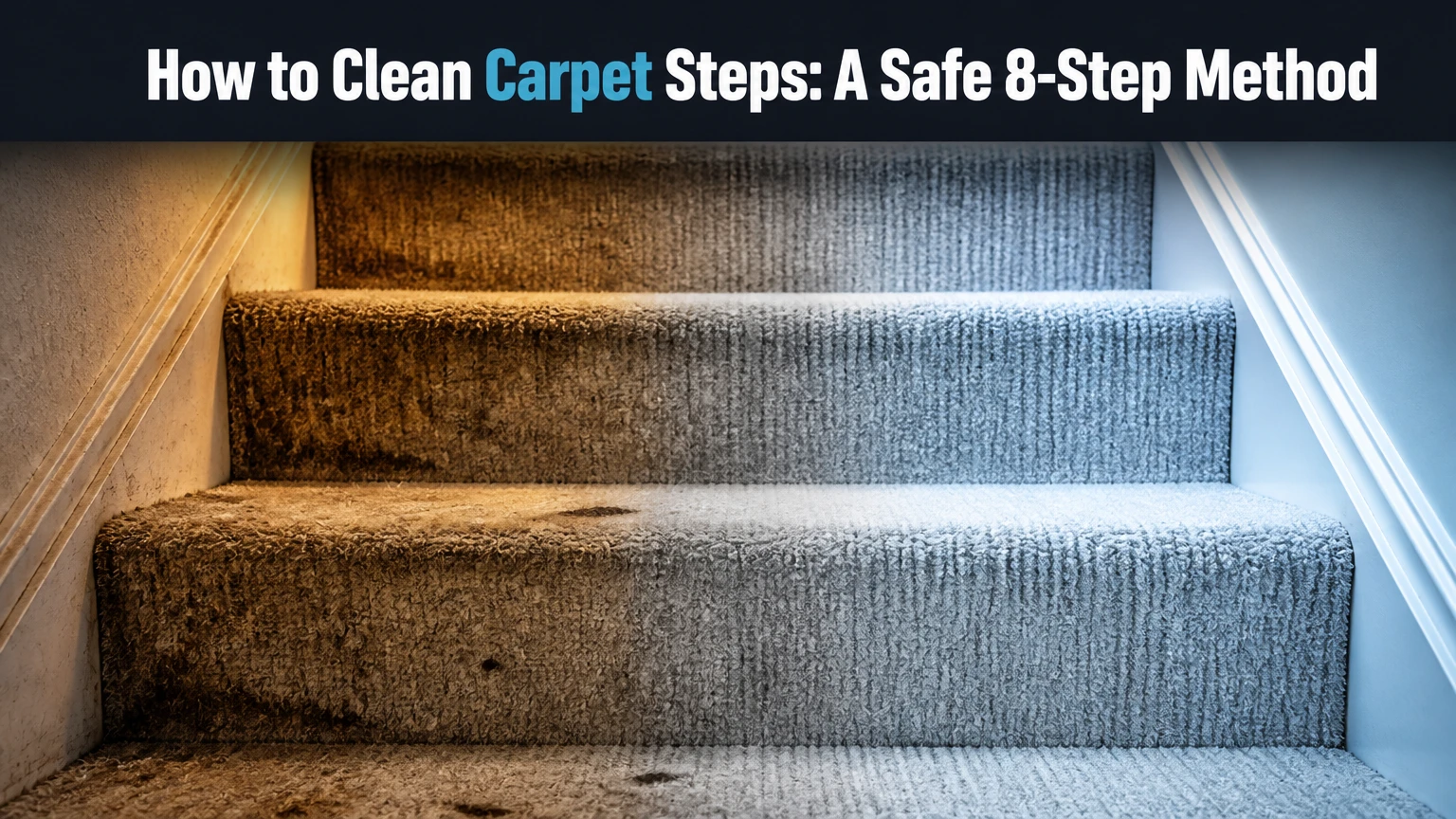
To clean carpet safely, remove dry soil, apply a fiber-appropriate pre-spray, agitate, allow controlled dwell time, extract with minimal water, treat remaining spots, groom the pile, and dry it quickly. The complete process usually takes 2-4 hours of work plus 6-12 hours of drying, and correct moisture control determines the result more than aggressive scrubbing.
Key Facts at a Glance
Vacuuming removes loose abrasive grit before water can turn it into sticky mud.
Hot-water extraction usually gives the deepest residential clean, but over-wetting can damage carpet backing.
Most synthetic wall-to-wall carpets tolerate measured alkaline pre-sprays; wool and plant fibers require gentler, fiber-specific chemistry.
A carpet should dry completely within 6-12 hours under typical conditions.
Blot fresh spills from the outside toward the center instead of rubbing them into the pile.
A professional cleaning commonly costs $0.25-$0.50 per square foot, while a rental machine commonly costs $30-$50 per day before solution fees.
What Does Carpet Cleaning Actually Remove?
Carpet cleaning removes particulate soil, oily traffic film, food residue, allergens attached to dust, and removable stains from carpet fibers and backing. Cleaning improves appearance and reduces the material that becomes airborne during foot traffic, but ordinary cleaning should not be described as complete sterilization or guaranteed pathogen removal.
The Carpet and Rug Institute’s consumer guidance identifies regular vacuuming as the most important routine carpet-care action. That advice matters because dry soil contains sharp mineral particles that abrade fibers when walked on. Industry materials often cite dry soil as roughly 79% of carpet debris, but the percentage varies by building, climate, occupants, and measurement method.
Cleaning has three distinct goals:
- Remove soil: Extract particles, oils, and residues from the pile.
- Control contamination: Reduce allergens, odor sources, and organic residue.
- Protect the textile: Avoid shrinkage, color bleeding, delamination, browning, and pile distortion.
Carpet type changes the safe process. Nylon and solution-dyed polyester generally tolerate more moisture than wool, viscose, sisal, or coir. The manufacturer’s care label takes priority over a generic internet recipe.
How Does the Carpet Cleaning Process Work?
Carpet cleaning combines chemical action, heat, agitation, and time, often abbreviated in professional training as CHAT. Chemical selection loosens soil, heat accelerates soil suspension, agitation distributes the solution, and dwell time allows the chemistry to work before extraction.
No single variable compensates for every other variable. More heat cannot fix an unsuitable pH, and more detergent cannot fix inadequate vacuuming. A skilled cleaner uses enough chemistry and moisture to suspend soil, then removes both soil and cleaning solution thoroughly.
| Variable | Practical purpose | Typical residential control |
|---|---|---|
| Chemicals | Break oil and soil bonds | Pre-spray diluted to the label, commonly pH 8-10 for synthetic carpet |
| Heat | Speeds soil suspension | Warm solution, commonly 100-150°F at the wand for home equipment |
| Agitation | Distributes chemistry through pile | Carpet brush or pile rake for 2-5 minutes per section |
| Time | Allows emulsification | Usually 5-15 minutes, without allowing pre-spray to dry |
The acronym is a planning model, not permission to maximize every setting. Wool, dyed natural fibers, carpet adhesives, and aging backings may require lower moisture, lower alkalinity, cooler water, or professional equipment.
Before You Start: Tools, Time, and Safety
Prepare 2-4 hours for a typical 300-500 square-foot room, excluding drying. The basic setup costs about $10-$30 for consumer supplies, or $50-$90 for a one-day extractor rental with cleaning solution; the exact amount depends on equipment access and product size.
Preparation checklist
| Requirement | Typical amount or setting | Why it matters |
|---|---|---|
| Vacuuming time | 10-20 minutes per room | Removes dry grit before wet cleaning |
| Carpet extractor | 1 portable upright or rental unit | Recovers suspended soil and rinse water |
| Pre-spray | 16-32 fluid ounces per 100 square feet | Loosens traffic film without flooding backing |
| Clean rinse water | 1-2 gallons per 100 square feet | Flushes detergent and suspended soil |
| Air movement | 1-2 fans per room | Shortens the drying window |
First identify the fiber if possible. Check the carpet label, installation paperwork, or manufacturer website. Do not use a strong alkaline degreaser, chlorine bleach, boiling water, or an untested solvent on wool, viscose, sisal, coir, antique carpet, or a carpet with unstable dye.
Vacuum slowly in two directions. Move lightweight furniture, place foil or plastic tabs under furniture legs, and keep pets and children away from wet carpet. Test every chemical in an inconspicuous corner, then wait several minutes for color transfer or texture change.
Step 1: Vacuum the Carpet Thoroughly
Vacuum the entire carpet slowly before applying moisture, making two passes in high-traffic lanes and one pass in lightly used areas. Use crevice tools along baseboards and under furniture edges, because grit concentrated at those boundaries often becomes visible after wet cleaning.
Empty the vacuum when airflow drops. A full bag or blocked filter can reduce soil recovery even when the machine sounds normal. For loose area rugs, vacuum the face and underside separately, then clean the floor beneath before returning the rug.
You’ll know it worked when: the vacuum collects little loose debris on a second slow pass and no visible grit remains in traffic lanes.
Common mistake: Vacuuming quickly once and assuming the carpet is clean. Fast passes remove surface lint but leave dense soil at the base of the pile.
Step 2: Pre-Treat Traffic Lanes and Spots
Apply a carpet pre-spray evenly to the most soiled areas, using approximately 16-32 fluid ounces per 100 square feet unless the product label specifies another coverage rate. Keep the spray on the fibers rather than soaking the backing, and protect painted wood, metal, and unsealed flooring from overspray.
Use a neutral or mildly alkaline synthetic-carpet pre-spray for ordinary soil. Use a wool-safe product for wool. Enzyme products can help with fresh protein-based pet residue, but enzymes do not replace extraction and may require a specified temperature and dwell period.
Treat visible spots according to their chemistry:
| Stain or soil | First treatment | Important limitation |
|---|---|---|
| Coffee or tea | Cool water rinse, then tannin spotter | Heat can set some colored residues |
| Grease or cooking oil | Wool-safe solvent or labeled degreaser | Solvent must be removed and fully dried |
| Pet urine | Absorb, rinse, then enzyme treatment | Surface cleaning cannot remove contamination in the pad |
| Red wine | Blot, dilute, then use a tested oxidizer | Oxidizers can strip unstable dyes |
| Ink | Professional solvent spotter | Solvents can dissolve backing adhesives or dyes |
You’ll know it worked when: the pre-spray darkens and softens traffic film without producing puddles or immediate color transfer.
Common mistake: Applying concentrated detergent directly to a stain. Concentration increases residue and color damage rather than guaranteeing better removal.
Step 3: Agitate the Pre-Spray
Work the pre-spray into the pile with a carpet brush, pile rake, or suitable counter-rotating brush machine. Agitate small sections of approximately 25-50 square feet so the solution stays active and does not dry before extraction.
Use gentle, overlapping passes on looped carpet. Aggressive brushing can fuzz cut-pile carpet, pull loops, or spread a concentrated stain. A rental extractor’s built-in brush may provide enough agitation for moderately soiled synthetic carpet, while heavily compacted traffic lanes benefit from a separate carpet brush.
You’ll know it worked when: the pile separates slightly, the traffic lane looks uniformly damp, and soil begins lifting without visible fiber distortion.
Common mistake: Scrubbing a spot repeatedly. Pressure can untwist yarn tips and create permanent texture change that resembles an unresolved stain.
Step 4: Allow Controlled Dwell Time
Allow the pre-spray to dwell for 5-15 minutes, keeping the carpet visibly damp and extracting before the solution dries. Warm, dry rooms may require a shorter dwell period, while cool conditions may permit the full label time.
Dwell time lets surfactants surround soil and lets alkaline chemistry loosen oily residues. It does not mean leaving detergent on the carpet indefinitely. Once the product dries, residue remains on the fiber and can attract soil.
Apply pre-spray to one manageable area at a time. If a section begins drying, lightly mist it with water or product only if the label permits, then extract promptly.
You’ll know it worked when: soil appears suspended in the damp pile and the section remains wet enough to extract evenly.
Common mistake: Pre-spraying the whole house before starting the machine. The first rooms can dry, leaving detergent residue and uneven results.
Step 5: Extract With Measured Water
Fill the extractor with clean water or the manufacturer’s approved rinse solution, then make slow wet passes followed by multiple vacuum-only passes. The goal is soil recovery with the least water that produces a clean result, not maximum saturation.
Portable machines commonly deliver weaker vacuum recovery than truck-mounted systems. Make one controlled wet pass, then two or three dry passes, emptying the recovery tank when required. Overlapping passes slightly prevents stripes, but excessive overlap adds water without proportional soil removal.
Hot-water extraction is often called steam cleaning, although many residential machines do not produce steam. The method sprays heated water and immediately vacuums the solution into a recovery tank. Professional equipment may use solution temperatures around 150-212°F, but the temperature at the carpet and the fiber’s tolerance are more important than the machine’s maximum rating.
You’ll know it worked when: the recovery tank contains visibly dirty water, the carpet feels damp rather than saturated, and no standing water remains.
Common mistake: Adding extra detergent to the tank. Excess chemistry increases sticky residue and can cause rapid re-soiling.
Step 6: Inspect and Spot-Treat Remaining Stains
Inspect the carpet while it is still damp and again after drying, because some stains become easier to evaluate after soil removal. Treat remaining spots with the mildest compatible product, blotting from the outside inward and rinsing or extracting when the product requires it.
A stain may be permanent because dye has altered the fiber, bleach has removed color, or the pile has been physically damaged. Red wine, hair dye, ink, rust, and old pet urine frequently need specialized treatment or replacement of affected material.
Pet urine deserves special caution. If urine reached the underlay, surface extraction may improve odor temporarily without removing the source. A professional may use ultraviolet inspection, moisture measurement, sub-surface flushing, or selective removal of contaminated pad and tack strip.
You’ll know it worked when: color transfer stops on a white towel and the treated area does not feel sticky after rinsing.
Common mistake: Mixing products. Combining oxidizers, acids, ammonia, bleach, or solvents can create toxic vapors, damage dyes, or produce uncontrolled chemical reactions.
Step 7: Groom the Carpet Pile
Groom the pile with a carpet rake while the carpet is damp but not flooded. Move the rake in the natural direction of the pile, then correct visible wand marks or flattened traffic lanes with light, even strokes.
Grooming improves appearance and distributes remaining moisture. It also exposes hidden damp areas that need additional vacuum-only passes. Do not rake looped, sculpted, distressed, or delicate carpet unless the manufacturer permits it.
You’ll know it worked when: pile direction looks consistent, wand marks are reduced, and furniture depressions are not being forced into a new shape.
Common mistake: Grooming aggressively to hide over-wetting. A rake cannot correct saturated backing, rippling, or delamination.
Step 8: Dry the Carpet Completely
Increase airflow immediately by opening suitable windows, running ceiling fans, using portable air movers, and operating HVAC or dehumidification when outdoor humidity permits. Aim for complete drying within 6-12 hours; dense carpet, high humidity, and weak extraction can extend drying to 24 hours.
Keep people off damp carpet when possible, or wear clean socks if access is necessary. Leave protective tabs under furniture until the carpet is fully dry. Do not replace rugs, close a damp room, or return heavy furniture directly onto wet fibers.
Use a moisture meter when available. A practical household check is to press a white towel into the carpet for 10 seconds; transfer of water or color indicates that drying or rinsing is incomplete, although a towel is not a substitute for professional measurement.
You’ll know it worked when: the carpet feels dry at the surface and base, has no cool damp patches, and smells neutral rather than musty.
Common mistake: Closing windows and turning off fans because the surface appears dry. Moisture can remain in the backing after the tips feel dry.
Which Carpet Cleaning Method Should You Choose?
Hot-water extraction is usually the best choice for heavily soiled residential carpet, while low-moisture encapsulation suits routine maintenance and short drying windows. Dry compound cleaning fits moisture-sensitive natural fibers, and bonnet cleaning is mainly a surface-maintenance method for commercial carpet.
| Method | Typical drying time | Best application | Main limitation |
|---|---|---|---|
| Hot-water extraction | 6-24 hours | Deep residential soil and allergen-bound dust | Over-wetting and slow drying |
| Encapsulation or VLM | 1-2 hours | Commercial maintenance and light-to-moderate soil | Limited recovery of heavy greasy soil |
| Dry compound | 0-2 hours | Delicate or moisture-sensitive carpet | Powder residue and weaker deep cleaning |
| Bonnet cleaning | 1-3 hours | Surface refresh in commercial lanes | Does not thoroughly clean backing soil |
When is hot-water extraction best?
Hot-water extraction is best for deep soil, accumulated pet residue, and carpets that need a restorative clean. The machine applies rinse water and recovers it with a vacuum, so effective cleaning depends on water recovery, not simply high temperature.
Professional carpet manufacturers commonly recommend periodic professional extraction for many synthetic carpets, and some warranties specify a cleaning method or interval. Warranty language differs by brand, so consult the actual care document rather than assuming extraction is universally mandatory.
Hot-water extraction is not ideal when a carpet cannot tolerate moisture, the backing is damaged, or the room cannot be ventilated. In those situations, low-moisture cleaning or specialist inspection may reduce risk.
When does encapsulation make sense?
Encapsulation makes sense for lightly or moderately soiled commercial carpet that must reopen quickly. A polymer solution surrounds soil, dries into brittle crystals, and allows later vacuuming to remove those crystals.
Encapsulation uses substantially less water than conventional extraction, but the exact reduction depends on equipment, application rate, and operator technique. It is not a substitute for restorative extraction when grease and embedded soil have accumulated.
Is dry carpet cleaning safer for delicate fibers?
Dry compound cleaning can reduce shrinkage and backing distortion because it adds little liquid water, but “dry” does not mean risk-free. Brush action, solvents, powder residue, dye instability, and inadequate vacuuming can still damage or soil delicate fibers.
Sisal, coir, viscose, antique rugs, and some handwoven carpets need fiber-specific protocols. A professional should inspect dye stability, construction, backing, and moisture sensitivity before choosing a method.
What Are Typical Costs and Drying Times?
Typical DIY carpet cleaning costs $50-$90 for a rental day, while professional residential cleaning commonly runs $0.25-$0.50 per square foot or $40-$80 per room. Drying commonly takes 6-12 hours after effective extraction, although humidity, carpet density, and backing condition can extend the period.
| Service situation | Typical price | Typical labor time | Typical drying time |
|---|---|---|---|
| DIY rental machine | $30-$50 per day plus $20-$40 solution | 2-4 hours per 300-500 square feet | 8-24 hours |
| Professional residential extraction | $0.25-$0.50 per square foot | 1-2 hours per 400-600 square feet | 6-12 hours |
| Commercial extraction | $0.10-$0.20 per square foot | 1 hour per 400-600 square feet | 6-12 hours |
| Commercial encapsulation | $0.15-$0.35 per square foot | 1-2 hours per 1,000 square feet | 1-2 hours |
Prices vary with minimum charges, stairs, furniture movement, urine treatment, geographic labor rates, and access to truck-mounted equipment. A low quote may exclude stain treatment, deodorizer, furniture moving, or tax.
How Often Should Carpet Be Cleaned?
Most homes benefit from professional or thorough machine cleaning every 12-18 months, while homes with pets, children, allergies, or heavy entry traffic may need cleaning every 6-12 months. Vacuuming frequency should be much higher, often two to seven times weekly in active lanes.
Use a maintenance schedule rather than waiting for visible gray lanes:
| Household condition | Vacuuming pattern | Deep-cleaning interval |
|---|---|---|
| One or two adults, no pets | 1-2 times weekly | Every 12-18 months |
| Children or indoor pets | 2-4 times weekly | Every 6-12 months |
| Heavy entry traffic | Daily in entry lanes | Every 6-12 months |
| Wool or delicate carpet | Low-suction routine care | Specialist interval, commonly 12-24 months |
The correct interval depends on soil loading and carpet warranty requirements. Frequent light cleaning is generally safer than infrequent aggressive cleaning because less chemistry and water are required each time.
Common Mistakes and How to Fix Them
How can you fix over-wet carpet?
Stop adding solution, remove water with repeated vacuum-only passes, increase airflow, and check the carpet again after several hours. Musty odor, rippling, delamination, or wet backing requires professional inspection rather than more detergent.
Over-wetting can saturate primary and secondary backing, loosen adhesive, cause delamination, or produce browning on cellulosic materials. If carpet remains wet after 24 hours, contact a water-damage or carpet-restoration professional.
Why does carpet look dirty again after cleaning?
Rapid re-soiling usually comes from detergent residue, incomplete rinsing, or oily soil left in the pile. Rinse with the machine manufacturer’s approved amount of clean water, extract thoroughly, and reduce pre-spray concentration next time.
Why do stains return after carpet dries?
Wicking occurs when dissolved material in the backing or pad migrates upward as moisture evaporates. Lightly re-treat the spot, blot or extract the residue, and dry it rapidly; recurring urine or beverage stains may require sub-surface treatment.
What causes brown carpet tips after cleaning?
Browning can occur when cellulosic backing materials migrate color into damp fibers, especially after slow drying or high-pH treatment. Do not apply a strong acid based on an internet recipe; a trained technician should select a compatible browning treatment and dry the carpet quickly.
What should you do about carpet ripples?
Allow the carpet to dry fully and inspect the condition after 24-48 hours, but do not assume every ripple will disappear. Persistent buckling usually requires professional power stretching, while moisture-damaged backing may require partial replacement.
Variations for Wool, Pets, and Rental Machines
How should wool carpet be cleaned?
Wool carpet should be vacuumed gently, tested for dye bleeding, cleaned with a wool-safe product, and dried quickly with controlled moisture. Avoid high-alkaline cleaners, chlorine bleach, aggressive brushes, and excessive heat because wool’s natural scales and protective oils are vulnerable to harsh treatment.
For expensive wool, handwoven, antique, or plant-fiber carpet, hire a technician with relevant training and products approved for the fiber. The Institute of Inspection Cleaning and Restoration Certification, or IICRC, provides industry training, while WoolSafe identifies products and professionals intended for wool-care applications.
How should you clean pet urine from carpet?
Blot fresh urine immediately, apply an appropriate enzyme product after testing, allow the label-required dwell time, and extract without flooding the backing. If odor returns after drying, assume the contamination extends below the pile until inspection proves otherwise.
Do not mix enzyme products with disinfectants or strong oxidizers. Saturating the area with household cleaner can spread urine through the pad and increase the eventual repair area.
How should you use a rented carpet machine?
Use the rental machine on pre-vacuumed carpet, follow the equipment’s water and detergent ratio, move slowly, and make extra vacuum-only passes. Rental machines often leave more moisture than professional truck-mounted systems, so clean smaller areas and use fans immediately.
Avoid repeated wet passes over one stain. If the machine leaves puddles, stop and check the recovery tank, vacuum hose, dirty-water seal, and nozzle for blockage.
When Should You Hire a Professional?
Hire a professional for wool, viscose, sisal, antique rugs, widespread pet urine, red dye transfer, flooding, persistent odor, or carpet that remains wet beyond 24 hours. Professional service is also appropriate when the carpet warranty specifies a method or when backing damage is possible.
Ask for the technician’s cleaning method, estimated drying time, included stain treatment, furniture-moving policy, and chemical compatibility with your fiber. A responsible cleaner should inspect the carpet, perform a colorfastness test, identify risks, and explain what a stain cannot realistically be removed.
Avoid providers who promise complete removal of every stain or claim that high heat alone guarantees sanitation. Cleaning quality depends on fiber identification, soil chemistry, water recovery, drying, and the condition beneath the carpet.
FAQ
Can I clean carpet with dish soap?
Dish soap is not a good general carpet cleaner because its surfactants can leave a sticky residue that attracts soil. Use a labeled carpet product diluted according to its instructions, then rinse and extract thoroughly when the product requires it.
Should I use baking soda before vacuuming?
Baking soda can absorb some surface odor temporarily, but it does not remove embedded soil or pet urine in the pad. Excess powder can load vacuum filters and remain in dense carpet, so use it sparingly and never treat it as a substitute for extraction.
Can I steam clean carpet once a week?
Weekly hot-water extraction is usually unnecessary and can keep carpet damp or accelerate residue buildup. Vacuum active areas frequently, clean spills immediately, and reserve machine extraction for soil accumulation or the manufacturer’s recommended maintenance interval.
How long should furniture stay off cleaned carpet?
Keep heavy furniture off damp carpet until the surface and backing are fully dry, commonly 6-12 hours. Use protective tabs under furniture legs, and avoid placing wood or metal directly on wet fibers because dye transfer and rust marks can occur.
Why does clean carpet smell musty?
Musty odor usually indicates slow drying, over-wetting, contaminated backing, or residue trapped below the pile. Increase airflow and inspect moisture; if odor persists after complete drying, professional extraction or removal of affected pad may be necessary.
The Bottom Line
The safest answer to how to clean carpet steps is a controlled eight-part process: vacuum, pre-treat, agitate, allow dwell time, extract, spot-treat, groom, and dry. Choose hot-water extraction for deep synthetic-carpet cleaning, low-moisture methods for rapid maintenance, and a trained specialist for wool, plant fibers, delicate rugs, extensive urine, or backing damage.