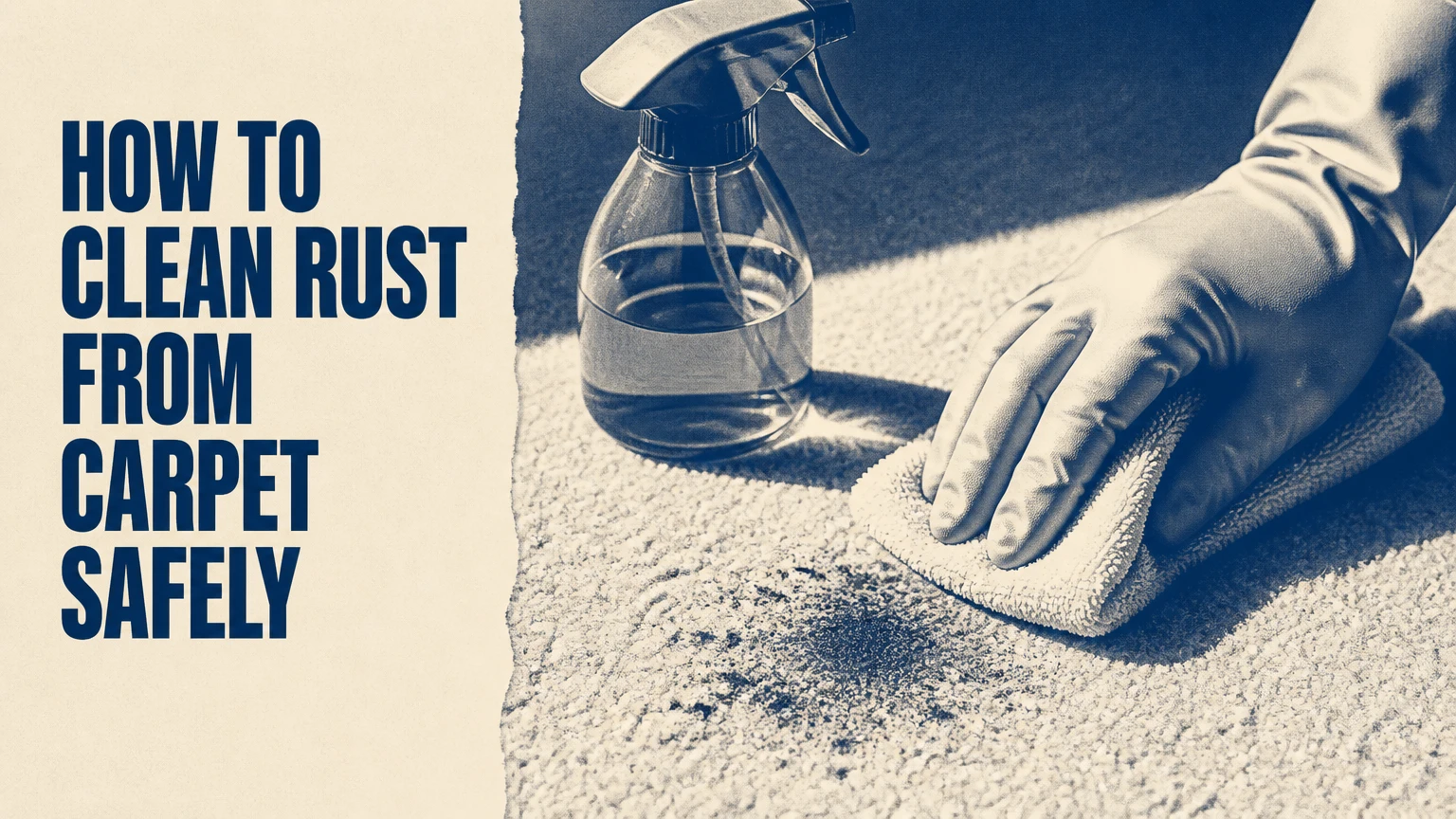
To clean rust from carpet, remove loose particles, test the fiber, apply a small amount of white vinegar or carpet-safe rust remover, blot without scrubbing, then rinse and dry quickly. Use mild vinegar only for light stains on colorfast carpet. Hire a professional for wool, silk, antique rugs, large stains, or uncertain fibers.
At a Glance
- Rust stains need an acidic or chelating treatment because ordinary detergent does not dissolve iron oxide.
- A fresh, light mark usually needs 15-30 minutes of treatment and careful blotting.
- Chlorine bleach, steam, and aggressive scrubbing can permanently damage carpet or darken iron stains.
- White vinegar is a cautious first option for colorfast synthetic carpet, not a universal treatment.
- Wool, silk, antique, handmade, and unknown-value rugs should receive professional assessment.
- Fast drying reduces wicking, which can leave a yellow or orange ring around the treated area.
What Causes Rust Stains on Carpet?
Rust stains form when iron, moisture, and oxygen react, producing iron oxide that attaches to carpet fibers. Common sources include rusty furniture feet, metal plant stands, leaking radiators, corroded tack strips, wet tools, and metal objects left on damp flooring.
Rust is a chemical stain rather than a normal food or soil stain. The orange-brown color may sit on the fiber surface at first, but moisture can carry dissolved iron deeper into the pile and backing. A stain that appears small on top may therefore have a larger damp area underneath.
The stain source must be removed before treatment. If a rusty table leg remains on wet carpet, cleaning may produce only temporary improvement. Place a plastic barrier or dry, nonmetallic furniture pad beneath the object after cleaning, and repair leaks before treating the carpet.
Why Does Ordinary Carpet Cleaner Fail on Rust?
Ordinary carpet cleaner usually fails because detergent lifts oils and soil, while iron oxide is largely insoluble in water. Rust removal requires a mild acid, a reducing agent, or a chelating product that changes how iron bonds to the carpet.
White vinegar and lemon juice provide weak acids that can loosen some light deposits. Purpose-made rust removers often use stronger acids or ingredients designed to bind iron. The chemistry explains why repeated applications of general carpet shampoo may spread the orange mark without removing it.
The chemistry also creates risk. A product strong enough to dissolve rust can affect dyes, wool fibers, latex, or carpet backing. Treat the smallest possible area, use a white cloth, and rinse according to the product label. Never mix rust remover with bleach, ammonia, peroxide, or another cleaning chemical.
What Should You Check Before Treating a Rust Stain?
Before treating a rust stain, identify the carpet fiber, check colorfastness, remove the stain source, and inspect the care label. A hidden-corner test is essential when the fiber, dye, or previous cleaning history is unknown.
Use this quick assessment:
| Carpet condition | Safer starting decision | Avoid first |
|---|---|---|
| Colorfast nylon or polyester | Small diluted vinegar test | Flooding the pile |
| Acrylic or olefin | Product-label test first | Strong acid left in place |
| Wool or silk | Contact a rug specialist | Vinegar, lemon, or solvent |
| Antique or hand-dyed rug | Professional inspection | Home chemical treatment |
| Unknown fiber | Hidden test, then cautious blotting | Commercial remover without testing |
Check the backing and nearby colors as well. A bright orange mark on white nylon is easier to treat than a rust-colored mark on dark, hand-dyed wool. If the test area lightens, bleeds, becomes sticky, or develops a halo, stop immediately.
How Do You Remove a Fresh, Light Rust Mark?
A fresh, light rust mark can usually be treated with a controlled vinegar method in four steps. The typical treatment takes 30-60 minutes, including blotting and drying, but colorfastness testing must come first.
- Remove loose rust. Lift dry crust with a dull butter knife, then vacuum the particles. Do not grind them into the pile.
- Apply mild acid. Dab a 1:1 mixture of white vinegar and water onto a white cloth, then press the cloth against the mark. Avoid pouring liquid directly onto the carpet.
- Wait and blot. Leave the dampened area for 10-15 minutes, then blot from the outside toward the center.
- Rinse and dry. Dab with a cloth moistened with clean water, blot again, and cover the area with dry towels for 30-60 minutes.
Use less liquid than seems necessary. Over-wetting carries iron into the backing and increases the chance of a ring. Repeat once only after the carpet is fully dry and the first treatment caused no color change.
How Do You Remove Dried or Stubborn Rust?
Dried or stubborn rust usually requires a carpet-labeled commercial rust remover rather than repeated vinegar applications. Commercial treatments often work in 1-5 minutes, but the label’s dwell time controls the process.
- Vacuum loose particles and identify the stain boundary.
- Test one drop in a hidden area, then wait until the test area dries.
- Place a white towel under or beside the working area if the carpet can be accessed safely.
- Apply the smallest labeled amount with a white cloth or applicator.
- Watch the stain continuously and stop at the first clear improvement.
- Blot with a clean, damp white cloth to remove dissolved iron and product.
- Rinse lightly, extract moisture, and dry the area with towels and airflow.
Do not assume a product made for tile, concrete, or laundry is safe for carpet. Commercial rust removers may damage dyes, latex, or backing even when the orange stain disappears. If two careful treatments fail, further chemistry is more likely to cause damage than improvement.
Which Rust Remover Is Safest for Each Carpet Type?
The safest rust remover depends on fiber, dye stability, stain age, and backing condition. No single product is safe for every carpet, so the best choice is the mildest method that matches the material.
| Carpet or stain situation | Preferred option | Typical working time | Main risk |
|---|---|---|---|
| Light mark on colorfast nylon | Diluted white vinegar | 10-15 minutes | Dye change |
| Light mark on polyester | Diluted vinegar or labeled product | 10-15 minutes | Residue or halo |
| Heavy mark on synthetic carpet | Carpet-specific rust remover | 1-5 minutes | Backing damage |
| Large stain over padding | Professional extraction | 1-3 hours | Wicking during drying |
| Wool, silk, or antique rug | Specialist treatment | Assessment first | Fiber or dye loss |
A carpet-specific commercial remover is generally more effective than household acid on synthetic fibers with deep staining. A professional is safer for protein fibers and valuable rugs because professional judgment includes pH, dye behavior, moisture control, and extraction.
Can Vinegar Remove Rust From Carpet?
Yes, white vinegar can remove some light rust marks from colorfast synthetic carpet, but vinegar is not reliably safe or effective for wool, silk, antique rugs, or deep stains. Vinegar works by providing mild acidity, not by cleaning every type of carpet stain.
Use distilled white vinegar rather than colored vinegar. For a first test, dilute one part vinegar with one part water and apply it to a hidden area. If the color remains stable after drying, dab the solution onto the stain for 10-15 minutes, blot, rinse with clean water, and dry.
Lemon juice has a similar acidic role, but lemon juice can contain sugars, pulp, or color compounds that leave residue. Salt may add abrasion and does not replace the acid. Baking soda neutralizes acidity, so applying baking soda immediately after vinegar can reduce the chemical action and create a powdery residue.
How Much Vinegar or Rust Remover Should You Use?
Use enough liquid to dampen the stained fibers, not enough to soak the carpet backing. For a spot up to 5 centimeters wide, start with 1-2 teaspoons of diluted vinegar or the smallest product amount stated on the label.
| Stain size | Starting liquid volume | Blotting material | Drying target |
|---|---|---|---|
| Up to 5 cm | 1-2 teaspoons | 2 white cloths | 30-60 minutes |
| 5-10 cm | 1 tablespoon | 3-4 white cloths | 1-2 hours |
| Larger than 10 cm | Label-directed amount | Several towels | Professional assessment |
These are practical starting quantities, not universal manufacturer instructions. Thick pile, absorbent padding, and stains that reach the backing require less surface flooding, not more. A commercial rust remover must be measured by its label because formulas differ substantially in strength.
If the carpet feels wet beyond the stain, stop applying liquid and extract moisture. Excess solution can create a larger brown or yellow area as dissolved soil and iron move through the pile.
How Long Should Rust Treatment Stay on Carpet?
A mild vinegar treatment should remain on a tested carpet for about 10-15 minutes, while a commercial rust remover commonly needs 1-5 minutes. Never extend the dwell time because a stain appears slow to change.
| Treatment | Typical dwell time | Maximum practical approach |
|---|---|---|
| Diluted white vinegar | 10-15 minutes | Blot and reassess |
| Undiluted vinegar test | 5-10 minutes | Rinse promptly |
| Carpet-specific remover | 1-5 minutes | Follow product label |
| Dish-soap rinse | 3-5 minutes | Blot before drying |
| Professional treatment | Technician controlled | Based on fiber and chemistry |
The stain may fade while the product is working, but the carpet can also lose dye or weaken if acid remains in place. Work in short cycles: apply, observe, blot, rinse, and dry. A second cycle is safer than one long exposure when the first cycle causes no adverse reaction.
Can You Use Bleach, Steam, or Hot Water on Rust?
No, chlorine bleach should not be used on a carpet rust stain, and steam or very hot water should be avoided until the iron stain has been removed. Bleach can alter dyes and may intensify the visible yellow-orange appearance of iron.
Steam adds heat and moisture, two conditions that can move rust deeper into carpet and backing. Hot water also increases the amount of liquid available for wicking. Neither method provides the targeted chemistry needed to dissolve or bind iron oxide.
Avoid these combinations:
| Product or method | Verdict on rust-stained carpet | Reason |
|---|---|---|
| Chlorine bleach | Do not use | Dye damage and darker iron discoloration |
| Steam cleaner | Delay until stain removal | Heat and moisture can spread rust |
| Hot water | Avoid initially | Increases migration and wicking |
| Ammonia | Avoid mixing or experimenting | Unsafe chemical reactions |
| Abrasive powder | Usually avoid | Damages fibers and leaves residue |
After the rust is treated and thoroughly rinsed, normal carpet cleaning may be appropriate. The rust-removal step comes first.
What If the Carpet Is Wool, Silk, or Antique?
Do not use a home acid treatment on wool, silk, antique, Persian, or hand-dyed carpet unless a qualified rug professional specifically recommends it. These materials can bleed, weaken, shrink, or develop permanent texture changes after exposure to acid and excess moisture.
Wool and silk are protein fibers, unlike nylon and polyester. Their dyes and finishes can react unpredictably with vinegar, lemon juice, commercial rust removers, or prolonged dampness. Antique rugs may also have unstable natural dyes and delicate foundations that a small spot test does not fully represent.
Blot the visible moisture with a dry white towel, remove the metal source, and keep the rug flat while arranging professional care. Do not roll a wet rug tightly or apply heat. Tell the cleaner whether the stain came from a rusty leg, water leak, or metal object, because the source affects the treatment plan.
How Do You Rinse Rust Remover Without Spreading the Stain?
Rinse rust remover by controlled blotting, using a barely damp white cloth and working from the outside edge toward the center. Do not pour water over the spot or scrub across the stain.
Use this sequence:
- Fold a white cloth into a small pad.
- Moisten one section with clean water.
- Press vertically onto the treated area for several seconds.
- Move to a clean section as orange residue transfers.
- Blot with a dry towel.
- Repeat until the towel shows little or no product residue.
A wet-dry vacuum can help with larger synthetic carpet areas, provided the machine is clean and the carpet manufacturer permits water extraction. Keep the extraction head moving so the area does not become saturated.
Rinsing matters because residual acid can affect carpet backing and dyes after the visible rust disappears. Proper rinsing removes both dissolved iron and the treatment chemical.
Why Did a Yellow Ring or Dark Patch Appear?
A yellow ring usually indicates wicking, while a darker patch often indicates residual rust, soil, or incompletely rinsed chemical. Wicking happens when moisture carrying dissolved material moves upward as the carpet dries.
Treat a ring by lightly applying a small amount of diluted dish soap solution, blotting the entire affected area evenly, rinsing with controlled dabs, and drying it rapidly under clean towels. Do not treat only the ring’s outer edge, because uneven moisture can create a second boundary.
For a dark patch, stop using acid and inspect the carpet after it dries fully. If the patch feels sticky or the color continues changing, product residue may remain. Lightly rinse and extract the area rather than adding another rust remover.
| Symptom | Likely cause | First response |
|---|---|---|
| Yellow outer ring | Wicking during drying | Evenly dampen, blot, dry fast |
| Dark orange center | Remaining iron oxide | One cautious re-treatment |
| Pale spot | Dye loss | Stop chemical treatment |
| Sticky texture | Product residue | Controlled rinse and extraction |
| Larger damp boundary | Over-wetting | Towel extraction and airflow |
When Should You Hire a Professional Carpet Cleaner?
Hire a professional when the rug is valuable or delicate, the rust reaches the backing, the stain covers more than about 10 centimeters, or one careful treatment fails. Professional help is also the safest choice when the fiber is unknown and replacement would be expensive.
Typical professional rust-treatment pricing varies by location, access, stain size, and rug construction. A practical planning range is:
| Service situation | Typical price range | Typical service time |
|---|---|---|
| Small synthetic spot | $75-$150 | 30-90 minutes |
| Several room-level stains | $150-$350 | 1-3 hours |
| Wool or silk rug | $100-$300 per rug | Assessment plus treatment |
| Antique or valuable rug | $200 or more | Specialist schedule |
These figures are typical service ranges, not fixed market prices. Ask whether the quote includes testing, rust treatment, rinsing, extraction, and drying.
A professional cannot guarantee invisible results when rust has permanently altered the dye. The earlier the stain is assessed, the better the chance of limiting damage.
How Can You Prevent Rust From Returning?
Prevent rust from returning by eliminating the metal, moisture, or oxygen source that created the stain. Dry the area completely, repair leaks, and place a moisture-resistant barrier under metal furniture.
Use these prevention measures:
- Add plastic or rubber cups beneath metal furniture feet.
- Keep plant pots on waterproof trays with raised drainage.
- Repair leaking radiators, pipes, and air-conditioning equipment.
- Dry spills within 15 minutes when possible.
- Inspect metal objects stored on basement or concrete floors.
- Replace corroded tack strips or damaged metal fixtures.
- Vacuum loose rust before it contacts damp carpet.
Do not place a rusty item back on cleaned carpet merely because the surface looks dry. Residual moisture under furniture can react with the metal again and recreate the stain within days. Prevention is often more reliable than repeated chemical treatment.
The Bottom Line
White vinegar can remove a light rust mark from tested, colorfast synthetic carpet when applied sparingly, blotted, rinsed, and dried within about 30-60 minutes. Carpet-specific rust remover is faster for stubborn synthetic-carpet stains, but chlorine bleach, steam, and excess water can worsen the damage. Wool, silk, antique, valuable, or unknown-fiber rugs should go to a professional before chemical treatment.