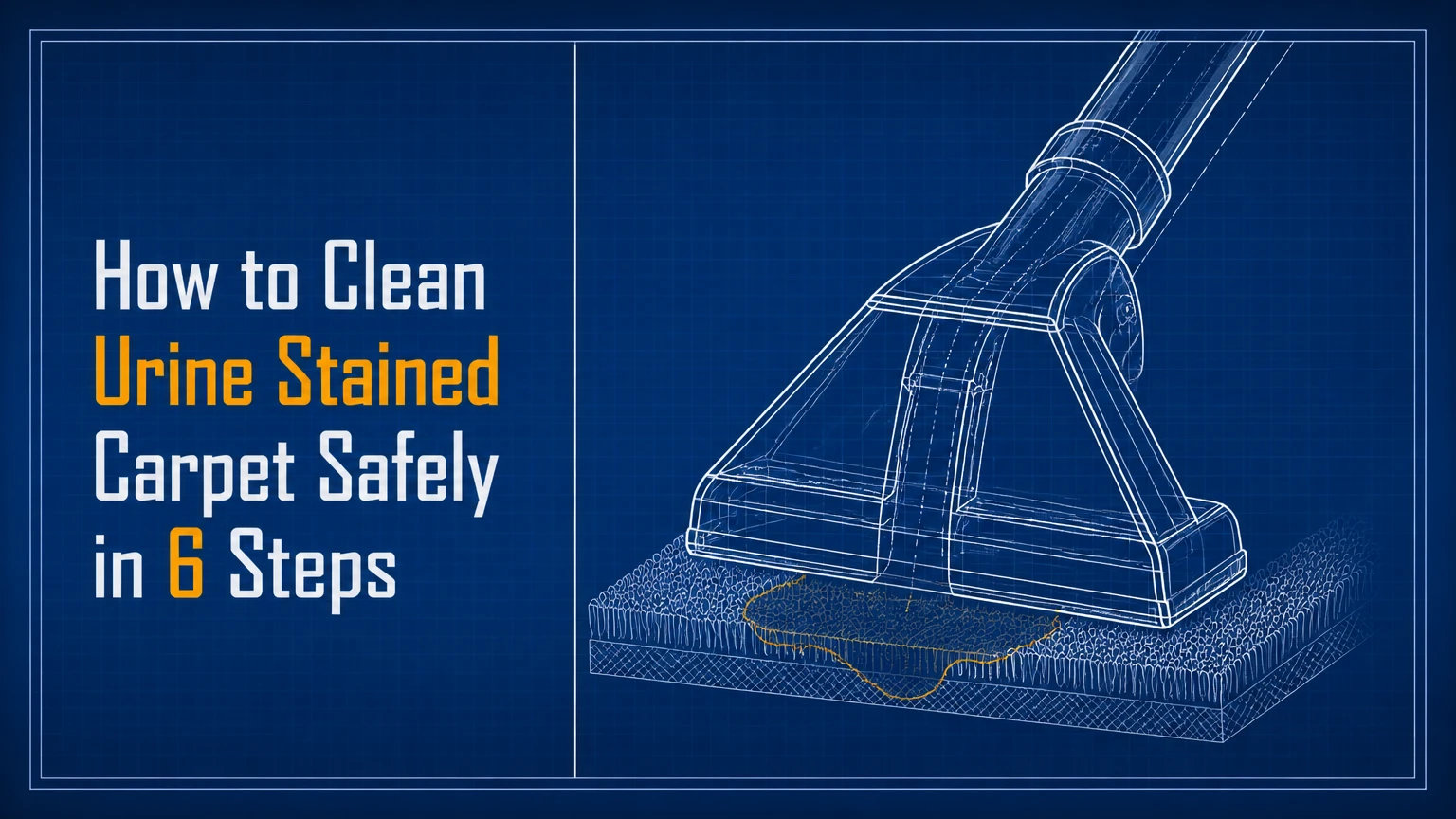
To clean urine stained carpet, remove liquid first, then treat the carpet fibres, backing, and cushion with a compatible cleaner. Fresh urine usually needs immediate blotting and controlled rinsing; dried urine generally needs an enzyme-based product with several hours of contact time. Success depends most on reaching the full contaminated depth without oversaturating the floor.
Key facts
Fresh urine should be blotted, not scrubbed, within the first few minutes.
Dried urine odour can return when humidity dissolves salts left in carpet backing or padding.
Enzyme cleaners need prolonged contact with the deposit and usually work poorly after chlorine, ammonia, or strong disinfectants.
Vinegar and baking soda may improve a small surface smell, but they rarely remove deep pet urine from carpet cushion.
Hydrogen peroxide can lighten yellow pigment while also damaging some dyes and natural fibres.
A professional inspection is appropriate when urine has reached the pad, subfloor, tack strip, or multiple square metres of carpet.
What Makes Urine Stains and Odours Difficult?
Urine stains are difficult because colour and odour come from different substances at different depths. Yellow urochrome contributes visible discolouration, while urea, proteins, salts, and uric-acid deposits can remain below the carpet surface after the liquid appears dry.
Fresh urine is mostly water, so rapid extraction has a high success rate. As urine dries, water evaporates and leaves concentrated residues on the fibre, backing, and cushion. Those deposits can absorb atmospheric moisture and release ammonia-like odours during humid weather or after the carpet is re-wetted.
The visible spot is not a reliable measure of the contaminated area. Liquid can spread laterally through carpet cushion, particularly when the carpet is installed over dense foam or felt. A 10-centimetre surface mark may therefore conceal a substantially wider pad deposit.
A useful distinction matters here: enzyme cleaners do not usually contain “live enzymes-producing bacteria” that digest urine into harmless water and carbon dioxide. Commercial formulas commonly contain enzymes, surfactants, solvents, or bacterial cultures, and the label determines how the product should be used.
Which part of urine causes the smell?
Uric-acid salts and other nitrogen-containing residues are the main long-term odour problem, while bacteria contribute to decomposition and ammonia-like smells. Water or ordinary detergent can remove some soluble residue, but dried deposits often require chemical digestion, oxidation, or physical extraction.
Do not assume that a yellow stain is still the strongest odour source. A nearly invisible area beneath furniture may contain more residue than the bright patch beside it. A UV-A blacklight can help locate older deposits, although detergents, optical brighteners, and some fibres also fluoresce.
Before You Start
Gather a wet/dry vacuum or carpet extractor, white absorbent towels, nitrile gloves, a measuring cup, a soft nylon brush, a fan, and a carpet-safe urine product. A typical small spot requires 250-500 millilitres of treatment solution, but the correct volume depends on how far the original urine travelled.
| Item | Typical amount | Purpose | Important limitation |
|---|---|---|---|
| White towels | 6-12 pieces | Blotting and transfer testing | Coloured cloth can bleed dye |
| Enzyme cleaner | 250-1,000 ml | Dried organic residue | Must match carpet label and dwell time |
| Wet/dry vacuum | 1 machine | Liquid recovery | Household vacuums are not water-safe |
| Fan | 1 unit | Drying air movement | Does not replace extraction |
| UV-A blacklight | 365-395 nm | Locating old deposits | Fluorescence is not proof of urine |
| Nitrile gloves | 1 pair | Hand protection | Wash hands after removal |
Test every cleaner on an inconspicuous area, especially on wool, viscose, silk, cotton rugs, dark dyes, and carpet with a stain-resistant treatment. Never mix chlorine bleach, ammonia, peroxide, vinegar, or other cleaners. Chemical mixtures can release irritating gases or create uncontrolled bleaching.
Open windows and keep children and pets away until the carpet is dry. For a person with a weakened immune system, respiratory condition, or sensitivity to cleaning chemicals, professional remediation is safer than prolonged indoor treatment.
How to Clean Urine Stained Carpet Step by Step
The six-step process normally takes 30-60 minutes of active work for a fresh spot, followed by 6-24 hours of drying or dwell time. Old contamination may require two treatments, pad access, or professional hot-water extraction because surface spraying cannot remove residue trapped underneath.
Step 1: Absorb Fresh Urine Immediately
Press white towels firmly into the wet area and replace them as soon as they become saturated. Continue until a fresh towel shows only slight moisture transfer, and use the heel of your hand or body weight rather than rubbing the pile.
For a large puddle, place several folded towels over the area and stand on them for 30-60 seconds at a time. Work from the outside toward the centre so the wet boundary does not spread. A wet/dry vacuum removes more liquid than towels when the contamination covers more than about 0.1 square metre.
You will know this step is complete when three successive towel presses transfer little or no liquid. Do not use a household vacuum cleaner, because water can reach its motor and create an electrical hazard.
Common mistake: Scrubbing immediately drives urine sideways and deeper into the backing. If the pile has already been distorted, stop rubbing, extract remaining moisture, and brush the fibres upright only after drying.
Step 2: Rinse and Extract the Fresh Deposit
Apply a small amount of cool or lukewarm water, roughly 100-250 millilitres for a hand-sized spot, then extract it immediately. The rinse loosens water-soluble urine residue; the vacuum or towels must remove that liquid rather than leave it in the cushion.
A 1:1 mixture of distilled white vinegar and water is sometimes used for a mild surface odour, but vinegar is not a dependable treatment for dried uric-acid deposits. Its acidity can reduce an ammonia smell temporarily, while its low pH may affect wool dyes or carpet backing. Plain water is the safer first rinse when fibre type is unknown.
After extraction, blot the perimeter and place a dry towel over the area for 10 minutes. Press the towel once more before moving to drying.
Common mistake: Flooding a fresh stain with a litre or more of solution can spread contamination into the pad. Use enough liquid to rinse the fibres, then recover it promptly.
Step 3: Locate Hidden or Dried Urine
Inspect the room in darkness with a 365-395 nm UV-A blacklight, holding it 10-20 centimetres above the carpet. Mark suspected spots with removable tape, then inspect nearby baseboards, rug edges, furniture legs, and carpet transitions.
UV fluorescence identifies possible contamination, not urine with certainty. Optical brighteners, detergent residue, adhesives, and some natural materials can fluoresce. Confirm a suspected spot by its location, odour, irregular edge, and response to a small water transfer test.
For a dry spot, lightly mist 50-100 millilitres of water and press a white towel into it. A strong odour or yellow transfer supports the diagnosis. Do not repeatedly wet the area before choosing a treatment, because moisture can reactivate odour and spread salts.
Practitioner rule: Treat the entire suspected footprint, not only the brightest section. The edge often contains a thinner but wider urine deposit.
Step 4: Apply a Carpet-Safe Enzyme Cleaner
Choose an enzyme product whose label specifically permits carpet use and identifies the required dwell time. Apply enough to reach the contaminated depth, usually 250-500 millilitres for a hand-sized area when the pad is involved, but follow the product directions and avoid saturating timber subfloors.
Enzyme cleaners work by breaking down proteins and other organic residues into smaller compounds that can be rinsed or extracted. They do not remove every mineral salt instantly, and they cannot reverse dye damage or repair a permanently bleached fibre.
Use a measuring cup or trigger-spray count so the treatment is repeatable. Apply from the outside toward the centre, then press gently with a soft brush to distribute the liquid through the pile. Avoid aggressive agitation, which can fuzz cut-pile carpet and drive contamination farther down.
You will know coverage is adequate when the treated area extends 5-10 centimetres beyond the visible or marked edge and the fibres are evenly damp, not dripping.
Common mistake: A few surface sprays may remove the smell for a day while leaving the pad contaminated. If the original urine reached the cushion, the treatment must reach the cushion too.
Step 5: Maintain Contact Time
Keep the treated area damp for the duration printed on the product label, commonly 8-24 hours for dried pet urine. Covering the spot with a clean, damp white towel can slow evaporation; plastic film may be appropriate only when the manufacturer permits it and the carpet cannot be damaged by prolonged moisture.
Do not add vinegar, baking soda, disinfectant, peroxide, or carpet shampoo during enzyme dwell time. Competing chemicals can alter pH, denature enzymes, or leave residue that prevents the treatment from working consistently.
For a small spot, place a sheet of plastic over a damp towel rather than directly against heavily saturated carpet. Check the area after several hours for dye transfer, backing damage, or excessive moisture. Remove the cover when the label says to do so.
Common mistake: Letting enzyme cleaner dry within 20 minutes eliminates the required contact period. Reapply enough product to restore dampness, then restart the label-directed dwell time.
Step 6: Extract, Rinse, and Dry Completely
After the dwell period, extract the cleaner with a wet/dry vacuum or carpet machine, then perform one controlled rinse with clean water if the product label allows it. Recover as much liquid as possible, because detergent residue can attract soil and create a stiff or sticky patch.
Place fans so air moves across the carpet rather than blasting one point. Lift furniture legs onto foil or plastic tabs until the carpet is dry, and maintain ventilation for 6-24 hours depending on humidity, pile density, and pad thickness.
The carpet is dry when the surface feels the same temperature and texture as surrounding areas, towels remain dry after firm pressure, and no cool dampness exists at the backing. Recheck the room after 24-48 hours and again on a humid day.
Common mistake: Masking the odour with fragrance or deodorizer leaves the source intact. If smell returns after drying, inspect the pad and subfloor rather than applying stronger perfume.
Which Urine-Cleaning Method Should You Choose?
Enzyme treatment is the best first choice for old pet urine on synthetic carpet, while controlled blotting and rinsing suit a fresh accident. Oxidizing products can reduce yellow colour, but they require dye testing and are not a substitute for removing contamination from the cushion.
| Method | Best use | Typical active time | Typical cost | Main limitation |
|---|---|---|---|---|
| Blot and water rinse | Fresh surface accident | 15-30 minutes | $0-$10 | Poor for dried deposits |
| Enzyme cleaner | Old pet urine and odour | 8-24 hours | $10-$30 per bottle | Requires full contact and drying |
| Peroxide or oxygen cleaner | Compatible light synthetic carpet | 15-30 minutes | $8-$25 | Can lighten dyes and wool |
| Vinegar and water | Mild temporary surface odour | 10-20 minutes | $1-$5 | Does not reliably digest uric salts |
| Professional extraction | Pad or subfloor contamination | 2-6 hours onsite | $150-$500 typical | May not include pad replacement |
Hydrogen peroxide and oxygen bleach are oxidation tools, not universal urine removers. They may break down visible pigment on solution-dyed nylon or polypropylene, yet they can lighten wool, viscose, cotton, and unstable dyes. Always test, observe the dried result, and never assume a “natural” carpet is colourfast.
Professional hot-water extraction is different from household steam deodorizing. A trained technician can inspect beneath the carpet, apply a targeted treatment, flush residues, and recover water under high vacuum. The process cannot guarantee success when the subfloor has absorbed urine or the carpet backing has delaminated.
When should carpet padding be replaced?
Replace the affected carpet cushion when odour remains after two correctly performed treatments, the pad feels stiff or discoloured, or urine has soaked through to timber, concrete, or tack strips. Small pad sections can often be cut out and replaced; widespread contamination may require lifting and treating the carpet and subfloor.
A technician should use moisture measurement and visual inspection rather than relying only on surface smell. For renters, photograph the area before treatment and notify the landlord if flooring removal may affect the lease or security deposit.
What Changes for Cat, Dog, Human, and Wool-Carpet Urine?
Cat urine usually needs the most aggressive depth assessment because adult cats produce concentrated deposits that can reach carpet cushion and subfloor. Dog urine varies greatly with animal size, water intake, and accident volume, while human urine may require additional hygiene precautions when illness or medication is involved.
| Situation | Recommended first action | Product constraint | Escalation trigger |
|---|---|---|---|
| Fresh dog urine | Blot and controlled water rinse | Carpet-safe neutral cleaner | Odour after 48 hours |
| Dried cat urine | UV inspection and enzyme saturation | Long dwell-time formula | Multiple spots or subfloor smell |
| Human urine | Gloves, blotting, detergent-compatible rinse | Avoid uncontrolled disinfectant mixtures | Repeated contamination or biohazard concern |
| Wool carpet | Blot only, then fibre-safe professional advice | Wool-approved, low-moisture product | Dye bleed, browning, or persistent smell |
| Area rug | Check backing and floor beneath | Do not wet hardwood padding | Moisture reaches flooring |
| Carpet over concrete | Extract and dry from both sides where possible | Avoid prolonged saturation | Odour remains below backing |
Wool and silk are poor candidates for improvised peroxide, alkaline powders, or prolonged soaking. Natural fibres can shrink, brown, bleed, or develop texture changes even when the urine stain itself improves. Blot the liquid, document the damage, and contact a rug or carpet technician familiar with natural fibres.
Repeated pet accidents require two solutions: cleaning and behaviour management. Block access while the carpet dries, remove nearby absorbent mats, clean vertical surfaces, and arrange veterinary assessment when a previously trained animal begins urinating indoors.
Common Mistakes and How to Fix Them
| Mistake | Why it fails | Recovery |
|---|---|---|
| Scrubbing the pile | Spreads liquid and damages fibres | Extract, dry, and groom fibres gently |
| Using ammonia cleaner | Adds an ammonia-like scent that may encourage repeat marking | Rinse and use a compatible enzyme product |
| Applying steam first | Heat can set some pigments and proteins | Stop heat treatment, cool, extract, then assess |
| Spraying too little enzyme | Leaves the pad untreated | Measure and repeat at the original contamination depth |
| Mixing vinegar and peroxide | Creates uncontrolled chemistry and possible irritation | Ventilate, remove people and pets, and rinse safely |
| Leaving baking soda in wet carpet | Forms residue and may stress vacuum filters | Let the surface dry, then vacuum slowly |
Baking soda absorbs some moisture and may reduce a temporary surface smell, but it does not reliably destroy uric-acid crystals inside carpet cushion. Vacuum only after the powder is completely dry, and use a machine designed for fine particulate material.
Steam cleaning is not automatically wrong. Professional hot-water extraction can be effective after appropriate urine treatment, provided the technician controls moisture, uses suitable chemistry, and extracts thoroughly. The problem is applying high heat before identifying the contamination and without recovering liquid from the pad.
How Long Does Urine Carpet Cleaning Take and Cost?
A fresh hand-sized accident typically takes 15-30 minutes of active cleanup and 6-12 hours to dry. A dried spot usually needs 20-45 minutes of preparation, 8-24 hours of enzyme dwell time, and potentially a second treatment after the carpet dries.
| Job type | Active work | Drying or dwell | Typical US cost |
|---|---|---|---|
| Fresh small spot | 15-30 minutes | 6-12 hours | $0-$10 |
| Dried single spot | 30-60 minutes | 8-24 hours | $10-$30 |
| Several room spots | 1-3 hours | 12-24 hours | $25-$100 supplies |
| Professional treatment | 2-6 hours | 6-24 hours | $150-$500 |
| Pad and subfloor remediation | 4-12 hours | 12-48 hours | $500-$2,000 or more |
These are typical US consumer ranges, not fixed prices. Labour, travel, carpet construction, contamination depth, furniture moving, regional wages, and pad replacement can change the total substantially.
Troubleshooting Persistent Odour and Stains
If the smell returns only during rain or high humidity, dried salts probably remain in the pad, backing, or subfloor. Reinspect with a blacklight, compare moisture readings if available, and treat the full footprint rather than repeatedly spraying the original visible mark.
A white or grey ring after cleaning is usually residue, soil wick-back, dye movement, or fibre damage. Lightly rinse a small section, extract it thoroughly, and allow complete drying before repeating the process. Stronger chemicals can enlarge the ring.
If the yellow stain remains but the odour is gone, the problem may be permanent dye change rather than removable urine. Oxidizing treatment may reduce colour on compatible synthetic carpet, but a repair patch or professional colour correction is safer than repeated applications.
If the pet returns to the same location, use an odour detector, restrict access, and clean the surrounding baseboard and furniture. The American Society for the Prevention of Cruelty to Animals recommends veterinary attention for sudden house-soiling because urinary disease, pain, anxiety, and territorial marking can all change elimination behaviour.
The Humane World for Animals gives a particularly useful warning: “Avoid using steam cleaners to clean urine odors from carpet or upholstery.” That guidance concerns heat and odour setting during premature treatment, not every professionally controlled extraction process.
FAQ
Can I remove urine smell from carpet without an enzyme cleaner?
You can reduce a fresh surface smell with immediate blotting, a controlled water rinse, and thorough extraction. Vinegar, baking soda, and ordinary detergent may improve appearance or temporary odour, but they are unreliable for dried deposits in the backing or cushion. Deep or recurring smells usually require enzyme treatment or professional extraction.
Does hydrogen peroxide remove urine stains from carpet?
Hydrogen peroxide can oxidize yellow pigment on some light, synthetic carpets, but it may bleach dyes and damage wool or plant-based fibres. Test an unseen area, use the lowest effective concentration permitted by the product label, and treat odour separately because pigment removal does not prove that urine residue is gone.
Should I use hot water extraction on pet urine?
Use hot-water extraction only after the contamination has been chemically treated and the machine can recover liquid effectively. A technician should inspect the pad and subfloor first. Household steam treatment applied to untreated urine may spread moisture, set some stains, or leave the cushion wet for too long.
Why does my carpet smell worse after cleaning?
Carpet can smell worse when water re-dissolves dried salts, when the pad is saturated, or when detergent residue traps soil. Dry the area rapidly, extract remaining moisture, and reassess after 24-48 hours. A smell that returns repeatedly indicates contamination below the visible carpet surface.
How do I stop my dog from urinating on the same carpet spot?
Remove the odour at carpet and pad depth, block access until the area is dry, and use veterinary or behaviour support if accidents repeat. Dogs can detect residues that people cannot smell. A washable barrier, furniture rearrangement, and immediate outdoor reinforcement can reduce re-soiling while the underlying cause is addressed.
Is urine-stained carpet a health hazard?
A single promptly cleaned accident is usually a manageable household contamination. Repeated or extensive urine exposure can create persistent odour, microbial growth in damp materials, and irritation during cleaning. Wear gloves, ventilate the room, avoid chemical mixtures, and use professional remediation when urine has soaked into porous flooring or the occupant is medically vulnerable.
The Bottom Line
The most reliable way to clean urine stained carpet is to remove fresh liquid immediately, identify the complete contaminated footprint, use a carpet-safe enzyme cleaner for dried organic residue, maintain the required dwell time, extract excess solution, and dry the carpet completely. Vinegar and baking soda are limited surface remedies, not dependable substitutes for depth treatment. When odour returns after two correct treatments, inspect or replace the affected padding and address the reason for repeat accidents.