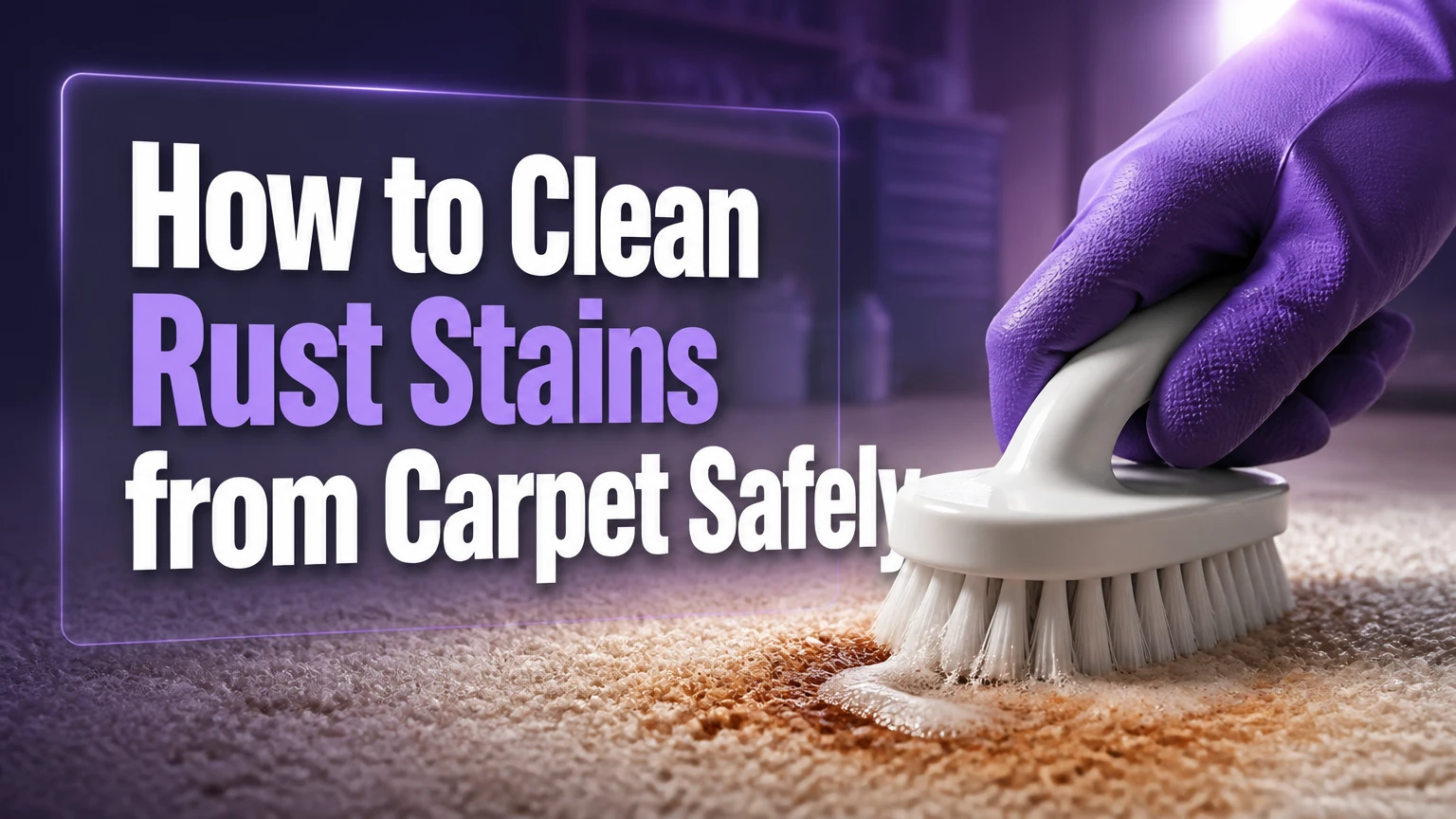
To clean rust stains from carpet, remove loose particles, identify the carpet fiber, test a labeled carpet-safe rust remover, apply it sparingly, blot as the rust dissolves, and rinse thoroughly. The safest DIY treatment is an oxalic-acid or citric-acid product approved for carpet, not bleach, steam, vigorous scrubbing, or an uncontrolled household mixture.
Key facts
Rust stains contain iron oxides, which ordinary soap and water do not reliably dissolve.
Acid-based rust removers work better than alkaline cleaners because acid converts insoluble iron compounds into removable iron salts.
A hidden colorfastness test is mandatory before treating nylon, polyester, polypropylene, wool, or an unidentified carpet.
Most small synthetic-carpet stains take 15-30 minutes to treat, excluding drying time.
Hydrofluoric-acid products can cause severe chemical burns and are unsuitable for casual home carpet cleaning.
Rust will return unless the wet, corroding metal source is repaired or isolated.
What creates a rust stain on carpet?
A carpet rust stain forms when oxidized iron from wet metal transfers onto carpet fibers, backing, or padding. Common sources include rusty furniture feet, filing cabinets, plant stands, radiator components, tools, metal wheels, exposed tack strips, and water leaking from corroded plumbing.
Rust is usually orange, red-brown, or yellow-brown. A gray or black mark may indicate another metal compound, burned fiber, dye transfer, or a chemical reaction rather than ordinary iron oxide. Diagnosis matters because a rust remover can worsen a non-rust stain.
Rust often appears in a recognizable shape. Four small spots beneath a chair suggest metal feet, while a broad edge stain may indicate a wet tack strip or moisture migrating through the pad. A ring beside a radiator may come from condensation rather than a spill.
Why does ordinary carpet cleaner fail?
Ordinary carpet shampoo usually fails because surfactants suspend oily soil, dust, and food residue but do not dissolve iron oxide effectively. Alkaline products, ammonia, washing soda, and many oxygen-based stain treatments can also alter the surrounding dye or leave rust unchanged.
Acidic chemistry is the relevant mechanism. Citric acid, acetic acid, and oxalic acid can react with iron compounds, but their strength, contact time, and effect on carpet dye differ substantially. A product formulated and labeled for carpet is more predictable than kitchen ingredients.
A practitioner rule is simple: treat rust as a metal stain, not as a normal food or mud stain. Pre-cleaning can remove surface soil, but the rust-colored iron requires a compatible chelating or acidic treatment.
Which rust-removal method should you use?
For a small stain on colorfast synthetic carpet, use a commercial carpet-safe rust remover according to its label. For wool, silk, sisal, jute, viscose, antique rugs, or an unknown high-value carpet, use a professional rug or carpet technician because acidic treatment can damage both fiber and dye.
| Method | Typical cost | Contact time | Appropriate carpet |
|---|---|---|---|
| Carpet-safe citric or oxalic remover | $8-$20 | 1-5 minutes | Colorfast nylon, polyester, polypropylene |
| Diluted citric-acid solution | $2-$6 | 3-10 minutes | Small, light synthetic stain after testing |
| Lemon juice and salt | $1-$3 | 15-30 minutes | Limited fallback for a faint synthetic stain |
| Professional rust treatment | $100-$300 minimum | 1-3 hours | Wool, silk, large, old, or recurring stains |
The table gives typical consumer ranges, not guaranteed prices. Product concentration, stain size, location, and local labor rates change the result.
Is vinegar safe for rust stains?
White vinegar is not the preferred rust remover for carpet. Acetic acid may loosen some surface iron residue, but vinegar is weaker and less predictable than a formulated rust product, and straight vinegar can affect dyes, backing adhesives, or natural fibers.
Dish soap has a separate role. A drop of mild detergent in water can remove greasy soil surrounding the rust, but detergent does not replace an iron-stain treatment. Do not mix vinegar with bleach, ammonia, peroxide, or commercial chemicals.
Can lemon juice and salt remove carpet rust?
Lemon juice may lighten a very fresh, shallow rust mark on colorfast synthetic carpet, but salt does not chemically dissolve rust and can abrade or remain trapped in the pile. Use this method only as a cautious fallback, with no direct sunlight and no aggressive rubbing.
For a controlled alternative, dilute one teaspoon of citric acid powder in one cup of cool distilled water, if the product label permits that use. A commercial carpet-safe product remains preferable because household acid concentration and dye compatibility are difficult to predict.
Before You Start
Prepare the area before applying any acidic product. The most common DIY damage occurs when a cleaner is poured over a large area, left too long, or used without a fiber and colorfastness test.
| Requirement | Typical specification | Why it matters |
|---|---|---|
| Treatment time | 15-30 minutes | Small synthetic-carpet spot |
| Drying time | 6-24 hours | Prevents wicking and odor |
| Product amount | 5-15 milliliters | Controls chemical spread |
| Water for rinsing | 100-250 milliliters | Removes dissolved residue |
| Ventilation | 2 open air paths | Reduces vapor and speeds drying |
| DIY difficulty | Moderate | Requires testing and measured application |
Gather white cotton towels, white paper towels, a spoon or dull plastic scraper, a vacuum, nitrile gloves, eye protection, a measuring cup, cool water, and a carpet-safe rust remover. Use a portable extractor only for controlled rinsing, not as the first treatment.
Check the carpet label if available. Nylon and polypropylene often tolerate properly used acidic rust products better than wool, rayon, sisal, jute, and cotton. “Synthetic” does not mean indestructible.
Do not begin if the source is still wet, the carpet is visibly discolored around the stain, the backing is deteriorating, or the rust covers more than about 0.1 square meter. Photograph the stain first if you rent the property or plan to claim damage.
How to clean rust stains from carpet
The following procedure is designed for a small rust mark on a colorfast synthetic carpet. It uses controlled application rather than soaking, because moisture can carry dissolved iron into the backing and create a larger yellow or brown ring.
Step 1: Remove the metal source
Move the rusty object away from the carpet and place it on a waterproof surface. Repair the leak, dry the metal, replace corroded furniture glides, or install a nonstaining barrier before cleaning.
Inspect nearby carpet for multiple marks. A clean-looking spot can reappear when a wet tack strip, rusty screw, or contaminated pad continues transferring iron.
You will know this step worked when: the carpet and metal source remain dry for at least several hours.
Common mistake: treating the visible stain while leaving a wet radiator leg, plant stand, or metal wheel in place.
Step 2: Remove loose rust and surface soil
Let the carpet surface become dry enough to vacuum. Lift crusted material with a dull plastic scraper or spoon, keeping the tool nearly parallel to the fibers, then vacuum slowly with the nozzle above the pile.
Do not use a knife, razor, wire brush, or sanding motion. Loose rust particles can spread through pale carpet and create additional orange marks.
If greasy dirt surrounds the stain, mix one teaspoon of clear dish detergent into two cups of cool water. Dab the perimeter with a white cloth, then blot with plain water and allow the area to dry before using rust remover.
You will know this step worked when: no loose flakes transfer to a white towel pressed gently onto the spot.
Common mistake: scrubbing first, which pushes particles down and distorts loop or cut-pile fibers.
Step 3: Test the fiber and dye
Apply one drop of the chosen rust remover to an inconspicuous area, such as beneath furniture or inside a closet. Wait for the label’s stated test period, then blot with a white towel and inspect the towel and carpet under normal light.
Stop if the towel shows carpet dye, the test area becomes lighter, the fibers feel rough, or the backing softens. A colorfastness test reduces risk but cannot guarantee that a larger treatment will be harmless.
For wool, silk, viscose, sisal, jute, and antique rugs, do not proceed with a household acid unless the manufacturer specifically approves it. The Institute of Inspection, Cleaning and Restoration Certification, or IICRC, emphasizes identifying textile construction and using appropriate procedures rather than assuming one stain method suits every floor covering.
You will know this step worked when: the test produces no dye transfer, fading, texture change, or adhesive disturbance.
Common mistake: testing only the cleaner bottle or an unrelated carpet remnant.
Step 4: Apply carpet-safe rust remover
Put on gloves and eye protection. Apply 5-15 milliliters, or approximately one to three teaspoons, to a folded white cloth or directly to the center of a small stain, keeping the wet area within the existing mark.
Follow the product label exactly. Many oxalic-acid or citric-acid rust removers need only 1-5 minutes, while a weaker formula may require 5-10 minutes. Never extend dwell time because the color appears slow to change.
Work from the outside edge toward the center with light dabbing. Avoid saturating the pad, carpet backing, or adjacent flooring.
You will know this step worked when: orange or brown color begins transferring to the white towel and the stain becomes visibly less intense.
Common mistake: pouring cleaner until the carpet is soaked.
Step 5: Blot as the iron dissolves
Press a clean white towel onto the treated area for 5-10 seconds, lift it vertically, and inspect the towel. Rotate to a clean section after each blot so dissolved iron does not return to the fibers.
Repeat the apply-and-blot cycle once or twice if the label permits. Do not brush back and forth. The aim is to transfer dissolved iron into the towel, not to force liquid deeper.
A useful stopping rule is to stop when two successive blots show almost no orange transfer. Additional chemical exposure can damage dye even when a faint shadow remains.
You will know this step worked when: the towel stops receiving visible rust and the pile retains its original texture.
Common mistake: using one towel throughout, which redistributes the stain.
Step 6: Rinse and extract the residue
Apply a small amount of cool water, approximately 30-60 milliliters for a hand-sized spot, then blot immediately. Repeat with fresh water until the towel no longer feels slippery and the product odor is substantially reduced.
A portable extractor can remove rinse water from synthetic carpet, but make slow passes and avoid flooding the pad. If you use a shop vacuum, use it only if the machine is rated for wet pickup and follow its safety instructions.
Do not assume baking soda neutralizes every rust remover. Neutralization depends on the product’s chemistry, and adding an alkaline powder can create heat, residue, or an unwanted reaction. Follow the product safety data sheet and label instead.
You will know this step worked when: no cleaner residue transfers to a damp white towel.
Common mistake: skipping the rinse because the stain appears gone.
Step 7: Dry from the surface downward
Fold several dry white towels over the spot and press with a flat, waterproof weight for 10-20 minutes. Replace wet towels, then run a fan across the area and keep people and pets away until the carpet is completely dry.
Avoid a hair dryer, radiator, iron, or steam cleaner. Forced heat can set some dyes, accelerate browning, or drive moisture and dissolved iron toward the surface.
Inspect after 6-24 hours. A faint returning ring indicates wicking or contamination below the face yarn, not necessarily treatment failure.
You will know this step worked when: the carpet feels dry, the pile stands normally, and no orange color returns after overnight drying.
Common mistake: judging the result while the carpet is still damp.
What changes for different carpet fibers?
Fiber type determines chemical tolerance, dye stability, and the likelihood of permanent damage. Synthetic carpet is generally the most suitable candidate for cautious DIY treatment, while protein and plant fibers require professional assessment.
| Carpet type | DIY rust treatment | Main risk | Preferred action |
|---|---|---|---|
| Nylon | Possible after testing | Dye bleed or color loss | Use labeled carpet product |
| Polyester | Possible after testing | Residue and texture change | Use small applications |
| Polypropylene | Often tolerant | Heat distortion or oily residue | Avoid heat and over-wetting |
| Wool | High risk | Fiber damage, yellowing, dye bleed | Call a rug specialist |
| Viscose or rayon | Very high risk | Browning, texture loss, shrinkage | Do not wet-clean casually |
| Sisal or jute | High risk | Water rings, shrinkage, browning | Use a qualified professional |
Cut-pile carpet usually tolerates careful blotting better than loop-pile carpet, where rubbing can pull or fuzz loops. Carpet tiles require extra caution because liquid can reach the seam adhesive or migrate beneath the tile.
Unknown carpet deserves conservative treatment. If the carpet is expensive, hand-tufted, patterned, more than 20 years old, or installed over a wood subfloor, a small professional inspection often costs less than replacing a damaged section.
Which options are safest and fastest?
A labeled carpet rust remover offers the best balance of effectiveness and control for a small, colorfast synthetic spot. Professional treatment is safer for vulnerable fibers, while lemon juice and salt are inexpensive but slow and mechanically risky.
| Option | Expected result | Risk level | Typical total cost |
|---|---|---|---|
| Formulated rust remover | Strongest on iron staining | Medium | $8-$20 |
| Citric-acid solution | Moderate on fresh spots | Medium | $2-$6 |
| Vinegar and detergent | Unreliable on true rust | Low-medium | $2-$5 |
| Lemon juice and salt | Limited lightening | Medium | $1-$3 |
| Professional service | Best for complex textiles | Low when qualified | $100-$300 |
Commercial products vary widely. Some contain oxalic acid, sulfamic acid, citric acid, or stronger ingredients, and some products marketed for rust on tile or concrete are not suitable for carpet.
Never select a product solely because it removes rust from metal, porcelain, or fabric clothing. Carpet has dyes, adhesives, latex, backing, and padding that change the safety profile.
Why should you avoid hydrofluoric-acid products?
Hydrofluoric acid is unsuitable for routine home carpet cleaning because exposure can cause severe tissue injury and systemic toxicity, even when pain is delayed. A product that contains hydrofluoric acid or does not clearly disclose its ingredients should not be used indoors on carpet.
Read the container and Safety Data Sheet. Use only products that explicitly state carpet compatibility, wear the listed PPE, ventilate the room, keep children and animals away, and never mix products.
What mistakes make rust stains worse?
The most damaging mistakes are heat, abrasion, uncontrolled saturation, incompatible chemicals, and failure to remove the rust source. Correcting technique often matters more than using a stronger product.
- Using chlorine bleach: Bleach can damage carpet dye and does not provide a reliable rust-removal pathway. It may also create a lighter, permanently altered patch.
- Using oxygen bleach first: Hydrogen-peroxide or percarbonate products can change color before the iron stain is removed.
- Scrubbing aggressively: Friction breaks yarn tips, spreads iron, and can create a visible fuzzy patch.
- Applying steam first: Heat and moisture can move iron into the backing and pad, making later extraction harder.
- Soaking the stain: Large wet areas promote wicking, adhesive disturbance, and prolonged drying.
- Using colored cloths: Dye from a red, blue, or patterned towel can transfer during acidic treatment.
- Mixing chemicals: Vinegar, ammonia, bleach, peroxide, baking soda, and commercial acids can react unpredictably or create irritating vapors.
A counterintuitive practitioner insight is that a faint residual shadow can be safer than repeated acid applications. Once rust transfer stops, further treatment may remove carpet dye rather than iron.
How do you fix a ring, darkening, or failed treatment?
Troubleshooting depends on the new symptom. Stop adding chemicals when the carpet changes color, develops a strong odor, feels brittle, or shows backing damage.
| Symptom | Likely cause | Immediate response | Escalation point |
|---|---|---|---|
| Yellow or brown ring | Wicking from pad or backing | Lightly rinse and towel-dry | Ring returns twice |
| Purple or black color | Chemical reaction or dye change | Rinse with cool water | Color persists after rinsing |
| Rust spreads outward | Over-application | Blot perimeter and extract | Area exceeds original stain |
| Carpet feels stiff | Dried chemical residue | Controlled water rinse | Texture remains after drying |
| Orange returns overnight | Active metal source | Inspect furniture or subfloor | Source is hidden or inaccessible |
How do you remove a yellow ring?
A yellow or brown ring usually results from moisture carrying residue upward as the carpet dries. Lightly dampen the entire affected patch with a small amount of cool water, place white towels over it, press without rubbing, and dry with airflow.
Do not add straight vinegar automatically. Vinegar can create another chemical exposure without removing contamination in the pad. If the ring returns after two controlled rinses, the backing or padding needs professional extraction or replacement.
What if rust remover turns the carpet purple or black?
A purple, black, or sharply darker reaction means the product may be reacting with another metal compound, dye, or previous treatment. Stop immediately, ventilate the room, and flush with cool water only if the product label directs rinsing.
Do not improvise with baking soda, ammonia, bleach, or peroxide. Photograph the change, retain the product container, and contact the manufacturer or a carpet professional for chemical-specific instructions.
When should you call a professional?
Call a professional for wool, silk, viscose, sisal, antique rugs, large stains, recurring rust, visible backing damage, or any stain that has already been treated with multiple chemicals. Professional help is also appropriate when the source lies beneath the carpet or when a rental deposit is at risk.
Typical professional pricing ranges from $100-$300 for a minimum visit and may reach $300-$600 for large rooms, specialty rugs, furniture movement, or pad contamination. Ask whether the quote includes rust treatment, rinsing, drying advice, and source diagnosis.
Choose a technician with textile-stain experience rather than assuming any general steam-cleaning company handles metal stains. The technician should identify fiber and backing, test an inconspicuous area, explain the chemical used, and state whether complete removal is realistic.
Professional cleaning cannot guarantee restoration when rust has permanently altered dye, corroded the backing, or remained wet for months. A replacement patch may be the better outcome for a small damaged section.
How do you prevent rust from returning?
Prevent recurrence by eliminating moisture and separating metal from carpet. Replace rusty glides, coat or seal metal feet only after they are fully dry, place nonstaining furniture cups beneath heavy legs, and repair plumbing or condensation sources.
Inspect the underside of furniture after cleaning. Felt pads can hide rust and retain water, while cheap rubber or dyed protectors can themselves discolor carpet. Use a stable, nonstaining barrier recommended for carpet.
If a rust mark follows a wall or doorway, inspect the tack strip, fasteners, baseboard, and subfloor for moisture. A recurring stain is often a building-maintenance problem rather than a cleaning problem.
Frequently Asked Questions
Can baking soda remove rust from carpet?
Baking soda does not dissolve iron oxide effectively. Baking soda can absorb odor or neutralize some mild household acids, but adding it to a commercial rust remover may create residue or an uncontrolled reaction. Rinse according to the product label instead, then dry the carpet thoroughly.
Can hydrogen peroxide remove rust stains from carpet?
Hydrogen peroxide is not a first-choice rust treatment because it can bleach carpet dye without reliably removing the iron compound. Peroxide is especially risky on dark, wool, viscose, and patterned carpet. Use a tested product formulated for rust and the specific carpet fiber.
How long does a rust stain take to dry after cleaning?
A small treated spot typically dries in 6-24 hours, depending on humidity, ventilation, carpet density, pad thickness, and the amount of rinse water used. A fan and towel extraction shorten drying time. Do not replace furniture until the carpet and pad feel completely dry.
Can rust stains be removed from a carpet pad?
Rust in carpet padding is difficult to remove completely because foam and fiber pads retain dissolved iron and moisture. A technician may extract the pad, treat it, or recommend replacing a small contaminated section. Treating only the carpet face often allows the stain to wick back.
Are rust removers safe around pets and children?
Rust removers are safe around pets and children only when the label permits household carpet use and the treated area remains inaccessible until fully rinsed and dry. Store the product securely, ventilate the room, and never leave an open container unattended. Product-specific safety instructions override household remedies.
Will professional steam cleaning remove carpet rust?
Steam cleaning alone usually does not dissolve rust because hot water extraction primarily flushes soil and detergent. A technician can apply a compatible rust treatment before extraction, but steam should not be the first response to an untreated iron stain. Tell the cleaner about every previous chemical used.
The Bottom Line
The safest way to clean rust stains from carpet is to remove the metal source, identify the fiber, test a carpet-labeled acid-based rust remover, apply a small measured amount, blot the dissolved iron, rinse, and dry without heat. Use DIY treatment only on a small, colorfast synthetic stain. For wool, delicate rugs, recurring marks, or contaminated padding, professional treatment is the safer choice.