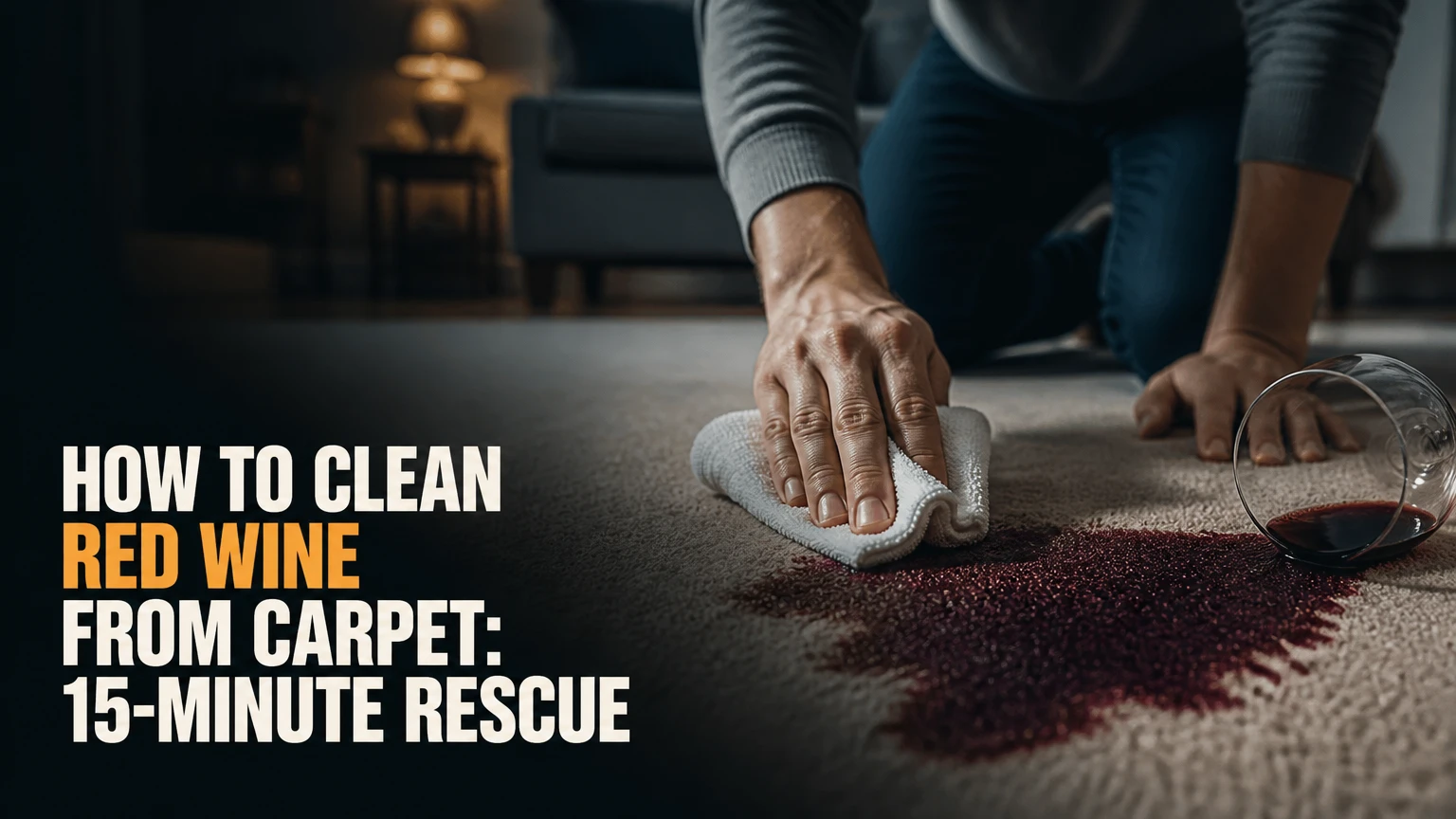
To clean red wine from carpet, immediately blot the spill with a white towel, dilute the remaining color with small amounts of cold water, and blot again. Then apply a carpet-safe treatment suited to the fiber, rinse away residue, and dry the area thoroughly. Freshness, moisture control, and patch testing determine the result.
Key Facts at a Glance
Treat a fresh red wine spill within the first 5 minutes whenever possible.
Use white towels and press vertically; rubbing spreads pigment and damages the pile.
Add water in small amounts, usually 1-2 tablespoons at a time, rather than flooding the carpet.
Use 3% hydrogen peroxide only after a hidden-area color test, and avoid it on wool, silk, viscose, and dark carpet.
Salt and baking soda absorb liquid but do not reliably remove a dried wine dye.
A typical fresh-spill treatment takes 15-30 minutes and costs $0-$15 at home.
Before You Start
A fresh spill usually responds to blotting, controlled dilution, and one compatible spot treatment. A dried mark needs rehydration and repeated extraction, while a wool rug, viscose rug, silk carpet, or valuable hand-knotted textile may require professional cleaning rather than a stronger household chemical.
| Requirement | Typical value | Practical specification |
|---|---|---|
| Fresh-spill treatment time | 15-30 minutes | Add drying time of 6-12 hours |
| Dried-stain treatment time | 30-90 minutes | Full drying can take 12-24 hours |
| DIY material cost | $0-$15 | Towels, water, dish soap, vinegar, or cleaner |
| Professional spot treatment | $40-$300 | Typical add-on range; minimum visits may cost more |
| Water quantity per application | 1-2 tablespoons | Increase only when the towel stops absorbing |
| Basic tools | 4-8 towels | White, absorbent, colorfast towels or paper towels |
You need clean white towels, a bowl, cold or cool water, a spoon, a vacuum, and one selected treatment. Choose either a clear, dye-free dish soap solution, a labeled carpet oxygen cleaner, or 3% hydrogen peroxide for a suitable light-colored synthetic carpet. Do not combine products.
Check the carpet label if it is available. W, S, WS, and X cleaning codes are common upholstery classifications, but carpet manufacturers use different care instructions, so the manufacturer’s label takes priority.
Why Does Red Wine Stain Carpet?
Red wine stains contain colored compounds, including anthocyanin pigments and tannins, suspended in water, alcohol, acids, and sugars. The liquid spreads through the pile and may reach the carpet backing or pad, which explains why a spot can look clean when wet and return as a ring after drying.
Heat can accelerate dye migration and set some stains, but the claim that hot water permanently “bakes” every red wine stain into every carpet fiber is too absolute. Stain permanence depends on wine composition, carpet dye, fiber chemistry, pH, exposure time, and previous cleaning. Nylon, wool, polyester, and polypropylene do not react identically.
The practical rule is simple: use cool water, low moisture, and gentle extraction until you know the carpet’s fiber and dye are stable. A red wine spill is a liquid stain first and a color-removal problem second.
How Does the Cleaning Process Work?
Blotting removes free liquid by absorption, dilution lowers the concentration of remaining wine, and surfactants help detach oily or sugary residue from fibers. Oxygen-based products can alter colored molecules, but oxidation also can lighten carpet dye, so chemical strength must match the carpet.
Salt and baking soda mainly absorb surface moisture. They are not dependable stain removers once wine has dried, and a powder layer cannot extract liquid trapped in the backing. Club soda provides water and mild carbonation, but its main benefit is controlled dilution rather than a special chemical reaction.
How to Clean Red Wine From Carpet Step by Step
The safest general process has five stages: remove liquid, dilute sparingly, apply one treatment, rinse residue, and dry from the top down. A successful treatment leaves no colored transfer on a fresh towel, creates no spreading halo, and dries without a sticky or crunchy residue.
Step 1: Stop the Spill and Blot Vertically
Remove glasses, cushions, and furniture from the area, then place a folded white towel over the wettest section. Press straight down for 10-15 seconds, lift the towel, rotate to a dry section, and repeat until little or no wine transfers.
Work from the outside edge toward the center. That direction limits horizontal spread, especially on plush carpet where liquid can travel beneath the visible mark.
You’ll know it worked when: the towel shows progressively lighter pink or red transfer and the surface no longer looks glossy.
Common mistake: rubbing with a sponge. Back-and-forth movement pushes wine into the pile and can fuzz cut-pile fibers.
Step 2: Dilute With Small Amounts of Cool Water
Pour or spoon 1-2 tablespoons of cool water onto the stain, staying inside the original boundary. Wait 5-10 seconds, then blot with a fresh white towel. Repeat once or twice if the towel continues to pick up strong color.
Do not pour a cup of water onto a small stain. Excess water carries wine into the backing, saturates the pad, and increases the chance of wicking and odor.
You’ll know it worked when: the transfer becomes pale and the damp area has not expanded beyond the original spill.
Common mistake: using hot water because it seems faster. Cool water gives you more control and avoids unnecessary heat exposure.
Step 3: Apply One Compatible Treatment
Choose the treatment from the decision table below, apply it to a towel first when possible, and dab from the perimeter inward. Leave the solution in contact only for the stated time, then blot rather than scrub.
For a general synthetic carpet, mix 1 teaspoon of clear dish soap with 1 cup of cool water. Apply 1-2 teaspoons of that solution at a time. For a light polyester or nylon carpet, a tested 3% hydrogen peroxide solution may provide more color removal, but peroxide is a dye risk.
You’ll know it worked when: a damp white towel picks up less color after each pass and the carpet’s original color remains unchanged.
Common mistake: mixing vinegar, peroxide, oxygen cleaner, ammonia, or bleach. Sequential or combined chemicals can produce unpredictable reactions and increase fiber or dye damage.
Step 4: Rinse Cleaning Residue
Dampen a clean towel with cool water and press it over the treated area. Use only enough water to remove soap or product residue, then immediately blot with a dry towel.
Residue matters because dried dish soap and some spot cleaners attract soil, leaving a gray or brown mark around the original stain. A rinse is especially important when the treatment contains surfactants or powder.
You’ll know it worked when: the towel no longer feels slippery and the carpet does not feel tacky after several presses.
Common mistake: skipping the rinse because the stain appears gone. Residue can create a new visible spot days later.
Step 5: Dry the Carpet Completely
Fold a dry white towel over the area, place a flat, washable weight over it, and leave it for 2-6 hours. Replace the towel when it becomes damp, then expose the carpet to moving air from a fan.
Keep furniture off the spot until the pile and backing feel dry. Drying may take 6-12 hours for a small surface stain and 12-24 hours when wine reached the pad.
You’ll know it worked when: the carpet has its normal texture, no cool dampness remains, and the mark does not darken as it dries.
Common mistake: judging the result while the carpet is wet. Moisture temporarily changes how carpet color reflects light.
Which Red Wine Treatment Should You Choose?
The best treatment depends on the carpet fiber, color, stain age, and amount of wine. Dish soap and water offer the lowest chemical risk for many synthetic carpets, while peroxide offers stronger pigment reduction with a greater bleaching risk; wool and specialty rugs need more restraint.
| Treatment | Fresh stain | Dried stain | Suitable fibers | Main risk |
|---|---|---|---|---|
| Cool water and blotting | High value | Low value | Nylon, polyester, olefin, wool with care | Spreading from over-wetting |
| Dish soap solution | High value | Moderate value | Most synthetic carpet; some wool after testing | Sticky residue |
| White vinegar solution | Moderate value | Low-moderate value | Wool or synthetic after testing | Dye change and odor |
| 3% hydrogen peroxide | Moderate-high value | Moderate-high value | Light nylon or polyester | Bleaching carpet dye |
| Oxygen carpet cleaner | Moderate-high value | High value | Product-approved synthetics | Residue or color loss |
| Salt or baking soda | Moderate for liquid | Low value | Surface use on stable carpet | Powder residue and false confidence |
| Club soda | Moderate for small splashes | Very low value | Most washable carpet after testing | Added moisture and sugar residue |
Is Dish Soap and Vinegar Safe for Carpet?
A diluted, clear dish soap solution is generally a sensible first treatment for colorfast synthetic carpet, and a weak white-vinegar solution can be appropriate for some wool carpets after a hidden-area test. Vinegar is not a universal dye neutralizer, and its acidity can alter sensitive dyes or backing materials.
For a cautious mixture, combine 1 teaspoon of clear dish soap and 1 tablespoon of white vinegar with 2 cups of cool water. Apply sparingly, wait 5 minutes, blot, then rinse with cool water. Avoid scented, colored, moisturising, or antibacterial dish soaps because additives can leave residue.
Wool has a scaly protein structure and can felt under friction or excess moisture. Never scrub wool, soak the backing, or use peroxide without written manufacturer approval.
When Is Hydrogen Peroxide Appropriate?
3% hydrogen peroxide is most appropriate for a small red wine mark on a light, colorfast nylon or polyester carpet after a hidden-area test. Apply a few drops to an unseen edge, wait 10 minutes, blot, and compare the dried area with the surrounding carpet before treating the stain.
If the test passes, apply peroxide sparingly with a white towel and allow 5-10 minutes of contact. Blot, rinse with cool water, and dry. Do not seal the area under plastic, heat it, or leave peroxide for an hour without monitoring.
Peroxide is not suitable for wool, silk, viscose, dark carpet, unstable dyes, or unknown antique rugs. A cleaner that removes red pigment can also remove the carpet’s intended pigment.
Do Salt, Baking Soda, or Club Soda Work?
Salt and baking soda can absorb a fresh, superficial puddle after initial blotting, but neither reliably removes pigment from a dried stain. Club soda can help dilute a small fresh splash, yet plain cool water performs the essential dilution step without adding mineral or sugar-containing residue.
If using salt or baking soda, cover only the damp surface, leave the powder until fully dry, usually 4-8 hours, then vacuum gently. Do not grind the crystals into the pile. Treat the remaining color with a compatible liquid method if necessary.
Club soda should be poured in a small quantity, not dumped over the carpet. Blot immediately and rinse if the product contains added sweetener or flavoring.
How Do Carpet Fibers Change the Method?
Carpet fiber determines chemical tolerance, friction resistance, and drying behavior. Nylon and polyester usually tolerate carefully tested household spot treatments better than wool, viscose, or silk, while polypropylene often resists absorption but still can show a backing or soil ring.
| Carpet or rug material | Preferred first action | Avoid | Escalation trigger |
|---|---|---|---|
| Nylon | Cool-water blotting, then mild detergent | Unchecked peroxide on colored carpet | Color changes after 10-minute test |
| Polyester | Cool-water blotting, then labeled oxygen cleaner | Strong solvents and excess moisture | Stain remains after two cycles |
| Olefin or polypropylene | Blot and low-moisture detergent | Heat and oily solvents | Wine reaches backing or pad |
| Wool | Blot, minimal cool water, wool-safe cleaner | Scrubbing, peroxide, soaking | Any dye transfer or pile distortion |
| Viscose or rayon | Stop and consult a rug professional | Water saturation and household chemicals | Immediate professional referral |
| Silk or antique rug | Absorb surface liquid only | Vinegar, peroxide, powders, friction | Professional cleaning required |
Carpet tiles deserve separate attention because liquid can travel through seams. If the tile is removable, lift it after surface blotting and check the underside and floor. A contaminated pad or subfloor must dry before the tile returns.
How Do You Remove a Dried Red Wine Stain?
A dried red wine stain usually requires controlled rehydration, repeated blotting, and a fiber-appropriate color treatment rather than a single application. Lightly mist the mark with cool water, wait 5 minutes, blot, and then use a labeled carpet oxygen product or a tested mild detergent solution.
Do not begin with a large volume of vinegar or peroxide. Dried pigment can sit in the backing, and aggressive wetting may produce a larger halo than the original stain. Work in sections no larger than 10 by 10 centimetres, or about 4 by 4 inches, and dry between treatment cycles.
For a synthetic carpet, follow the oxygen cleaner’s label exactly. Product formulas vary, and a laundry oxygen powder is not automatically safe for carpet. Stop after two careful cycles if the stain remains unchanged, because more product may damage dye without improving removal.
What Should You Do if a Red Wine Ring Returns?
A returning ring usually indicates wicking, which occurs when moisture from the backing or pad moves upward during drying and carries dissolved residue toward the pile tips. Re-dampen the entire visible boundary lightly with cool water, blot outward to inward, and dry the area under absorbent towels.
If the ring is larger than the original stain, the first treatment probably used too much liquid or left residue behind. Place several layers of white towel over the damp area, apply a flat weight for 2-6 hours, and replace wet towels rather than leaving the carpet sealed.
A ring can also be soil-attracting residue rather than wine. Rinse the area with a barely damp towel and dry it with airflow. If the outline returns after two full drying cycles, professional extraction may be needed to clean the backing and pad.
Common Mistakes and How to Fix Them
| Mistake | What it causes | Recovery action | Do not repeat |
|---|---|---|---|
| Scrubbing | Frayed pile and wider stain | Stop friction, blot vertically | Brush or rub the fibers |
| Flooding with water | Pad saturation and wicking | Extract with towels and fan-dry | Pouring water directly from a cup |
| Hot-water treatment | Faster dye movement and possible setting | Cool the area, blot, then reassess | Steam before spot removal |
| Colored towel | Secondary dye transfer | Blot with a white towel and cool water | Printed cloths or dyed sponges |
| Mixing chemicals | Unpredictable reaction or damage | Ventilate, stop products, rinse cautiously | Peroxide with vinegar or bleach |
| Repeated peroxide use | Lightened carpet dye | Stop when original color changes | Treating without a dried patch test |
White wine does not neutralize red wine. It adds liquid, acids, alcohol, and sugars, so using it increases the material that must be removed.
A wet-dry vacuum can help on a large spill if the carpet manufacturer permits water extraction. Make slow passes without flooding, empty the recovery tank promptly, and finish with towels and airflow. A household vacuum should never be used on wet carpet.
How Much Does Red Wine Removal Cost?
DIY treatment typically costs $0-$15 when towels, dish soap, vinegar, or an existing carpet cleaner are available. Professional spot treatment commonly costs $40-$300 as an add-on, while an emergency visit dedicated to one spill may carry a typical $100-$300 minimum before travel, labor, or rug-specific charges.
| Situation | DIY time | Typical DIY cost | Typical professional range |
|---|---|---|---|
| Fresh splash under 15 cm | 15-30 minutes | $0-$5 | $40-$100 add-on |
| Large fresh spill over 30 cm | 30-60 minutes | $5-$15 | $75-$200 |
| Dried synthetic-carpet stain | 30-90 minutes | $5-$15 | $75-$250 |
| Wool or specialty rug | Surface blot only | $0-$10 | $100-$300 or more |
| Wine in pad or subfloor | 1-2 hours of DIY drying | $0-$20 | $150-$300 plus extraction |
These are typical consumer and service ranges, not fixed prices. Location, access, after-hours service, carpet construction, furniture moving, and whether the entire room must be cleaned can change the invoice.
When Should You Call a Professional?
Call a professional when the carpet is wool, silk, viscose, antique, hand-knotted, or expensive; when the spill reaches the backing or pad; or when a color test shows dye transfer. Professional help is also sensible after two controlled treatment cycles fail, because repeated home chemistry can enlarge the damage.
Ask for a technician experienced with the specific fiber, not only general wall-to-wall carpet. Tell the technician the wine type, approximate spill size, time since the accident, and every product already applied. Product history affects the safest next step.
Do not wait for a specialty rug appointment while leaving the area wet. Blot surface moisture, place dry towels over the spot, provide airflow, and keep heat away from the textile.
Frequently Asked Questions
Can I use laundry detergent on red wine carpet stains?
Laundry detergent is not the preferred first choice because many formulas contain optical brighteners, enzymes, fragrances, or dyes that can leave residue or alter carpet color. Use a small amount of clear dish soap or a carpet product labeled for the fiber instead, then rinse and dry the treated area.
How long can red wine sit before it becomes permanent?
There is no universal permanence deadline. A fresh spill treated within 5-15 minutes is easier to remove, but a dried stain can still respond to rehydration and a compatible oxygen product. Dye stability, carpet fiber, exposure to heat, and penetration into the pad matter more than a single clock time.
Can steam cleaning remove red wine from carpet?
Professional hot-water extraction can remove wine residue, but steam is not the first response to a fresh spill and heat can increase dye migration in some situations. Remove as much pigment as possible first, follow the carpet manufacturer’s instructions, and use a professional for large or deeply saturated spills.
Why does the cleaned carpet look darker?
A dark patch usually indicates remaining moisture, a damp pad, residue, or wicking. Compare the area after 12-24 hours of airflow rather than while wet. If the dark outline remains after complete drying, rinse lightly, extract moisture with towels, and consider professional extraction.
Can I use bleach on a red wine stain?
Household chlorine bleach should not be used on carpet. Chlorine can destroy carpet dye, weaken fibers, damage backing, and create hazardous fumes when mixed with acidic or other cleaning products. A tested 3% hydrogen peroxide treatment is a different chemical and still carries bleaching risk.
Will professional cleaning guarantee complete removal?
No cleaning method can guarantee complete removal because some wine stains alter the carpet dye or reach inaccessible backing layers. A reputable technician should inspect the fiber, test for colorfastness, explain the likely outcome, and identify whether replacement or repair is more practical.
The Bottom Line
The most reliable way to clean red wine from carpet is to blot immediately, dilute with small amounts of cool water, apply one fiber-appropriate treatment, rinse away residue, and dry the carpet completely. Use mild detergent for many synthetic carpets, reserve tested 3% peroxide for suitable light carpet, and leave wool, viscose, silk, and valuable rugs to a qualified professional.