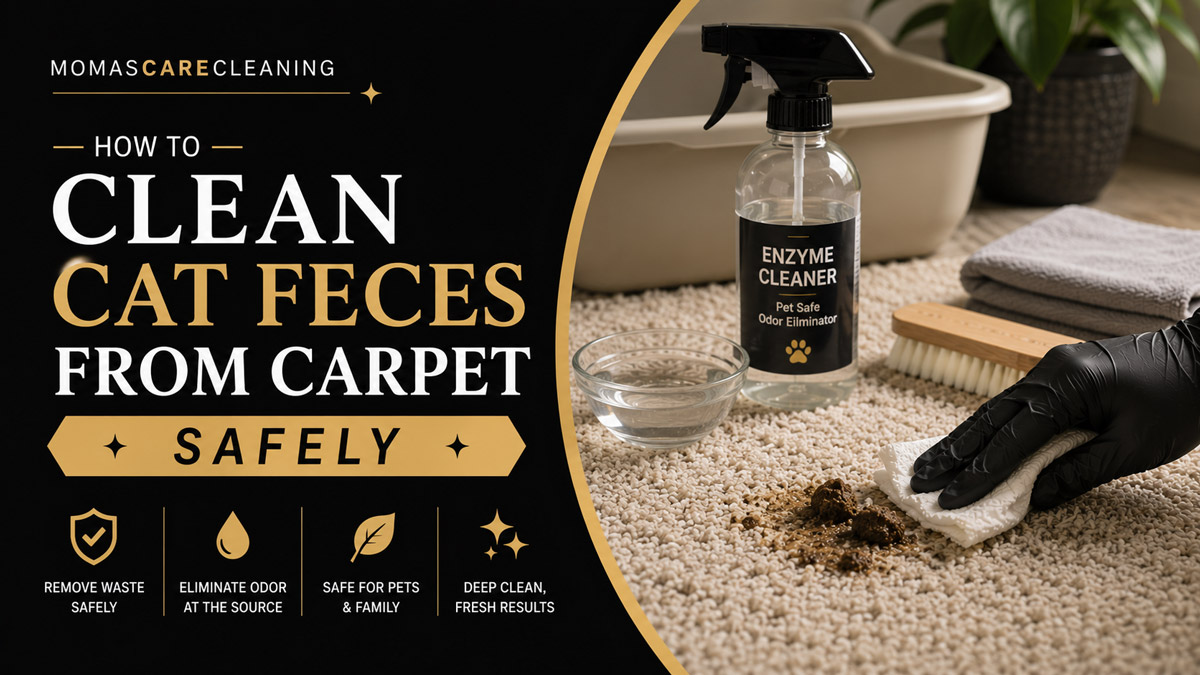
To clean cat feces from carpet, wear gloves, lift the solid waste without rubbing, blot moisture, apply a carpet-safe enzymatic cleaner, and extract the residue before thorough drying. Fresh messes usually take 20-30 minutes to treat, while dried or diarrhea-soiled carpet may require repeated treatment or professional extraction.
Key Facts
Use a plastic scraper or disposable cardboard to lift feces vertically from carpet fibers.
Enzymatic pet cleaners target proteins and other organic residue, but they do not replace physical removal or guarantee removal of every uric-acid crystal.
Test every cleaner on a hidden area, especially on wool, viscose, silk, dark, or hand-dyed carpet.
Treat beyond the visible stain because liquid can reach the carpet backing and underlay.
Avoid ammonia, chlorine bleach, abrasive scrubbing, steam, and hair-dryer heat during initial cleanup.
A persistent odor after drying often indicates contamination in the carpet pad or subfloor, not a surface stain.
What You Need Before Cleaning Cat Feces From Carpet
A basic cleanup requires disposable gloves, a scraper, absorbent white towels, a sealed waste bag, and a carpet-labeled enzymatic cleaner. Add a wet-dry vacuum or portable extractor when diarrhea, liquid contamination, or a large area has penetrated the carpet backing.
Before-you-start checklist
| Item | Typical quantity or specification | Purpose |
|---|---|---|
| Nitrile or disposable gloves | 1 pair per cleanup | Protect hands from fecal organisms and cleaning chemicals |
| Plastic scraper or cardboard | 1 disposable tool | Lift solids without cutting carpet fibers |
| White paper towels | 10-30 sheets | Blot moisture and reveal dye transfer |
| Enzymatic carpet cleaner | 250-500 mL for a small spot | Break down remaining organic residue |
| Waste bags | 2 nested bags | Contain feces and contaminated towels |
| Wet-dry vacuum | 1 unit, optional | Remove liquid from pile and pad |
| Old white towel | 1-2 towels | Wick moisture during drying |
| Fan or dehumidifier | 1 unit, optional | Reduce drying time without heating the stain |
Keep children and pets away from the work area. Wash hands with soap and water after removing gloves, because hand sanitizer does not reliably remove all contamination from visibly soiled hands.
The Centers for Disease Control and Prevention advises using gloves when handling cat feces and washing hands afterward because cat feces can transmit Toxoplasma gondii. Pregnant or immunocompromised people should avoid handling cat feces when another adult can do the cleanup.
How to Clean Cat Feces From Carpet Step by Step
The correct sequence is solid removal, moisture absorption, surface testing, enzymatic treatment, extraction, and drying. The most important rule is to remove as much physical waste as possible before adding liquid, because cleaner cannot compensate for feces pushed into the pile or pad.
Step 1: Protect Yourself and Isolate the Area
Put on disposable gloves, open a window if practical, and keep the cat away from the carpet until it is fully dry. If the feces are near food bowls, children’s toys, bedding, or an air vent, move those items before cleaning.
Use a disposable tool rather than a household brush. Place the waste bag beside you so contaminated materials do not travel across the room.
You will know this step worked when: the cleanup zone is isolated and every tool that touched feces can be discarded or disinfected.
Common mistake: beginning with a spray bottle. Liquid softens the feces and increases the contaminated area.
Step 2: Lift the Solid Waste
Slide a stiff piece of cardboard or a plastic scraper under the feces and lift upward. Work from the outer edge toward the center, using several small passes instead of one forceful scrape.
For dried feces, place a barely damp white towel over the material for 5-10 minutes. The goal is to soften the surface enough to lift it, not to saturate the carpet. Remove loosened pieces with the scraper, then place all waste and towels in a sealed bag.
You will know this step worked when: no visible solid remains and the carpet pile has not been flattened by horizontal rubbing.
Common mistake: vacuuming dry feces. A household vacuum can aerosolize particles, spread odor through its filter, and contaminate the machine.
Step 3: Absorb Residual Moisture
Fold a dry white paper towel or cloth and press directly downward over the spot. Hold pressure for 10-15 seconds, replace the towel, and repeat until the towel picks up little or no moisture.
Do not scrub. Scrubbing spreads fecal residue sideways and can drive it below the carpet face, while colored towels can transfer dye into damp fibers.
You will know this step worked when: the towel remains nearly clean after firm vertical blotting and the carpet feels damp rather than wet.
Common mistake: using hot water immediately. Heat can spread protein-based staining and make extraction more difficult.
Step 4: Test and Apply an Enzymatic Cleaner
Choose an enzymatic product labeled for carpet and pet feces or organic pet stains. Test a small amount in a hidden location, wait at least 5 minutes, and blot with a white cloth. Stop if the carpet color transfers, the test area lightens, or the fibers become rough.
Apply enough cleaner to reach the contaminated fibers, extending approximately 5-10 cm beyond the visible mark. A small spot usually needs 30-100 mL, but the product label takes priority because formulas and application rates differ.
Enzymatic cleaners commonly contain protease, lipase, or amylase enzymes. These enzymes help break down protein, fat, and starch residues into smaller compounds that are easier to remove. Enzymes do not literally consume every odor molecule, and many products are less effective after incompatible chemicals have been applied.
You will know this step worked when: the entire affected pile is evenly damp, without liquid running into the pad or surrounding furniture.
Common mistake: applying a tiny mist to a deep stain. Surface wetting cannot reach residue trapped at the backing.
Step 5: Allow Dwell Time, Then Extract
Follow the cleaner’s label for dwell time. A typical contact period is 10-30 minutes, while dried contamination may require a longer covered treatment if the manufacturer permits it.
After dwell time, press clean towels into the area or use a wet-dry vacuum. A portable extractor can flush a larger contaminated section, but make slow passes and remove as much liquid as possible. Do not repeatedly flood the carpet, because over-wetting can loosen adhesive, damage backing, or create conditions for microbial growth.
If the product instructs you not to rinse, extract only the excess. If the label specifies rinsing, use the minimum clean-water rinse needed and extract thoroughly.
You will know this step worked when: no visible residue remains and the carpet is damp, not saturated.
Common mistake: using a steam cleaner as the first treatment. Steam may spread contamination and heat can set some protein-based stains; extraction is more appropriate after solid removal and chemical dwell time.
Step 6: Wick and Dry the Carpet Completely
Lay a clean white towel over the damp area and press it down with a waterproof, flat weight. A sealed container filled with water works better than a book because it will not absorb moisture or transfer ink. Replace the towel when it becomes damp.
Use a fan or dehumidifier at room temperature. Typical drying time is 6-12 hours for a small surface spot and 12-24 hours when the pad was dampened. Avoid direct heat.
You will know this step worked when: the carpet feels dry at the pile and backing, the odor does not intensify in warm air, and the fibers return to their normal texture.
Common mistake: judging success before the carpet dries. Moisture temporarily suppresses some odors, so inspect again after 24 hours.
Which Cleaner Should You Use?
An enzymatic carpet cleaner is the best first choice for residual cat feces because it addresses organic residue without the bleaching risk of peroxide. A portable extractor becomes more valuable when contamination reaches the pad, while peroxide is a limited stain-treatment option that may damage color.
| Cleaning option | Best use | Typical working time | Main limitation |
|---|---|---|---|
| Enzymatic pet cleaner | Fresh residue and organic odor | 10-30 minutes dwell | Requires correct coverage and drying |
| Plain cool water | Initial blotting and label-directed rinsing | 5-15 minutes | Does not neutralize embedded odor |
| 3% hydrogen peroxide product | Persistent discoloration on colorfast synthetic carpet | 5-15 minutes | Can bleach or lighten fibers |
| Portable extractor | Diarrhea and deep pad contamination | 20-60 minutes | Can over-wet carpet and underlay |
| Professional hot-water extraction | Large, old, or recurring contamination | 1-3 hours onsite | Surface cleaning may not fix subfloor odor |
| Carpet replacement | Saturated pad, damaged backing, severe recurrence | 1-2 days typical | Highest cost and disruption |
Never mix hydrogen peroxide with chlorine bleach, ammonia, vinegar, or another cleaner. Apply one product, remove its residue as directed, and allow the area to dry before considering a different treatment.
Is hydrogen peroxide safe for cat feces stains?
A 3% hydrogen peroxide product can lighten a fecal pigment stain on some synthetic carpets, but it is not a universal odor remover and can permanently bleach wool, viscose, silk, cotton, dark nylon, or hand-dyed rugs. Use it only after colorfastness testing and only when the product label permits carpet application.
The safer sequence is to complete enzymatic treatment first, extract excess moisture, and reassess after drying. If a yellow or brown mark remains but odor is gone, a carpet professional can select a controlled reducing or oxidizing treatment based on the fiber and dye.
How Much Does Carpet Feces Cleanup Cost?
Typical do-it-yourself material cost is $10-$35 for gloves, towels, bags, and a consumer enzymatic cleaner. Professional pricing commonly ranges from $75-$250 for a small service call or approximately $100-$300 per room, depending on location, access, contamination depth, and whether padding or subfloor treatment is required.
| Option | Typical cost in the United States | Typical drying period | Appropriate situation |
|---|---|---|---|
| DIY enzyme cleaner | $10-$35 | 6-24 hours | One small or moderate spot |
| Portable extractor rental | $30-$80 per day | 12-24 hours | Several spots or diarrhea |
| Consumer extractor purchase | $100-$350 | 12-24 hours | Repeated incidents in a pet home |
| Professional spot treatment | $75-$250 | 12-48 hours | Deep, old, or difficult contamination |
| Pad replacement | $1-$3 per square foot | 24-48 hours | Saturated or odor-retaining underlay |
| Carpet replacement | $3-$12 per square foot installed | 24-72 hours | Damaged backing or persistent subfloor odor |
Prices vary substantially by country and service market. Treat these figures as planning ranges, not guarantees.
What Changes for Dried Feces, Diarrhea, or Wool Carpet?
Dried solid feces need controlled softening, diarrhea needs deeper extraction, and wool carpet needs gentler chemistry and faster escalation. Carpet fiber, backing, dye stability, contamination volume, and time since the accident determine whether a home treatment is appropriate.
Dried cat feces
Remove brittle pieces first, then soften only the remaining material with a damp white cloth for 5-10 minutes. Avoid scraping aggressively because dried feces can bind to individual fibers and pull them from the backing.
After lifting the residue, use a tested cleaner and allow the label-directed dwell period. Repeat once after complete drying if odor remains. Two controlled treatments are safer than repeatedly saturating the carpet in one session.
Cat diarrhea
Diarrhea is more difficult because liquid fecal matter travels through the pile, backing, and pad. Remove solids, blot immediately, then use an extractor with a carpet-compatible solution after color testing.
For an area larger than approximately 30 cm across, multiple accidents, or visible seepage beneath the carpet, professional cleaning is preferable. The professional may need to lift a carpet edge, inspect the pad, and treat or replace contaminated underlay.
Wool, silk, viscose, and antique rugs
Do not assume a pet enzyme spray is safe for wool or delicate rugs. Wool is a protein fiber, and high-pH products, peroxide, prolonged saturation, or aggressive agitation can cause discoloration, felting, fiber weakening, or texture change.
For valuable, antique, silk, viscose, or hand-dyed rugs, lift solids, blot with a dry white towel, use only a small amount of cool water if necessary, and contact a rug specialist. Do not apply peroxide, household bleach, ammonia, or steam without written fiber-specific instructions.
Common Mistakes and How to Fix Them
The most damaging cleanup errors are rubbing, chemical mixing, incomplete extraction, and treating only the visible center. Each mistake has a different recovery method, and repeating the original mistake usually increases the contaminated area.
Scrubbing the carpet
Problem: Horizontal scrubbing spreads residue and distorts the pile.
Fix: Stop rubbing, lift remaining material, then blot vertically with clean towels.
Using ammonia
Problem: Ammonia can resemble urine-related odor cues to cats and does not remove fecal proteins effectively.
Fix: Extract the ammonia product with clean water if the carpet allows, dry fully, then use a tested enzyme cleaner. Never mix ammonia with bleach.
Applying too little cleaner
Problem: A light spray treats the tips of the fibers while residue remains near the backing.
Fix: Apply label-directed coverage across the visible area plus a 5-10 cm margin, then extract excess liquid.
Heating the stain
Problem: Hair dryers and steam can spread or set some organic stains and may damage synthetic backing.
Fix: Let the area cool, blot or extract, and dry with moving room-temperature air.
Leaving the pad wet
Problem: Damp underlay can retain odor and may support microbial growth.
Fix: Extract repeatedly with slow passes, increase ventilation, and inspect the backing if odor returns after drying.
Using a household vacuum
Problem: A vacuum can spread particles and contaminate the machine.
Fix: Dispose of solids manually. Clean or replace the vacuum filter only if the machine was accidentally used.
Why Does the Odor Return After Cleaning?
Returning odor usually means organic residue remains in the carpet backing, pad, or subfloor. Heat and humidity can make that odor noticeable again even when the carpet surface appears clean.
Use a moisture meter if available, or compare the odor at the pile, carpet edge, and floor beneath. Reapply an appropriate enzyme product only when the carpet can be extracted and dried thoroughly. If odor remains after two properly performed treatments, lift an accessible edge for inspection or call a professional.
Professional help is warranted when:
- The contamination covers more than 0.3 square meters.
- Diarrhea soaked through to the pad or floor.
- The odor returns after 24-48 hours of drying.
- The carpet backing is delaminating or the pad feels spongy.
- The rug is wool, silk, viscose, antique, or expensive.
- A pregnant or immunocompromised person must perform the cleanup.
- The cat repeatedly defecates in the same location.
A recurring accident also requires a cat-health investigation. Constipation, diarrhea, arthritis, stress, litter-box aversion, and urinary or gastrointestinal disease can all change elimination behavior. Clean carpet alone will not solve a medical or environmental trigger.
How Do You Stop a Cat From Returning to the Spot?
A cat is less likely to revisit the area when odor is removed below the carpet surface and the litter-box cause is corrected. After cleaning, block access for 24-48 hours, rearrange furniture, and place a temporary feeding station or resting area nearby if practical.
The American Association of Feline Practitioners recommends providing suitable litter-box access, including one box per cat plus one extra in many multi-cat households. Use unscented litter, scoop at least daily, and place boxes where the cat can reach them without confronting another animal.
Avoid punishment. Punishment can increase stress and does not remove the odor cue that attracts repeat soiling.
How Long Will the Carpet Take to Dry?
A lightly dampened synthetic carpet spot typically dries in 6-12 hours, while a pad that received enzyme cleaner or extraction water commonly needs 12-24 hours. Wool, dense pile, poor ventilation, and high indoor humidity can extend drying to 24-48 hours.
| Carpet condition | Typical cleaner volume | Typical drying time | Inspection point |
|---|---|---|---|
| Small fresh solid spot | 30-60 mL | 6-12 hours | Surface and odor after 24 hours |
| Dried solid residue | 50-100 mL | 8-18 hours | Fiber tips and backing edge |
| Loose stool or diarrhea | 100-500 mL plus extraction | 12-24 hours | Pad and subfloor |
| Dense synthetic pile | 100-250 mL | 12-24 hours | Carpet backing |
| Wool or delicate rug | Specialist-determined | 24-48 hours | Dye and texture change |
Do not replace furniture or allow the cat back until the carpet feels dry through the pile. A damp towel test can reveal moisture that the hand misses.
The Bottom Line
To clean cat feces from carpet, remove the solids first, blot without scrubbing, apply a tested enzymatic carpet cleaner, extract excess moisture, and dry the area completely. Fresh surface contamination is often manageable in 20-30 minutes, but diarrhea, wool rugs, recurring odor, and pad contamination require deeper extraction or professional assessment.
FAQ
Can I use vinegar to clean cat feces from carpet?
Vinegar can reduce some surface odors, but vinegar does not reliably break down fecal proteins or remove contamination from carpet padding. Do not combine vinegar with bleach, hydrogen peroxide, or commercial cleaners. Use a carpet-labeled enzymatic product after solid removal instead, then extract and dry the area.
Can I clean cat poop from carpet without an enzyme cleaner?
Yes, a small fresh spot can be physically removed, blotted, rinsed according to carpet instructions, extracted, and dried without an enzyme cleaner. However, plain water does not chemically break down all organic residue, so enzyme treatment is more useful when odor remains or liquid reached the backing.
Should I throw away carpet after a cat has defecated on it?
Do not discard carpet solely because of one surface accident. Replacement becomes reasonable when the pad is saturated, the backing is damaged, contamination is widespread, or odor persists after professional extraction and subfloor inspection.
Is cat feces on carpet dangerous after it dries?
Dried cat feces can still contaminate hands and surfaces when disturbed. Wear gloves, avoid vacuuming the dry material, bag the waste, wash hands with soap and water, and keep children away during cleanup. People who are pregnant or immunocompromised should arrange for someone else to handle the waste.
How often should I repeat enzymatic treatment?
Repeat treatment once after the carpet has dried and the odor has been reassessed, following the product label. If two complete applications fail, further spraying may only add moisture. Inspect the pad and subfloor or hire a professional instead of repeatedly saturating the same area.