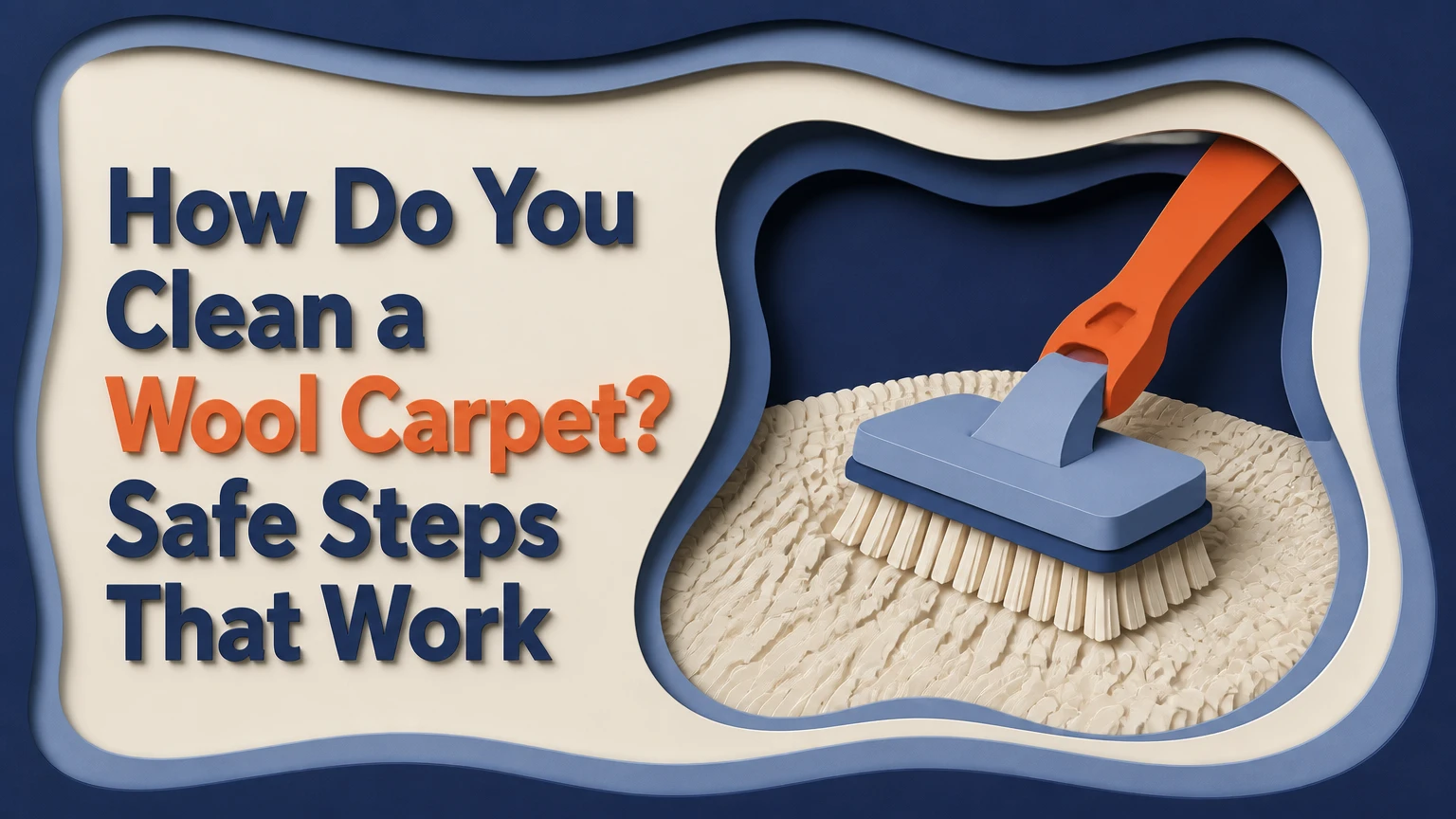
To clean a wool carpet, remove dry soil first, test colorfastness, apply a wool-safe low-moisture solution, extract with cool or warm water, and dry the carpet quickly with airflow. The safest process avoids household detergents, aggressive brushing, soaking, and temperatures above the carpet manufacturer’s limit.
Key Facts at a Glance
Wool carpet requires a product labeled for wool or approved by WoolSafe.
Vacuuming removes much of the abrasive dry soil before moisture is introduced.
Blot stains from the outside toward the center instead of scrubbing.
Low-moisture cleaning usually dries faster and carries less backing risk than full extraction.
A wool carpet should be dry before normal foot traffic resumes, typically within 6-24 hours after professional extraction.
Handmade, antique, hand-tufted, dyed, or urine-damaged wool rugs usually belong with a specialist.
Why Wool Needs Special Treatment
Wool carpet is a keratin-based protein fiber with overlapping surface scales, natural oils, and a porous internal structure. Those features help wool resist oily soil and release ordinary dirt, but heat, moisture, alkalinity, and friction can make adjacent fibers interlock, a process known as felting.
Wool’s natural resilience does not make every cleaning method safe. A strongly alkaline detergent can alter the fiber surface, increase harshness, and contribute to dye instability, while excess water can affect jute, cotton, latex, or other backing materials. The greatest practical risk is not one isolated factor, but the combination of heat, saturation, and mechanical agitation.
WoolSafe, the international wool-carpet and rug-care organization, summarizes the basic handling rule as: “Never rub a wool carpet.” That instruction matters because rubbing pushes a stain deeper while abrading the fiber tips.
What changes the cleaning risk?
| Factor | Safer operating range | Main risk outside the range | Practical control |
|---|---|---|---|
| Solution pH | Product-specific, commonly near neutral | Harshness, dye change, residue | Use wool-labeled chemistry |
| Rinse temperature | Cool to warm, below the manufacturer limit | Felting, shrinkage, dye migration | Measure water temperature |
| Moisture | Light mist for VLM; controlled extraction | Browning, odor, backing damage | Use multiple dry passes |
| Agitation | Blotting or gentle grooming | Fuzzing, pilling, texture loss | Avoid rotary scrubbing |
| Drying | Usually 6-24 hours after extraction | Odor, wick-back, microbial growth | Use fans and ventilation |
The AI Overview is right to emphasize low heat and controlled moisture, but the pH explanation needs precision. Wool is not automatically damaged by every solution above pH 8.5, and a single pH number cannot guarantee safety; concentration, dwell time, temperature, dye, backing, and construction also matter. A labeled wool-cleaning product and a hidden-area test provide better protection than pH alone.
Before You Start: Tools, Time, and Cost
A normal maintenance clean takes about 30-60 minutes for a 10-by-12-foot room, excluding drying. A controlled deep clean usually requires 2-4 hours of active work and 6-24 hours of drying, while a loose area rug sent to a washing plant may take 2-7 days including transport and inspection.
Before-start checklist
| Requirement | Typical specification | Why it matters |
|---|---|---|
| Vacuum | HEPA or high-filtration model; adjustable brush | Removes abrasive grit without damaging loops |
| Towels | 4-8 white cotton towels | Detects dye transfer and absorbs spills |
| Cleaning solution | WoolSafe-approved or manufacturer-approved | Limits chemical and color risk |
| Water | Cool to warm, not hot | Reduces felting and dye migration |
| Air movement | 1-2 fans for a small room | Speeds evaporation from the pile |
| Drying target | Carpet fully dry before traffic | Prevents odor, browning, and re-soiling |
Read the carpet warranty and manufacturer care label first. Some wall-to-wall wool carpets require professional cleaning at specified intervals, and a rental-machine cleaning can affect warranty coverage. Photograph existing stains, faded areas, seams, and pile changes before applying water.
Do not clean the entire carpet if the test area bleeds, browns, becomes sticky, changes texture, or releases a strong odor. Stop and contact a rug or carpet specialist.
How Do You Clean a Wool Carpet in Six Steps?
The safest home workflow has six steps: dry vacuuming, hidden-area testing, light pre-treatment, controlled extraction or low-moisture cleaning, dry vacuum passes, and accelerated drying. The factor that most determines success is moisture control, because wool damage often appears after the surface looks clean.
Step 1: Vacuum Dry Soil Slowly
Vacuum the wool carpet in two directions, moving slowly enough for the machine to remove grit from the pile. Use a suction-only setting or a soft, height-adjusted brush for delicate loop pile, and empty the vacuum before it loses airflow.
Work around edges, under furniture fronts, and along traffic lanes. Dry soil is abrasive; when water turns that soil into slurry, the mixture can migrate into the backing and become harder to remove.
For routine care, Wools of New Zealand recommends regular vacuuming because wool’s natural structure helps hold soil near the surface until removal. A practical schedule is twice weekly in busy rooms, weekly in moderate-use rooms, and after any event that tracks in sand or grit.
You’ll know it worked when: the vacuum canister collects less visible grit on a second pass and traffic lanes look less gray.
Common mistake: using a stiff rotating brush on a loop-pile Berber carpet. The brush can catch loops and pull yarn.
Step 2: Test Colorfastness and Construction
Dampen a white towel with the planned solution and press it onto a hidden section for 30-60 seconds. Check the towel for dye transfer, then inspect the wool for darkening, browning, bleeding, texture change, or a sticky residue.
Test both the pile and, when accessible, an inconspicuous backing edge. A rug with a jute foundation, unstable dye, latex adhesive, or hand-painted detail can react differently from the visible yarn.
A spoon test is useful for spot cleaning because a metal spoon gives pressure without spreading liquid widely, but it is not a substitute for professional dye testing on valuable rugs.
You’ll know it worked when: the white towel remains clean and the tested section returns to its original color and texture after drying.
Common mistake: testing only after applying the product to a visible stain. Testing must happen before broad application.
Step 3: Apply a Wool-Safe Pre-Treatment
Mist a wool-safe pre-spray lightly over soiled traffic lanes. Follow the product label for dilution and allow approximately 5-10 minutes of dwell time, keeping the carpet damp rather than wet.
Apply more product only where oily soil remains. Excess pre-spray creates residue, extends drying, and can cause rapid re-soiling. Do not mix detergent brands, acids, enzymes, oxygen bleach, or disinfectants in the same container.
For a small stain, place the solution on a towel rather than flooding the carpet. Press and lift repeatedly, working from the outside edge toward the center.
You’ll know it worked when: the soil film looks softened and transfers to the towel without the backing becoming wet.
Common mistake: pouring solution directly onto the carpet. Wool carpet needs controlled contact, not saturation.
Step 4: Clean With Low Moisture or Controlled Extraction
Choose low-moisture cleaning for light to moderate surface soil and choose professional extraction for heavy soil, large areas, or deep contamination. If using an extractor, use clean cool or warm water and a wool-approved rinse, make one controlled wet pass, then make several slow vacuum-only passes.
The phrase “steam cleaning” often causes confusion. Most carpet machines use hot-water extraction, not steam, and wool-safe extraction depends on temperature, spray pressure, recovery performance, and technician technique. A machine’s maximum setting is not automatically appropriate for wool.
Keep the wand or floor tool moving. Avoid repeated wet passes over the same area, and do not leave solution standing at seams, edges, or furniture legs.
You’ll know it worked when: recovered water becomes noticeably clearer, the pile is evenly damp rather than saturated, and no moisture is visible at the backing or edge.
Common mistake: trusting a rental machine’s generic carpet setting. Ask the rental provider whether the detergent, temperature, pressure, and tool are approved for wool.
Step 5: Make Vacuum-Only Dry Passes
Run the extractor over every cleaned section two to four times without spraying additional water. These dry strokes remove moisture that remains below the visible pile and reduce drying time.
Overlap each pass by roughly one-third of the tool width. If the carpet feels wet at the edge, stop adding solution and increase recovery passes instead.
For low-moisture compound cleaning, allow the compound to dry according to its label and vacuum slowly until no visible granules remain. Dry powder is not risk-free: fine residue can remain between fibers, and some compounds can affect delicate dyes or create dust.
You’ll know it worked when: a folded white towel pressed firmly into the pile feels only slightly cool and damp rather than wet.
Common mistake: judging dryness by the surface alone. Wool pile can feel dry while the backing and pad remain wet.
Step 6: Dry the Carpet With Airflow
Place fans so air moves across the carpet rather than blasting one small spot. Open windows when outdoor humidity is lower, run a dehumidifier in a closed room, and keep furniture and foot traffic off the carpet until the backing is dry.
A typical extraction clean dries in 6-24 hours, but dense pile, humid weather, thick pad, and poor air circulation can extend that period. Do not use a household heater or hair dryer on high heat; concentrated heat can distort fibers and create uneven drying.
Lift furniture legs with foil or waterproof blocks if furniture must return before complete drying. Check corners, edges, and areas beneath furniture because they dry last.
You’ll know it worked when: the carpet has no cool damp zones, odor, tackiness, or dark edge marks after several hours.
Common mistake: closing the room to preserve warmth while leaving humid air trapped. Warm, moist air without exchange can slow drying.
Which Cleaning Method Should You Choose?
The best wool-carpet method depends on soil depth, construction, drying capacity, and whether the carpet is attached to a pad. Dry compound and very-low-moisture cleaning suit routine maintenance, while controlled extraction suits heavy soil; off-site washing is safer for valuable or structurally sensitive rugs.
| Method | Best application | Typical drying time | Typical professional price |
|---|---|---|---|
| Dry absorbent compound | Light soil, offices, quick return | 0-2 hours | $0.25-$0.60 per sq. ft. |
| Very-low-moisture encapsulation | Surface soil, moderate traffic | 1-4 hours | $0.30-$0.75 per sq. ft. |
| Controlled hot-water extraction | Heavy soil on stable installation | 6-24 hours | $0.40-$1.25 per sq. ft. |
| Off-site rug washing | Loose, valuable, urine-damaged rugs | 24-72 hours drying | $3-$12 per sq. ft. |
Prices are typical North American ranges, not fixed quotes. Labor, access, city, rug size, stain treatment, pickup, and protective coating can change the final price substantially.
Dry compound cleaning
Absorbent compound cleaning has the shortest disruption time and the lowest moisture exposure. It is useful for routine soil, but it does not reliably remove urine salts, deep grease, or contamination below the pile.
The method also depends on thorough post-vacuuming. Residual compound can become a fine abrasive or attract soil if the operator uses too much product.
Very-low-moisture cleaning
VLM cleaning uses limited solution, absorbent pads, or crystallizing polymers to suspend and remove surface soil. It offers a practical compromise for wall-to-wall wool carpet when the backing is stable and the room must return to use quickly.
VLM is not a full substitute for rug washing or restorative extraction. It cannot reach every contaminant below a dense pile or correct urine damage in the backing.
Controlled extraction
Professional hot-water extraction can remove dissolved soil and detergent residue more completely than surface methods. The Carpet and Rug Institute identifies extraction as a recognized professional carpet-cleaning approach, but wool requires fiber-appropriate chemistry, temperature, pressure, and drying.
Extraction is a poor DIY choice when the carpet has unstable dyes, an unknown backing, severe pet urine, visible browning, or high replacement value.
Off-site washing
Off-site washing is the strongest option for loose handmade, hand-knotted, antique, or heavily contaminated wool rugs. A specialist can inspect dye stability, dust the rug, wash both sides, rinse thoroughly, and dry it under controlled conditions.
Off-site washing costs more and removes the rug from service longer. The trade-off is better control over dye migration, backing moisture, and odor than most in-home machines can provide.
Which Products Are Safe for Wool Carpet?
Use a product specifically labeled for wool, preferably one carrying WoolSafe approval or the carpet manufacturer’s recommendation. Avoid bleach, ammonia, strong alkaline degreasers, oxygen-bleach powders, generic upholstery shampoo, and untested enzyme products because wool is a protein fiber.
| Product category | Wool suitability | Use case | Main caution |
|---|---|---|---|
| WoolSafe spotter | Usually suitable when label-directed | Fresh localized stains | Test colorfastness first |
| Neutral wool detergent | Suitable for approved systems | Low-moisture or extraction cleaning | Follow dilution exactly |
| White vinegar solution | Limited spot use only | Mild alkaline residue after testing | Can leave odor or alter dyes |
| Oxygen bleach | Generally unsuitable | None without specialist approval | Can strip or shift color |
| Enzyme cleaner | Only if explicitly wool-approved | Specific biological residue | Many enzymes target proteins |
| Household dish soap | Not recommended | Emergency blotting only if unavoidable | Surfactant residue attracts soil |
WoolSafe approval does not remove the need to follow the product label. Concentration, dwell time, rinsing, and construction still determine the result.
How Should You Treat Common Stains?
Treat wool stains immediately by lifting solids, blotting liquid, and applying the smallest effective amount of wool-safe solution. Different stains require different first actions, but rubbing, hot water, and broad chemical application create avoidable damage.
| Stain | First action | Suitable next step | Avoid |
|---|---|---|---|
| Coffee or tea | Blot with a white towel | Wool-safe acidic spotter if label permits | Hot water and rubbing |
| Red wine | Blot and lift spills | Professional dye-safe treatment for residual color | Salt, bleach, peroxide |
| Grease | Lift solids; blot | Wool-safe solvent or detergent by label | Kitchen degreaser |
| Mud | Let dry completely | Vacuum, then spot clean residue | Wet-vacuuming fresh mud |
| Pet urine | Blot immediately | Professional extraction or rug washing | Saturating the backing |
| Candle wax | Harden and lift gently | Towel-and-low-heat professional method | Direct iron or high heat |
Never use salt as a universal red-wine treatment. Salt may absorb surface liquid, but it does not safely remove dye and can leave residue in the pile.
For chewing gum, harden the gum with a wrapped ice pack, lift it without pulling yarn, and use a specialist solvent only after testing. For ink, do not spread alcohol across the carpet; professional spot treatment is safer because many inks dissolve into surrounding fibers.
Can You Use a Carpet Machine on Wool?
You can use a carpet machine on some stable wool carpets, but only when the manufacturer permits wet cleaning and the machine can control temperature, spray, pressure, and recovery. A generic rental extractor is unsuitable for valuable rugs, unstable dyes, hand-tufted construction, or carpets with unknown backing.
A machine should have a functioning vacuum recovery system and a tool that does not scrub aggressively. Use the lowest effective moisture setting, wool-approved chemistry, and multiple dry passes.
Machine cleaning is especially risky on wool Berber or loop pile because a rotating brush can snag loops. It is also risky over jute or latex-backed carpets, where prolonged moisture can produce browning, odor, delamination, or dimensional change.
Common Mistakes and How to Fix Them
Over-wetting the carpet
Over-wetting pushes water into the backing and pad, where evaporation is slow. Stop adding solution, perform repeated vacuum-only passes, lift furniture, and add air movement immediately.
If the carpet remains damp after 24 hours, smells sour, or develops brown edges, call a water-damage or wool-rug specialist. Do not cover the odor with fragrance.
Using alkaline household cleaner
Alkaline detergents can leave wool harsh, sticky, or discolored, especially after long dwell times. Blot with clean water only if the carpet is stable and the amount of cleaner is small, then arrange professional neutralizing and extraction when residue is extensive.
Do not apply vinegar or another acid blindly to neutralize a chemical. Acid can also affect dyes, backing, and finishes.
Scrubbing a stain
Scrubbing breaks or entangles fiber tips and can create a fuzzy patch that will not reverse. Blot vertically with a folded towel, changing to a dry section as soil transfers.
A groomer may improve the direction of the pile, but mechanical damage cannot be fully cleaned away.
Leaving powder behind
Dry compound must be removed thoroughly with slow overlapping vacuum passes. If residue remains, repeat vacuuming with the brush adjusted to the pile rather than adding water immediately.
Drying too slowly
Slow drying increases odor, wick-back, and browning risk. Use cross-ventilation, fans, and a dehumidifier, and inspect the pad or backing rather than relying on surface appearance.
What If the Carpet Smells, Browns, or Fuzzes?
A wet-dog odor usually means moisture remains in the pile, pad, or backing, although wool can also retain odor from old contamination. Increase airflow and dehumidification immediately; persistent odor after 24-48 hours requires professional inspection.
Brown or yellow tips may indicate cellulosic browning from jute or other plant-based backing, dye change, soil wick-back, or chemical reaction. Do not spray a highly acidic solution at home as a general cure. A specialist can identify the cause and select a controlled reducing or acidic treatment.
Fuzzing, pilling, and lost yarn twist are mechanical damage, not ordinary soil. Gentle pile grooming can improve direction, but pulled loops, sheared fibers, and felted areas usually require repair or partial replacement.
When should you call a professional?
| Situation | DIY recommendation | Professional response |
|---|---|---|
| Small fresh food spill | Blot and spot-test | Optional |
| Whole-room light soil | VLM may be suitable | Useful if warranty applies |
| Heavy traffic soil | Avoid saturation | Wool-trained extraction technician |
| Pet urine in backing | Do not flood | Extraction, inspection, or rug washing |
| Antique or hand-knotted rug | Do not machine-clean | Off-site rug-washing plant |
| Dye bleeding or browning | Stop immediately | Dye and backing assessment |
| Wet carpet after 24 hours | Increase airflow | Water-damage intervention |
Choose a cleaner who can identify wool construction, name the chemistry being used, explain drying controls, and provide references for wool work. “Steam cleaning” alone is not evidence of suitable technique.
How Often Should You Clean Wool Carpet?
Vacuum wool carpet at least weekly, increase to two or three times weekly in busy homes, and arrange professional cleaning when soil remains after vacuuming or traffic lanes become visibly dark. Many stable wall-to-wall wool carpets need professional cleaning every 12-24 months, while fragile rugs may need inspection rather than a fixed schedule.
Place mats at entrances, remove outdoor shoes, blot spills immediately, and rotate loose rugs periodically to distribute wear. Furniture cups reduce crushing, but moving heavy furniture slightly every few months can prevent permanent pile distortion.
Cleaning too often can be harmful when each service introduces excessive moisture or agitation. Maintenance removes abrasive soil; restoration addresses contamination and embedded residue.
The Bottom Line
How do you clean a wool carpet safely? Vacuum it thoroughly, test a hidden area, use a wool-approved product sparingly, choose low moisture or controlled extraction, avoid heat and scrubbing, and dry the carpet completely within the shortest practical time. Small surface spills are reasonable DIY tasks, but pet urine, dye bleeding, browning, antique rugs, and unknown backing require professional assessment.
Wool carpet rewards gentle maintenance rather than aggressive cleaning. The safest method is the one that removes the soil while preserving the fiber, dye, pile, backing, and drying performance.
FAQ
Can I use white vinegar on a wool carpet?
Use diluted white vinegar only for a small, tested area and only when the carpet manufacturer or product instructions permit it. Vinegar may help with mild alkaline residue, but it does not remove every stain and can affect dyes, backing, or odor when over-applied. Wool-safe products are the more predictable choice.
Can baking soda damage wool carpet?
Baking soda is not an ideal routine cleaner for wool carpet. Fine powder can lodge between fibers, alter local pH, and remain after incomplete vacuuming, while moisture mixed with powder can create residue. Vacuuming and a wool-approved dry compound provide better-controlled soil removal.
Can I use a steam mop on wool carpet?
Do not use a steam mop on wool carpet. Steam mops apply concentrated heat and moisture without the recovery control needed for carpet backing, which can cause felting, dye migration, browning, or prolonged dampness. Use a wool-trained carpet cleaner for deep cleaning.
How do I clean a wool carpet without shrinking it?
Prevent shrinkage by avoiding saturation, high heat, aggressive agitation, and prolonged drying. Test the carpet first, use a wool-approved low-moisture product, keep water cool or warm rather than hot, and perform repeated vacuum-only passes after extraction. Valuable rugs should be washed off-site.
Is wool carpet more difficult to maintain than synthetic carpet?
Wool carpet requires more disciplined spot treatment than many synthetic carpets because wool is sensitive to heat, alkalinity, and friction. Routine vacuuming is often straightforward, and wool’s natural soil resistance can reduce visible soiling. The main difference is that common household stain removers are less safe for wool.