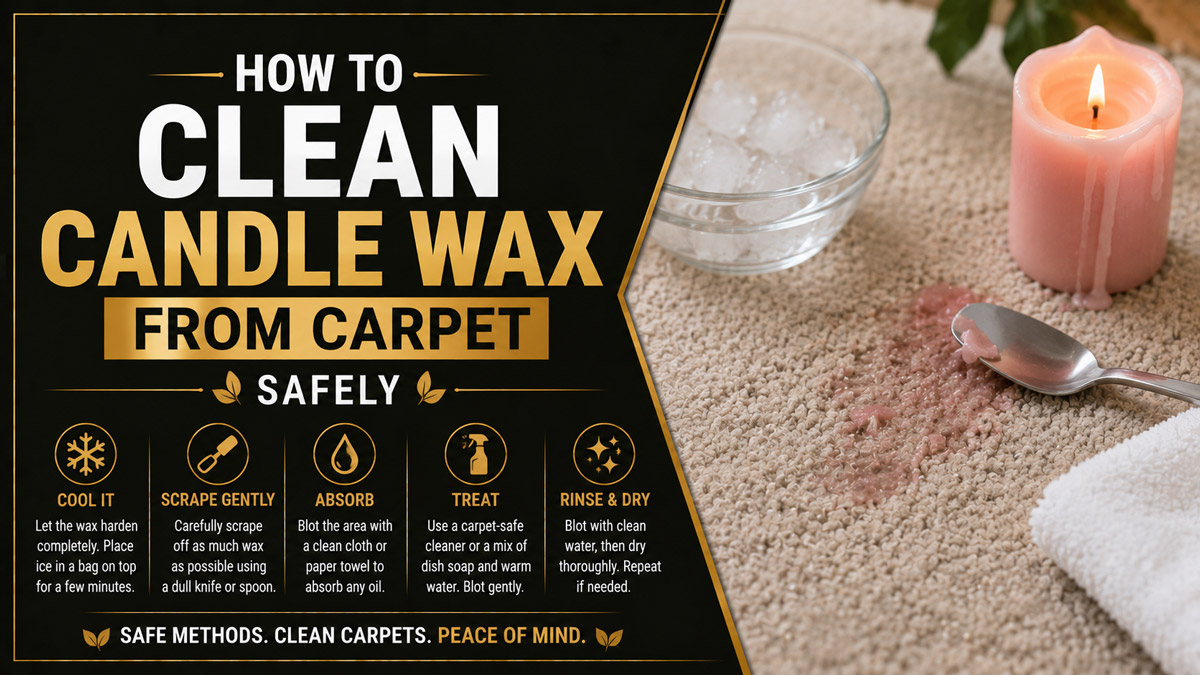
To clean candle wax from carpet, harden the spill with ice, lift away the brittle pieces, then transfer the remaining wax into plain white paper using controlled low heat. Treat any dye or oily film separately with a tested carpet-safe product. The complete process usually takes 15-30 minutes and depends mainly on carpet fiber and wax depth.
Key Facts
Candle wax is a thermoplastic solid that softens when heated and can be absorbed by paper.
Ice makes surface wax brittle, so scraping removes bulk material without spreading it.
An iron must be dry, continuously moving, and set to the lowest effective heat.
Printed paper, steam, high heat, and aggressive scrubbing can create secondary damage.
Colored wax may leave dye after the wax disappears, especially on pale or porous carpet.
Wool, silk, antique, hand-knotted, and glued carpets require more conservative treatment.
Before You Start
Candle wax removal requires approximately 15-30 minutes, basic household materials, and a controlled work area. The lowest-risk setup includes a plastic-bagged ice pack, a dull scraper, a vacuum, plain white absorbent paper, a dry iron, white cloths, and a carpet-safe spot-treatment product.
| Item | Typical quantity or setting | Purpose |
|---|---|---|
| Ice pack or ice cubes | 1 pack, 10-15 minutes | Harden the wax |
| Plastic bag | 1 leakproof bag | Keep carpet dry |
| Dull butter knife or scraper | 1 tool, 10-15 cm blade | Lift brittle wax |
| Plain white paper towel | 4-10 sheets | Absorb melted wax |
| Dry clothes iron | Lowest setting, no steam | Soften remaining wax |
| White microfiber cloths | 2-4 cloths | Blot residue and dye |
| Vacuum cleaner | 1 pass before and after | Remove flakes and restore pile |
| Carpet-safe spot cleaner | 5-10 ml maximum | Treat remaining film |
Work in a ventilated room and keep the iron away from children, pets, curtains, and flammable candle materials. Read the carpet manufacturer’s care label first. A small hidden patch test is mandatory before using alcohol, detergent, solvent, or oxygen-based cleaner.
Do not begin with a wet cleaner. Water does not dissolve paraffin, and excess moisture can spread oily material through the backing.
Why the Heat-Transfer Method Works
The heat-transfer method works because candle wax changes from a solid to a mobile liquid while absorbent paper removes the softened material by capillary action. Candle wax commonly contains paraffin, soy wax, beeswax, stearin, fragrance oil, and colorant, so the visible spill and the remaining residue may require different treatments.
Cold treatment removes the thick upper layer mechanically. Controlled warmth then softens wax trapped around individual carpet tufts, while paper provides a cleaner destination than the surrounding fibers. The method is effective only when the heat is moderate and the paper is replaced frequently.
Wax temperature varies by formulation. A typical paraffin candle softens around 45-65°C, while some blends behave differently because fragrance oils, additives, and pigments change the melting range. Carpet fibers also have different heat tolerances, so the iron setting must never be chosen from the candle label alone.
Practitioner rule: The paper should receive the wax, not merely cover it. If melted wax spreads beyond the paper’s edge, stop heating, reposition a larger barrier, and reduce the heat.
How to Clean Candle Wax From Carpet
Follow the six-step process below to remove the bulk wax, extract embedded material, and treat the residue without spreading the mark. The success factor is controlled transfer: every stage should move wax from carpet to a disposable or washable absorbent surface.
Step 1: Harden and Lift the Bulk Wax
Place ice cubes or a cold pack inside a sealed plastic bag and set it over the wax for 10-15 minutes. Once the wax feels hard and brittle, angle a dull butter knife, spoon edge, or carpet scraper under the raised pieces and lift them with short strokes.
Avoid a sharp knife because it can cut pile loops, slice the backing, or pull tufts from a looped carpet. Place the removed pieces on paper rather than dropping them beside the spill. Vacuum the area using a nozzle held just above the carpet.
You will know Step 1 worked when most raised wax has disappeared and only a thin, bonded film remains. The common mistake is scraping while the wax is still flexible, which presses it deeper into the pile.
Step 2: Protect the Carpet and Surrounding Area
Place a sheet of plain white paper towel, unprinted brown kraft paper, or a clean white cotton cloth over the remaining spot. Extend the barrier at least 5 cm beyond the visible wax so a softened edge cannot migrate into clean carpet.
Do not use newspaper, glossy advertising paper, printed grocery bags, colored towels, or patterned fabric. Heat and moisture can release ink or dye from those materials. If the spill is larger than one paper towel, overlap several sheets and tape the outer edges to the surrounding floor, never to the carpet pile.
Cover nearby furniture legs with foil or a towel if the iron cord could pull against them. You will know the barrier is adequate when the entire wax area sits beneath absorbent material with no exposed edge.
Step 3: Transfer Wax With Controlled Heat
Set a dry clothes iron to its lowest effective setting, turn off steam, and allow the soleplate to reach temperature. Press the iron lightly over the paper for 5-10 seconds, lift it, and inspect the paper. Use short passes rather than holding the iron in one place.
If no wax transfers, increase heat only one small setting at a time, while testing after each 5-second pass. Keep the iron moving over the protected area and never leave it stationary for more than a few seconds. A hairdryer on low can replace the iron when access is awkward, but it requires slower work and careful airflow control.
You will know the transfer is working when a translucent or greasy patch appears on the paper. The common mistake is using high heat because the wax melts faster; synthetic fibers can flatten, fuse, or develop a permanent shiny patch.
Step 4: Rotate the Absorbent Surface
Lift the paper after every pass and move a clean section over the wax. Replace saturated paper immediately because a wax-loaded surface can return liquid wax to the carpet. Continue for 2-8 cycles, depending on spill size and depth.
For a large spill, work from the outside toward the center with separate paper sections. That direction limits lateral spread. Do not rub the paper across the carpet, since friction distributes softened wax across neighboring tufts.
You will know the thermal extraction is complete when three consecutive 5-second passes leave no translucent mark on clean paper. A faint dark outline may remain because of dampness, crushed pile, or dye rather than removable wax.
Step 5: Treat Oily Film and Candle Dye
Identify the remaining mark before applying a cleaner. A greasy, translucent patch indicates wax oil; a sharp pink, red, blue, or green mark indicates pigment; a flattened dark patch may be compressed pile rather than contamination.
For a small oily film, mix approximately 2 ml of clear dishwashing liquid with 250 ml of lukewarm water. Dampen a white cloth, wring it almost dry, and blot from the outside toward the center. Follow with a second cloth dampened with plain water to remove detergent, then blot dry.
For dye, apply rubbing alcohol to a white cloth rather than pouring it directly onto carpet. Use 1-2 ml at a time, blot for 10-15 seconds, and inspect the cloth after each pass. Stop if carpet color transfers to the cloth, because the cleaner is then removing the carpet dye as well as the candle pigment.
You will know the treatment is controlled when the cloth lifts color without creating a wet halo. The common mistake is saturating the spot, which pushes dye into the backing and increases drying time.
Step 6: Rinse, Dry, and Restore the Pile
Blot the treated area with a barely damp white cloth, then press a dry towel over it for 30-60 seconds. Replace the towel when it feels damp. Do not pour water onto the carpet or use a steam cleaner during wax removal.
Place a dry towel over the spot and weigh it with a flat, non-staining object for 15-30 minutes if moisture remains. Remove the weight, allow the carpet to air-dry completely, and vacuum in two directions to lift compressed fibers.
You will know the job is finished when the carpet is dry, the paper shows no wax transfer, and the pile looks consistent from several viewing angles. Vacuuming before complete drying can redistribute loosened residue.
Which Wax-Removal Method Fits Your Carpet?
The iron-and-paper method is usually the fastest option for low-pile nylon or polyester carpet, while ice and scraping is safer for heat-sensitive rugs. A hairdryer offers more gradual warming, but commercial solvents are better reserved for residual film or professional use after spot testing.
| Method | Working temperature or condition | Typical time | Best use | Main risk |
|---|---|---|---|---|
| Ice and scrape | 0-10°C surface cooling, 10-15 minutes | 20-40 minutes | Thick wax and delicate pile | Pulling loops while scraping |
| Iron and paper | Lowest dry setting, 5-10 seconds per pass | 15-30 minutes | Standard synthetic carpet | Fiber melting or flattening |
| Hairdryer and paper | Low airflow, 10-20 cm away | 20-35 minutes | Edges and confined spaces | Blowing liquid wax outward |
| Carpet-safe solvent | Room temperature, 1-2 ml test amount | 15-30 minutes | Residual oil or dye | Color loss and backing damage |
| Professional extraction | Technician-selected process | 1-3 days including scheduling | Valuable or damaged rugs | Treatment cost |
An iron gives the strongest transfer because its soleplate delivers concentrated heat, but that advantage becomes a liability on polypropylene or heat-sensitive fibers. A hairdryer is slower and less efficient for deep wax, yet its distance from the carpet makes overheating easier to avoid.
Commercial solvent is not automatically superior. Many products dissolve oily residue but do little for solid wax, and some contain ingredients that affect latex backing or carpet dye. Remove the bulk mechanically and thermally before testing a solvent.
Carpet Material and Fiber-Specific Adjustments
Carpet fiber determines whether controlled heat is appropriate, and the backing determines whether liquid treatment can cause permanent delamination or staining. When the material is unknown, use ice and scraping first, then test any heat on an inconspicuous area.
| Carpet material | Heat approach | Chemical caution | Safer default |
|---|---|---|---|
| Nylon | Lowest dry setting, 5-second checks | Test alcohol and detergent | Ice followed by paper transfer |
| Polyester | Lowest setting only | Avoid prolonged heat | Ice, paper, and brief warming |
| Olefin or polypropylene | Prefer no direct iron | Heat can deform or glaze fibers | Ice and professional advice |
| Wool | Avoid direct high heat | Use wool-safe, pH-neutral products | Blot and contact a rug cleaner |
| Silk or viscose | Avoid heat and water | Dye bleed and texture change are common | Professional rug treatment |
| Antique or hand-knotted rug | No untested solvent | Backing and natural dyes may react | Conservator or specialist cleaner |
Wool can tolerate some warmth, but tolerance does not make an iron the correct first choice. Natural dyes, rug construction, and previous treatments matter more than the fiber label alone. Silk and viscose can develop irreversible texture changes from moisture, rubbing, or localized heat.
A glossy, melted, or stiff patch indicates physical fiber damage rather than leftover wax. Cleaning cannot restore fused synthetic filaments. A professional may trim damaged tips, reweave a small area, or install a matching patch.
How to Remove Candle Dye and Greasy Residue
Candle dye requires blotting after wax extraction, while greasy residue requires limited detergent and a controlled rinse. Removing wax and removing its color are separate tasks, so repeating the iron process will not necessarily lighten a pigment stain.
Use this diagnostic sequence:
- Check for transfer. Press a clean white cloth on the dry spot. A greasy mark suggests oil; visible color suggests dye.
- Patch-test the product. Test alcohol, oxygen-based cleaner, or carpet detergent in a hidden area for 10 minutes.
- Blot, never scrub. Work from the perimeter inward and use a new cloth section after each pass.
- Limit liquid. Apply enough to dampen the cloth, not enough to wet the backing.
- Rinse and dry. Remove detergent with a barely damp cloth and press dry towels onto the area.
Avoid chlorine bleach, acetone, nail-polish remover, paint thinner, and undiluted degreasers. These chemicals can strip carpet color, dissolve backing adhesives, or create a larger repair than the original wax spot.
Oxygen-based carpet products may help with some colored candle stains, but the product label must specifically allow the carpet fiber. Do not combine alcohol, peroxide, bleach, ammonia, or solvent products.
What Are the Time and Cost Requirements?
A small surface spill typically costs $0-$10 to treat at home and takes 15-30 minutes, excluding drying time. A large, colored, deeply embedded, or valuable-rug spill can require $50-$200 or more for professional service, depending on location, rug construction, travel, and repair needs.
| Situation | Home-treatment time | Typical home cost | Professional range | Likely difficulty |
|---|---|---|---|---|
| Fresh white wax, 10 cm spot | 15-20 minutes | $0-$5 | $50-$100 | Low |
| Hardened colored wax, 10-20 cm spot | 25-45 minutes | $3-$15 | $75-$150 | Moderate |
| Wax pressed into thick shag | 30-60 minutes | $0-$15 | $100-$200 | High |
| Wool or silk rug | 20 minutes for containment | $0-$10 | $100-$300 | High |
| Melted synthetic fibers | 30 minutes for assessment | $0-$10 | $75-$250 for repair | High |
Drying may take 2-8 hours in a normally ventilated room when only a small amount of rinse water is used. A saturated carpet can take 24-48 hours and carries a higher risk of odor, backing damage, and microbial growth.
Common Mistakes and How to Fix Them
Using a Hot Iron or Steam
High heat can melt synthetic carpet and flatten the pile, while steam adds moisture without improving wax transfer. Stop immediately if the carpet develops shine, stiffness, curl, or a plastic odor.
Allow the area to cool, then inspect the fibers. If strands have fused, cleaning will not reverse the damage. Carefully trimming only the raised damaged tips may improve appearance, but a patch is often the better repair for visible areas.
Scrubbing Melted Wax
Scrubbing spreads liquefied wax sideways and drives pigment between tufts. Blotting is the correct replacement because it lifts material vertically into a cloth or paper surface.
If scrubbing has spread the mark, let the carpet cool, harden the remaining wax again with ice, and remove the outer contamination before repeating small, controlled transfers.
Using Printed or Colored Paper
Ink and towel dye can transfer when warmed, creating a second stain that resembles candle pigment. Replace the material with plain white paper or an unbleached, unprinted brown paper bag.
If ink has transferred, do not heat the spot again. Test a small amount of rubbing alcohol on white cloth, but stop if the carpet’s own color lifts.
Pouring Cleaner Directly Onto the Carpet
Direct application over-wets the pile and may carry dye into the backing. Apply product to a cloth in measured amounts instead.
If the area is saturated, press dry towels onto it without rubbing and ventilate the room. Avoid adding another chemical until the carpet is dry and the product label has been checked.
Removing Wax but Ignoring the Backing
Wax can travel below the visible pile, particularly when a candle has been stepped on or furniture has compressed the spill. A dark outline may reappear as the carpet warms.
Do not flood the backing to chase an unseen deposit. Extract what transfers safely, then request professional inspection if odor, recurring grease, or a spreading halo develops.
Variations for Difficult Locations
Wax Near a Wall or Furniture Leg
Use a hairdryer on low from 10-20 cm away and hold paper against the carpet with a wooden ruler or flat spoon. Warm a section no larger than 5 cm at a time, because restricted access makes lateral spreading more likely.
Protect wood, paint, and upholstery from heat. A narrow iron tip should not be forced into a corner where the soleplate can touch the baseboard.
Wax on Thick Shag or High-Pile Carpet
Freeze the spill longer, often 15-20 minutes, and remove accessible chunks with fingers covered by a disposable glove. Separate the pile gently with a comb before using paper and heat.
Work in sections of approximately 5 cm. Thick pile retains wax below the surface, so repeated short transfers are safer than one prolonged heating cycle.
Wax Melted Into Carpet by a Foot or Chair
Remove pressure from the area and let the carpet cool fully before scraping. If wax has entered the backing, surface extraction may remove the visible deposit while leaving a greasy shadow.
Use the smallest practical amount of detergent after thermal extraction. Persistent recurrence indicates contamination below the pile and is a reasonable point to call a professional.
When to Stop and Call a Professional
Professional cleaning is the safer choice for silk, viscose, antique, hand-knotted, heavily dyed, or high-value rugs, and for carpet with unknown fiber content. It is also appropriate when the wax covers more than approximately 30 cm, has entered the backing, or has caused visible fiber melting.
Stop home treatment when any of these conditions appears:
- Carpet color transfers to a white test cloth.
- The backing becomes wet despite minimal application.
- A chemical produces a halo, bleaching, or sticky texture.
- The wax remains after three controlled paper-transfer cycles.
- The carpet develops a plastic smell, glaze, or fused tufts.
- The rug has sentimental, antique, or high replacement value.
A carpet cleaner can select a solvent, low-moisture process, hot-water extraction, or repair method based on fiber and backing. Tell the technician the wax type, candle color, products already used, and whether heat was applied.
The Bottom Line
The safest general method for how to clean candle wax from carpet is ice and scraping followed by low, dry heat through plain white paper. Extract the solid wax first, transfer the embedded film in short passes, and treat dye or grease only after the wax is gone. Use no steam, high heat, printed paper, or aggressive scrubbing.
For unknown, natural, delicate, or valuable carpet, stop after cold removal and seek professional advice. A clean result depends less on melting the wax quickly than on controlling where the melted wax goes.
FAQ
Can I use a brown paper bag instead of paper towels?
Yes. A plain, unprinted brown kraft paper bag can absorb softened wax, provided it has no ink, plastic coating, grease, or food residue. Cut the bag flat, place the clean interior against the carpet, and replace it when a translucent wax mark appears.
How do I remove candle wax from carpet without an iron?
Use ice and a dull scraper to remove the bulk, then warm the remaining wax with a hairdryer on low while holding white paper over the spot. Keep the dryer 10-20 cm away and move it continuously. The process takes longer than an iron but offers more gradual heat control.
Does rubbing alcohol remove red candle wax?
Rubbing alcohol can help remove red candle dye after the solid wax has been extracted, but it does not replace the scraping and heat-transfer steps. Apply 1-2 ml to a white cloth, blot inward, and stop if the carpet’s own color transfers.
Can I use a vacuum cleaner on candle wax?
Use a vacuum after the wax has been chilled and scraped into loose pieces. Do not vacuum liquid or warm wax, because it can coat the hose, filter, brush roll, and internal components. A nozzle held just above the carpet removes brittle flakes safely.
Will carpet cleaning remove a wax stain completely?
Professional carpet cleaning can remove much of the wax and residue, but it cannot restore fibers that heat has melted or dyes that have permanently altered the carpet. Tell the cleaner whether the spill is paraffin, soy, or beeswax and whether it contains red or dark pigment.
How do I remove wax from a rental carpet?
Photograph the spill before treatment, check the rental agreement, and use the lowest-risk ice-and-paper process on a small synthetic carpet spot. Avoid untested solvents and high heat. If the carpet color lifts or the fibers change texture, stop and report the issue rather than expanding the damage.