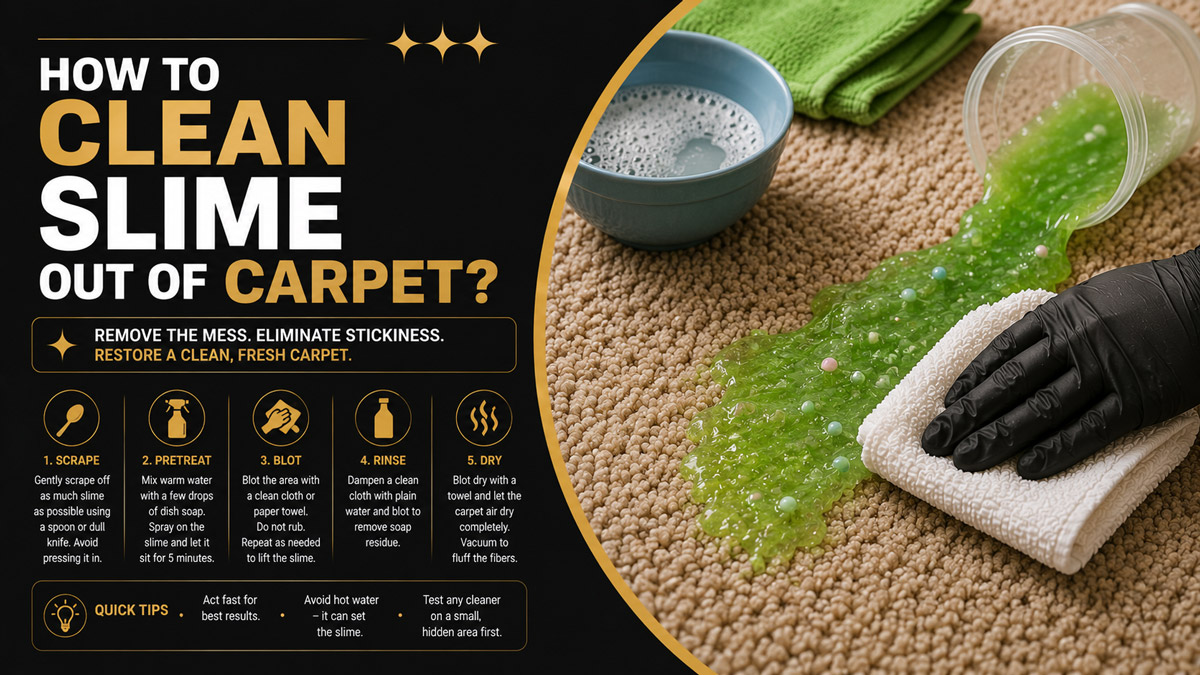
To clean slime out of carpet, first lift away as much slime as possible, then soften the remaining residue with a small amount of an appropriate cleaning solution, blot it out, rinse the treated fibers, and dry them thoroughly. For many synthetic carpets, diluted white vinegar works well, but carpet type, dye stability, slime age, and moisture control determine whether it is the right choice.
Key Facts: At a Glance
- Remove bulk slime mechanically before adding liquid cleaner.
- Blot carpet fibers instead of scrubbing them aggressively.
- Pretest every cleaner in a hidden area before treating the stain.
- A common DIY mixture is 2 parts white vinegar to 1 part water.
- Keep cleaning liquid in the carpet pile rather than saturating the backing.
- Treat leftover dye as a separate stain after the slime itself is gone.
Before You Start
A small slime spot on ordinary synthetic residential carpet is usually a 20-45 minute hands-on job, although complete drying can take several hours. The procedure is easy to moderate when the slime remains in the surface pile, but becomes harder if it has dried around individual fibers or soaked into the backing.
The Carpet and Rug Institute advises homeowners to pretest spot treatments, apply small amounts, work from the outer edge toward the center, and rinse remaining cleaning product from carpet after treatment. Its concise practitioner rule is: “Blot; don’t scrub.”
Tools and materials
For a stain roughly the size of your hand, prepare:
- 2-4 clean white cloths or plain white paper towels
- 1 spoon, plastic scraper, or dull butter knife
- 1 small bowl or spray bottle
- About 1/3 cup white vinegar
- About 2-3 tablespoons water
- 1 cup clean rinse water
- 1 dry towel
- A soft carpet-safe brush, optional
- Ice cubes in a sealed bag, optional for chunky dried slime
- Carpet-safe spot cleaner, optional alternative
Avoid colored towels because moisture and cleaning agents can sometimes transfer unstable towel dye to the carpet.
| Item | Typical quantity for one small spot | Typical DIY cost |
|---|---|---|
| White vinegar | 1/3 cup | Under $1 of product |
| White cloths | 2-4 | $0 if already owned |
| Plastic scraper or spoon | 1 | $0-$5 |
| Carpet spot cleaner | 8-32 oz bottle | About $8-$25 |
| Ice | 4-8 cubes | Under $1 |
| Hands-on cleaning time | 20-45 minutes | $0 labor |
| Drying period | Roughly 2-12 hours | Depends on humidity and airflow |
These are practical household ranges rather than fixed prices. Professional service charges vary considerably by location, minimum service fee, carpet type, stain size, and whether extraction of the carpet backing or pad is required.
How to Clean Slime Out of Carpet in 7 Steps
The most reliable process is lift, test, soften, separate, blot, rinse, and dry. Success depends less on force than on removing the slime in stages, because aggressive scraping or repeated scrubbing can damage the carpet before the residue has softened enough to release.
Step 1: Lift Off the Thickest Slime
Use a spoon, plastic scraper, or dull knife to lift as much slime as possible without pulling carpet yarns. Work from the outside of the deposit toward the center so the contaminated area does not grow.
For wet slime, scoop from underneath rather than smearing the surface. For rubbery slime, pinch or lift larger pieces after loosening their edges.
You’ll know it worked when: most of the three-dimensional blob is gone and only a film or material trapped between fibers remains.
Common mistake: pressing the scraper downward. That drives soft slime toward the backing instead of lifting it.
The Carpet and Rug Institute similarly recommends scraping or scooping semi-solid spills before treating the remaining spot.
Step 2: Blot Fresh Moisture Without Rubbing
Press a dry white cloth onto fresh slime residue to transfer moisture and loose material. Lift the cloth vertically, reposition it to a clean section, and repeat.
Do not scrub rapidly from side to side. Mechanical friction can spread the contaminant, distort carpet tufts, and make the cleaned area look different even when the stain is gone. CRI’s stain-care guidance specifically favors blotting because it pulls material into an absorbent towel without unnecessarily disturbing carpet fibers.
You’ll know it worked when: the cloth removes progressively less slime.
Common mistake: using the same dirty part of the towel repeatedly, which simply redeposits material.
Step 3: Test the Cleaner in a Hidden Area
Apply a few drops of your chosen solution to an inconspicuous section, such as carpet inside a closet or behind furniture. Blot with a clean white cloth and inspect both the cloth and carpet after several minutes.
Stop if carpet dye transfers noticeably to the cloth, the fiber changes texture, the backing becomes tacky, or the treated area develops an obvious color shift. Carpet composition matters, so a solution that behaves normally on solution-dyed synthetic carpet should not automatically be assumed safe for wool, viscose, plant fibers, or specialty rugs.
CRI also recommends testing spot-removal agents for color transfer or carpet damage before treating the visible stain.
You’ll know it worked when: the test area dries without visible color or texture change.
Step 4: Soften the Remaining Slime
For a compatible synthetic carpet, mix 2 parts white vinegar with 1 part water. For example, combine 1/3 cup vinegar with about 2 tablespoons plus 2 teaspoons water.
Apply just enough solution to dampen the slime-containing pile. Do not pour a large volume through the carpet.
Allow about 5-10 minutes for the residue to soften. Check the stain rather than treating the clock as absolute. When the slime changes from rubbery or sticky to softer material that releases under gentle movement, it is ready for the next step.
BISSELL’s published slime-removal guidance also uses a 2:1 vinegar-to-water mixture. The Carpet and Rug Institute separately identifies household white vinegar as approximately 5% acetic acid and gives a one-part-vinegar-to-two-parts-water mixture for certain carpet spot-removal situations, showing why manufacturer instructions and carpet compatibility should outrank any universal DIY ratio.
Common mistake: assuming stronger vinegar or more liquid always cleans faster. More moisture can create a bigger extraction problem without improving removal.
Step 5: Loosen and Blot the Softened Residue
Gently separate softened slime from the fibers using your fingers through a cloth, a spoon edge, or a soft carpet-safe brush. Use short controlled movements rather than vigorous scrubbing.
Blot immediately with a fresh white cloth. Rotate the cloth whenever slime transfers onto it.
Repeat the soften-and-blot cycle if necessary. One controlled second application is usually preferable to flooding the carpet once.
You’ll know it worked when: the carpet fibers separate normally and the towel stops collecting sticky or gelatinous residue.
Common mistake: continuing to scrub because a colored shadow remains. The slime may already be removed, leaving only its dye behind. Dye requires a different treatment.
Step 6: Rinse Out the Cleaning Residue
Dampen a clean white cloth with cool or lukewarm water and blot the treated area several times. The goal is to dilute and remove leftover vinegar, detergent, or spot-cleaning product without saturating the carpet.
CRI states that incomplete rinsing can leave cleaning solution in carpet fibers and contribute to accelerated resoiling. Its general carpet-care guidance recommends blotting with clear water after the spot is removed.
You’ll know it worked when: the fibers no longer feel sticky and the towel picks up little or no cleaning residue.
Common mistake: treating rinsing as optional. A cleaner can remove slime successfully yet leave residue that attracts soil later.
Step 7: Extract Moisture and Let the Carpet Dry
Place a folded dry white towel over the cleaned area and press firmly to absorb moisture. Replace it with a dry section and repeat until little water transfers.
Then expose the carpet to normal airflow. A fan directed across the area can shorten drying time. Do not replace furniture over damp carpet.
Vacuum only after the fibers have dried enough to move freely. Vacuuming helps separate and realign the pile after spot cleaning.
You’ll know it worked when: the carpet feels dry through the pile rather than merely dry on the tips.
Which Slime Removal Method Works Best?
No single method is best for every carpet. Diluted vinegar is practical for many glue-based slime deposits on compatible synthetic carpet, ice is useful for thick surface material, carpet-approved spot cleaner is preferable when warranty instructions specify it, and solvent treatments should be reserved for specific remaining stains rather than used as a default first step.
| Method | Best use | Working time | Main limitation |
|---|---|---|---|
| Diluted white vinegar | Glue-based slime on compatible synthetic carpet | 5-10 min dwell | Must be pretested and rinsed |
| Ice in sealed bag | Thick, gummy surface slime | 5-15 min | Less useful for thin residue between fibers |
| Carpet-approved spot cleaner | Manufacturer-compatible treatment | Label-specific | Formula and fiber compatibility vary |
| 70% isopropyl alcohol on cloth | Selected pigment or ink-like residue | 1-5 min cycles | Can affect backing or finishes if overapplied |
| Mild detergent solution | Light remaining soil after bulk removal | 2-5 min | May leave residue without thorough rinse |
| Professional extraction | Large or backing-level contamination | Service dependent | Higher cost than DIY |
Is Vinegar Really the Best Slime Cleaner?
Vinegar is useful, but calling it universally “the best” is too broad. Household slime formulas, carpet fibers, dyes, adhesives, stain-resistant treatments, and backing systems vary.
For ordinary synthetic carpet that passes a hidden-area test, diluted white vinegar is a reasonable first-line option because manufacturers such as BISSELL publish vinegar-based slime-removal instructions. CRI also recognizes diluted white vinegar in carpet spotting guidance, although its specified dilution varies by stain type.
The practical rule is therefore simple: use the weakest compatible treatment that releases the slime, and control the amount of moisture.
Does Ice Work on Slime?
Ice can help when a thick piece of slime remains gummy enough to stretch during scraping. Place ice in a sealed plastic bag and hold it against the slime for several minutes, then try lifting the firmer material with a dull scraper.
Ice is less useful when the visible blob is gone and only a thin film remains between individual carpet fibers. At that stage, controlled softening and blotting usually provide more access to the residue.
Do not rub melting ice directly into the carpet. The goal is temperature change, not extra water.
How Do You Remove Dried Slime From Carpet?
Dried slime should usually be softened before aggressive scraping. Start by lifting only material that releases easily, then introduce a small quantity of carpet-compatible moisture so the remaining residue can become flexible enough to remove without pulling fibers.
First, vacuum loose dry crumbs if they detach freely. Next, pretest your cleaning solution. Dampen the dried residue and allow several minutes of contact, then gently flex or lift it with a dull tool.
For a stubborn patch, place a damp white cloth over the residue for 10-20 minutes, checking periodically. Reapply only enough liquid to maintain contact with the surface fibers.
Avoid digging a knife beneath a hard deposit that is tightly wrapped around carpet yarns. The slime may be stronger than the individual fibers at that moment.
Should You Scrape Bone-Dry Slime?
Scrape only pieces that release with minimal resistance. If dried slime has bonded around several yarns, soften it first.
That distinction improves on the common instruction to either “scrape everything dry” or “never scrape dry slime.” Both are too absolute. Loose brittle pieces can be removed mechanically, while strongly adhered material should be softened before further manipulation.
What If the Slime Is Gone but Color Remains?
A colored shadow after slime removal is usually a separate staining problem, so stop treating it as if more slime remains. First rinse away the original cleaning product and let the area approach normal moisture levels before deciding whether pigment treatment is necessary.
If the carpet manufacturer permits solvent spotting, 70% isopropyl alcohol may be appropriate for certain dye-like residues. Apply it to a white cloth rather than pouring it onto the carpet.
CRI gives that same application precaution when recommending 70% isopropyl alcohol for ballpoint ink: put the alcohol on a cloth or paper towel, not directly onto the carpet.
Do not automatically use hydrogen peroxide, bleach, acetone, nail-polish remover, or concentrated solvent on a colored carpet. Oxidizers can alter carpet dye, while strong solvents may affect backing components or finishes.
What If Glitter Remains?
Let the carpet dry first, then vacuum loose glitter using repeated passes from different directions. Sticky glitter trapped in remaining slime should be removed with the slime rather than brushed farther through the pile.
A lint roller can lift surface glitter after drying, but use light pressure so adhesive from the roller does not transfer to the carpet.
Can You Clean Slime Without Vinegar?
Yes. The best vinegar-free choice is usually a carpet spot-removal product approved for the carpet type, followed by controlled rinsing and blotting according to its label.
Ice can also remove thick surface material without adding a chemical cleaner. Mild detergent may help with light residue when the carpet manufacturer permits it.
The Carpet and Rug Institute’s general spotting guidance provides a simple detergent reference for some household spills: approximately 1/4 teaspoon of clear dishwashing liquid in 1 cup of water, followed by cool-water blotting and drying. That does not make dish soap a universal slime formula, but it illustrates how dilute carpet spotting solutions normally are.
Should You Mix Baking Soda and Vinegar?
Do not assume the dramatic fizz means the mixture cleans slime better. Baking soda is alkaline and vinegar is acidic, so combining them consumes much of the acid while producing carbon dioxide bubbles.
BISSELL itself notes in separate cleaning guidance that baking soda and vinegar can neutralize each other’s useful properties when combined.
If vinegar is being used specifically to soften glue-based slime, applying a layer of baking soda at the same time can therefore work against the goal of maintaining an acidic solution.
Can Vinegar Damage Certain Carpets?
Yes. A cleaning method that works on one carpet construction can damage another, especially when natural fibers, unstable dyes, specialty finishes, handcrafted rugs, or unknown backing materials are involved.
WoolSafe warns that stain-removal advice cannot be transferred blindly between fiber types. Its January 2026 technical commentary specifically notes that a method tolerated by polypropylene carpet can cause significant damage to natural-fiber carpet.
| Carpet or rug type | DIY approach | Main precaution |
|---|---|---|
| Nylon synthetic carpet | Pretest, then controlled spot treatment | Verify dye stability |
| Polyester or PET carpet | Pretest and blot | Avoid excessive liquid |
| Polypropylene/olefin | Usually moisture tolerant, still pretest | Backing may remain moisture-sensitive |
| Wool carpet | Prefer wool-approved chemistry | Avoid improvised aggressive treatments |
| Viscose/rayon rug | Professional care strongly preferred | Water can cause texture and color problems |
| Jute or sisal | Minimize moisture, seek specialist advice | Natural plant fibers can distort or brown |
| Handmade or valuable rug | Stop after safe surface removal | Construction and dyes may require specialist cleaning |
The material table is a decision guide, not a substitute for the carpet manufacturer’s care instructions.
Does Hot Water Permanently Set Slime?
The claim that hot water universally “cooks the proteins and polymers” in slime is misleading. Many common homemade slimes are based primarily on glue polymers and borate chemistry, not protein, so there is no single protein-setting mechanism that explains every slime stain.
Extremely hot water is still unnecessary. It increases moisture and heat exposure without offering a clear advantage over cool or lukewarm spot cleaning.
For household carpet care, CRI frequently recommends cool or lukewarm water for rinsing spot treatments.
Use cool to lukewarm water, not boiling water. The reason is controlled carpet care, not a universal rule that hot water permanently “cooks” all slime.
Common Mistakes and How to Fix Them
1. Scrubbing Before Removing the Bulk Slime
Problem: Soft slime spreads into surrounding tufts.
Fix: Stop scrubbing, lift surface material with a spoon, then blot the expanded area from the edges toward the center.
2. Pouring Too Much Vinegar or Water
Problem: The pile becomes saturated and liquid reaches the backing or pad.
Fix: Press dry towels into the carpet repeatedly. Increase airflow and delay further wet treatment until excess moisture has been extracted.
3. Assuming a Colored Shadow Means Slime Remains
Problem: Repeated cleaning exposes carpet fibers to unnecessary chemistry and abrasion.
Fix: Test the area for stickiness. If the fibers feel clean but remain colored, switch to a dye-stain strategy instead of repeating slime removal.
4. Pouring Rubbing Alcohol Directly on the Carpet
Problem: Solvent can travel beyond the stain and reach underlying materials.
Fix: Put a small amount on a white cloth and blot only the affected fibers. CRI specifically recommends cloth application rather than direct pouring when using isopropyl alcohol as a carpet spotter.
5. Skipping the Final Rinse
Problem: Dried cleaning residue can leave fibers stiff or encourage rapid resoiling.
Fix: Blot several times with a clean cloth dampened with clear water, then towel-dry the area. CRI advises clear-water rinsing after spot removal.
6. Treating Wool Like Synthetic Carpet
Problem: A DIY treatment can create permanent color or texture damage that costs more to repair than the original slime stain.
Fix: Remove loose surface material carefully, identify the fiber, and use a wool-compatible product or professional cleaner. WoolSafe explicitly cautions that cleaning techniques are not interchangeable across fiber types.
Three Practitioner Rules That Prevent Most Damage
Rule 1: Remove material before treating color. The sticky slime and its pigment are related but separate cleaning problems. Finish bulk residue removal before escalating to a dye-removal product.
Rule 2: Moisture quantity matters as much as chemistry. A mild cleaner used sparingly can be safer than the “perfect” cleaner poured through the carpet.
Rule 3: Stop when the carpet changes rather than the stain. Dye transfer, pile distortion, fuzzing, backing softening, or texture change is a signal to end DIY treatment even if discoloration remains.
How Long Does Slime Removal Take and What Does It Cost?
A small, recent surface stain may take 20-30 minutes of active work, while dried or deeply embedded slime can require 45-60 minutes of repeated softening and blotting. Drying can extend the total elapsed project into several hours.
| Situation | Hands-on time | Expected supplies |
|---|---|---|
| Fresh small slime spot | 15-30 min | Cloths, scraper, cleaner |
| Semi-dried slime | 25-45 min | Cleaner plus repeated blotting |
| Fully dried residue | 30-60 min | Softening, scraper, towels |
| Slime plus dye stain | 30-75 min | Separate pigment treatment |
| Large backing-level spill | Often not practical DIY | Professional extraction may be needed |
DIY material use for a single small spot is often only a few dollars if the household already has white vinegar, cloths, and a scraper. A commercial carpet spot cleaner commonly adds roughly $8-$25 to the purchase cost.
Professional pricing cannot be reduced to one trustworthy national number because many cleaners charge service minimums and price according to room size, fiber, access, treatment requirements, and extraction work.
When Should You Call a Professional Carpet Cleaner?
Stop DIY treatment when the stain covers a large area, moisture has reached the carpet pad, the carpet is wool or another sensitive natural fiber, dye transfers during testing, or repeated treatment changes the carpet texture without removing the stain.
Professional treatment is also sensible for handmade rugs, unknown fibers, expensive carpet, old stains previously treated with several chemicals, or slime containing paint, cosmetics, oil, or other additives.
A technician can identify whether the remaining problem is polymer residue, pigment, oily additive, carpet discoloration, or damage to the fiber itself. Those conditions require different treatments.
An important limitation applies here: even professional cleaning cannot “remove” color that has already been chemically stripped from carpet fiber. WoolSafe’s color-restoration guidance emphasizes that actual color loss must be restored rather than cleaned away.
FAQ
Can I leave vinegar on carpet overnight?
Leaving a wet vinegar treatment on carpet overnight is usually unnecessary. For slime, use a controlled contact period, blot the softened residue, rinse with clear water, and dry the area. Prolonged saturation creates more moisture-management risk without guaranteeing better removal.
Will slime come out after it has completely dried?
Yes, many dried slime deposits can still be removed. Lift loose brittle material first, then soften strongly adhered residue with a small amount of carpet-compatible cleaning solution. Work gradually so dried slime releases from the fibers instead of pulling carpet yarns out with it.
Can I vacuum slime out of carpet?
Vacuum only dry, loose fragments. Do not vacuum wet or sticky slime because it can smear inside the carpet pile and contaminate the vacuum’s airflow path, brush roll, hose, or collection system. Complete the wet cleaning process first, allow the carpet to dry, then vacuum the restored pile.
Will dish soap remove slime from carpet?
A very dilute clear dishwashing detergent can help remove some remaining residue, but it is not automatically the best treatment for glue-based slime. Use only a small concentration, pretest it, blot rather than scrub, and rinse thoroughly so surfactant does not remain in the carpet.
Why is the carpet still sticky after the slime is gone?
Persistent stickiness usually means slime polymer, detergent, or another cleaner remains between the fibers. Rewet the area lightly with clear water, blot with a clean white towel, and repeat. If stickiness continues after drying, reassess the residue before adding another chemical product.
Can slime permanently stain carpet?
Yes. The slime itself may be removable while concentrated dye, glitter coatings, paint, cosmetic pigment, or another additive leaves discoloration behind. Permanent color change is also possible if an unsuitable cleaner alters the carpet dye, which is why pretesting is more important than using the strongest available stain remover.
Conclusion
The safest way to clean slime out of carpet is to remove the bulk material first, soften only the residue that remains, blot rather than scrub, rinse away cleaning solution, and dry the carpet completely. Diluted vinegar can work well on compatible synthetic carpet, but it should never replace a hidden-area test or the manufacturer’s care instructions.
Fresh slime, dried slime, and leftover dye are three different cleaning situations. Treating each one separately reduces unnecessary moisture and chemical exposure. When the carpet is wool, natural fiber, handmade, heavily saturated, or visibly changing during treatment, stop DIY cleaning and use a fiber-appropriate professional method.