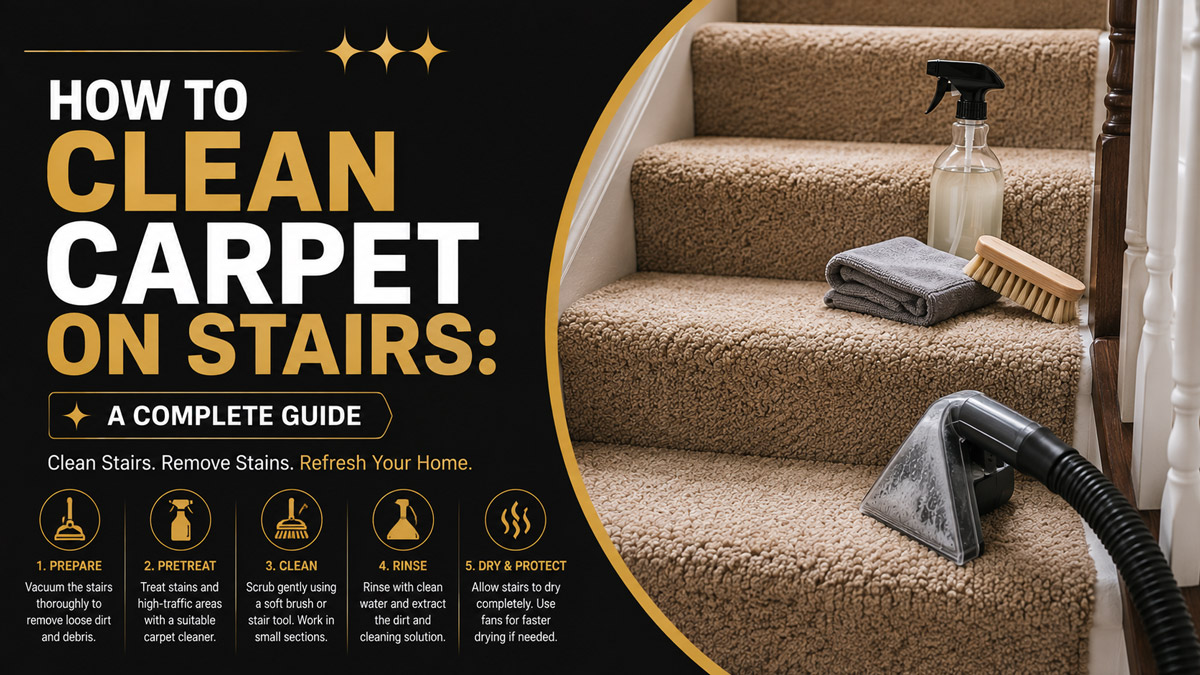
To clean carpet on stairs, vacuum every tread, riser, edge, and stair nose first, pretreat dirty areas for about 5-10 minutes, gently agitate the carpet, then rinse and extract the loosened soil with a stair or upholstery tool. Finish with several suction-only passes and strong airflow so the carpet dries without becoming saturated.
The hardest part is not applying cleaner. It is removing enough soil and moisture from the stair nose and compressed traffic areas without soaking the carpet backing or padding.
Key Facts at a Glance
- Vacuuming before wet cleaning removes abrasive dry soil that detergent alone cannot effectively extract.
- Stair noses usually need more attention because repeated foot impact compresses the carpet pile and embeds soil.
- Pretreatment commonly needs about 5-10 minutes of contact time, but the solution should not dry on the carpet.
- Extraction cleaning usually needs several suction-only passes after each wet pass.
- Typical extraction-cleaned carpet may take about 4-8 hours to dry, depending on airflow, humidity, carpet construction, and how much water was removed.
- More water does not produce a cleaner stair. Excess moisture increases the risk of wicking, odor, slow drying, and backing problems.
Before You Start
Most household staircases can be cleaned as a DIY project when the carpet is synthetic, securely installed, and affected primarily by normal soil or removable stains.
Stop before wet cleaning if the carpet is sisal, an unknown natural fiber, badly delaminated, loose around the stair nose, contaminated by a large pet accident, or already has a persistent musty odor. Those conditions need either specialized low-moisture treatment or professional assessment.
Typical DIY preparation
- Active cleaning time: about 3-5 minutes per stair, plus vacuuming and drying
- Difficulty: moderate
- Typical machine rental: about $35-$50 per day
- Typical cleaning formula: roughly $15-$25
- Typical professional charge: around $3-$6 per stair, often with a minimum service charge
- Typical extraction drying time: about 4-8 hours
- Main risk: overwetting the carpet, pad, or stair structure
What You Need
Gather everything before starting because moving equipment repeatedly on a staircase creates unnecessary trip hazards.
You may need:
- Vacuum with a hose and crevice attachment
- Small powered stair or upholstery vacuum tool, if available
- Carpet-safe pretreatment
- Trigger spray bottle
- Nylon carpet brush
- White microfiber towels
- Portable carpet extractor or machine with a hose attachment
- Carpet rinse or manufacturer-approved extraction formula
- Household fan or carpet air mover
- Carpet rake or clean nylon brush
- Gloves
- Small bucket of clean water for rinsing tools
A compact extractor is usually easier to control than carrying a full upright carpet cleaner from one step to another.
Identify the Carpet Before Adding Water
The carpet fiber affects how aggressively you can clean it.
Check the manufacturer’s documentation, installation records, or carpet label if available. If the material is uncertain, use the least aggressive cleaning method and test any chemical in an inconspicuous area first.
| Carpet type | Preferred approach | Moisture level | Main caution |
|---|---|---|---|
| Nylon cut pile | Extraction or low-moisture cleaning | Moderate | Avoid excess detergent |
| Polyester | Extraction or low-moisture cleaning | Moderate | Oily traffic soil may need pretreatment |
| Loop/Berber | Controlled extraction | Low-moderate | Do not aggressively brush loops |
| Wool | Wool-approved low-moisture or controlled extraction | Low | Avoid high alkalinity and excess heat |
| Sisal/natural plant fiber | Specialist dry or very low-moisture method | Very low | Water can cause distortion or discoloration |
| Unknown fiber | Spot-test and use conservative method | Low | Stop if color transfers or texture changes |
A hidden test matters even when a cleaner says it is suitable for carpet. Apply a small amount, blot with a white towel, and inspect for dye transfer, texture change, browning, or adhesive problems before treating the visible staircase.
How to Clean Carpet on Stairs Step by Step
The most reliable sequence is dry soil removal, targeted pretreatment, controlled agitation, extraction, additional dry passes, and rapid drying. Work methodically rather than flooding several stairs with cleaner at once.
Step 1: Clear and Inspect the Staircase
Remove shoes, baskets, decorations, toys, stair rods that are designed to be removable, and anything that blocks access to the carpet.
Inspect the staircase before cleaning. Look for loose carpet, torn seams, exposed tack strips, unstable stair nosing, pulled loops, pet contamination, existing water marks, and heavily worn areas.
Do not assume every dark area is dirt. Permanent fiber abrasion can make a clean stair nose appear darker because the pile no longer reflects light evenly.
Success checkpoint: Every carpeted surface is accessible and no structural or installation problem makes wet cleaning unsafe.
Common mistake: Starting with a machine before checking the carpet attachment around the stair nose.
Step 2: Vacuum the Treads, Risers, Edges, and Noses
Vacuuming is one of the most important steps because stair carpeting traps sand, hair, lint, skin particles, dust, and other dry soil where the tread meets the riser.
Begin at the top so loosened debris moves toward stairs that have not yet been cleaned.
Vacuum each tread slowly. Then clean the vertical riser, curve the tool around the stair nose, and run a crevice attachment along both wall edges and the tread-riser junction.
For pet hair, a powered stair tool or rubber-edged upholstery tool can loosen material that ordinary suction leaves behind.
Make several passes over visibly gray traffic areas rather than increasing detergent later.
Success checkpoint: Running a hand across the carpet no longer releases obvious crumbs, hair, or gritty particles.
Common mistake: Treating vacuuming as optional because an extractor also has suction. Wetting loose dry soil can make removal harder.
Step 3: Pretreat the Traffic Areas
Apply a carpet-compatible pretreatment to the dirtiest sections, normally the center of each tread and the rounded stair nose.
Use enough spray to coat the fibers lightly and evenly. The carpet should feel damp, not saturated.
A typical pretreatment dwell time is about 5-10 minutes. Follow the product label when it specifies a different period, and do not allow the chemical to dry before extraction.
Treat only as many stairs as you can clean within the required dwell time.
For isolated stains, blot loose residue first and use a stain treatment appropriate to the contaminant rather than repeatedly spraying general detergent.
Success checkpoint: The traffic area is uniformly damp and the cleaner has had time to work without soaking through the carpet.
Common mistake: Applying extra chemical to dark areas instead of allowing adequate dwell time.
Step 4: Agitate Matted Areas Gently
Agitation helps distribute pretreatment through dirty fibers and can loosen compacted soil around stair noses.
Use a nylon carpet brush and short controlled strokes. On cut-pile synthetic carpet, brushing lightly against the pile direction can help lift flattened fibers before extraction.
Use far less agitation on looped carpet. Aggressive brushing can fuzz yarns, disturb loops, and permanently change the carpet’s appearance.
Wool and delicate natural fibers require even more restraint. If you cannot establish that your brush and chemical are appropriate for the fiber, skip aggressive agitation.
Success checkpoint: Pretreatment has reached the traffic fibers and the pile looks loosened rather than frayed.
Common mistake: Scrubbing a stain rapidly back and forth. Excessive friction can distort the tips of carpet yarns even after the stain disappears.
Step 5: Extract the Riser and Stair Nose
A hose-mounted upholstery or stair tool gives better control than trying to balance an upright machine on each step.
Start with the vertical riser. Place the extraction tool firmly against the carpet, activate the spray while moving the tool in a controlled pass, then release the trigger.
Move around the stair nose carefully because this area often contains the deepest soil. Use overlapping passes rather than holding the spray in one place.
The goal is to rinse loosened contaminants toward the extraction slot immediately.
Do not flood a stubborn dark stair nose. Persistent darkness may represent wear, not removable dirt.
Success checkpoint: Extracted water becomes progressively cleaner and the carpet is damp rather than dripping.
Common mistake: Repeated wet passes without matching them with suction-only passes.
Step 6: Extract the Tread
Clean the horizontal tread with slow, overlapping strokes.
One controlled wet pass may be sufficient for moderately dirty carpet. Heavier traffic may need another pass, but repeated spraying should not be the default.
Keep the hose behind you and away from your feet. Stair cleaning becomes unsafe quickly when hoses, cords, wet fibers, and equipment share the same narrow working area.
Avoid placing a heavy extractor on an unstable step. Leave the main unit on a secure landing whenever the hose length allows it.
Success checkpoint: The tread looks evenly cleaned without standing moisture or visibly soaked edges.
Common mistake: Concentrating exclusively on the middle traffic lane while leaving dirty edges that become obvious once the center dries.
Step 7: Make Two or Three Dry Passes
Release the spray trigger and extract the same surfaces again using suction only.
Make 2-3 slow dry passes across the tread, nose, and riser. Heavily padded carpet may benefit from additional passes if the extraction tool continues pulling significant moisture.
This stage often matters more than another detergent pass.
Press the tool firmly enough to maintain good contact with the carpet, but do not grind it against the fibers.
Success checkpoint: Each additional extraction pass removes noticeably less water, and the carpet feels evenly damp instead of wet.
Common mistake: Stopping as soon as the visible soil disappears.
Step 8: Groom the Carpet
Use a clean carpet rake or soft nylon brush to align cut-pile fibers after extraction.
Grooming removes wand marks and helps separated fibers dry in a consistent position. It can also make it easier to identify an area that was accidentally skipped.
Do not aggressively rake delicate loops or natural fibers.
Success checkpoint: The pile lies evenly with no heavily compressed wet patches.
Common mistake: Trying to correct permanent stair-nose wear by repeatedly brushing the same area.
Step 9: Dry the Staircase Quickly
Place a fan where it can move air along the staircase. A fan at the lower level directed upward can create continuous airflow across multiple stairs.
Ventilation, indoor humidity, carpet thickness, padding, extraction efficiency, and the amount of water applied all influence drying time.
The supplied cleaning data gives 4-8 hours as a typical steam or hot-water-extraction drying range. Treat this as a planning estimate, not a guarantee.
Keep foot traffic off the carpet until it feels dry throughout the pile. Damp carpet attracts new soil and compresses easily.
Success checkpoint: The carpet feels dry rather than cool and damp when pressed with a clean hand or dry towel.
Common mistake: Assuming the surface is dry while the lower pile remains wet.
Which Stair Carpet Cleaning Method Is Best?
Hot water extraction provides the strongest deep-cleaning option for many synthetic stair carpets, but it is not automatically the best choice for every fiber or contamination level.
Low-moisture methods reduce drying time and overwetting risk. Dry compound systems are useful where moisture must be minimized, while manual foam cleaning is better suited to limited spot work than restoring an entire heavily soiled staircase.
| Method | Typical drying | Best application | Main limitation | Equipment |
|---|---|---|---|---|
| Hot water extraction | About 4-8 hours | Heavy traffic soil, mud, many synthetic carpets | Overwetting risk | Extractor plus stair tool |
| Dry compound | Essentially immediate after final vacuum | Moisture-sensitive carpet | Limited deep rinsing | Compound, brush, vacuum |
| Encapsulation | Often under 1 hour | Maintenance and low-moisture cleaning | Less suitable for deep contamination | Encapsulation solution, brush, vacuum |
| Manual foam | Product-dependent | Individual spots and light surface soil | Labor-intensive, limited deep cleaning | Foam, brush, towels |
| Professional extraction | Varies by system | Severe soil or difficult stair installations | Higher service cost | Commercial extraction system |
Is Hot Water Extraction the Same as Steam Cleaning?
The terms are frequently used interchangeably in consumer carpet cleaning, although many carpet extraction machines primarily spray heated cleaning solution and recover it rather than exposing carpet to a continuous jet of true steam.
The practical concern is moisture recovery. A machine that sprays more solution but recovers less water can leave stairs wetter than a more efficient extractor.
Hot water extraction works best on compatible carpet when the operator uses controlled wet passes followed immediately by multiple dry passes.
Can You Clean Carpeted Stairs Without a Machine?
Yes. Carpeted stairs with light soil can be cleaned manually using thorough vacuuming, a low-moisture carpet product, controlled brushing, and clean absorbent towels.
Vacuum first. Apply a small amount of carpet cleaner according to its directions, agitate gently, then blot or wipe away loosened soil using white microfiber towels.
Change towels as they become dirty instead of redistributing soil.
Manual cleaning is inexpensive and useful for small areas, but it is not equivalent to extraction when contamination has penetrated deeply into the pile or backing.
When Does Dry Compound Cleaning Make Sense?
Dry compound cleaning makes sense when minimizing water is more important than obtaining the deepest possible rinse.
A slightly moist absorbent compound is worked through the carpet, allowed to bind with soil, and then removed by thorough vacuuming.
The method is useful for moisture-sensitive situations and quick return to service. Its limitation is depth. Dry compound cannot rinse deeply embedded residue from carpet and padding in the same way a properly operated extractor can.
How Much Time and Money Does Stair Cleaning Take?
DIY stair cleaning commonly requires several minutes of active work per stair plus preparation, machine cleanup, and drying. Professional pricing is often calculated per step but may be subject to a minimum visit charge.
The following figures come from the supplied AI Overview and should be treated as typical planning ranges rather than fixed prices.
| Metric | Typical figure | What changes it |
|---|---|---|
| DIY work per step | 3-5 minutes | Soil level, stains, stair shape |
| Extraction drying | 4-8 hours | Humidity, airflow, water recovery |
| DIY machine rental | $35-$50/day | Machine, market, rental period |
| Cleaning formula | $15-$25 | Brand and quantity |
| Professional cleaning | $3-$6/step | Location, minimum charge, condition |
| Typical minimum service charge | $99-$150 | Company and market |
A 12-step staircase therefore may require roughly 36-60 minutes of direct step-by-step cleaning after preparation, although stain treatment and repeated extraction can extend the job.
Machine setup, vacuuming, cleanup, and drying are additional.
How Should Wool, Berber, and Sisal Stairs Be Cleaned?
Natural and looped carpets require a more conservative cleaning strategy because aggressive chemistry, heavy moisture, and mechanical scrubbing can create damage that resembles permanent staining.
Wool Stair Carpet
Use a cleaner specifically approved for wool and keep moisture controlled.
The supplied AI Overview lists an ideal wool-cleaning solution range of approximately pH 7.0-8.5 and warns against highly alkaline household chemicals. Product instructions and carpet-manufacturer requirements should take priority over a generic range.
Do not improvise with bleach.
When the carpet is valuable, heavily stained, or its construction is uncertain, professional cleaning is usually safer than experimenting with stronger chemicals.
Berber and Other Loop Carpet
Vacuum loops thoroughly because dry particles settle between yarns.
Use minimal brushing. A stiff brush that is harmless on some cut-pile carpet can fuzz or damage loops.
Controlled extraction may be suitable when permitted by the carpet manufacturer, but remove moisture efficiently.
Sisal and Plant-Fiber Carpet
Sisal should not be treated like ordinary synthetic wall-to-wall carpet.
Heavy wet cleaning can cause discoloration, dimensional change, or texture problems. Favor a manufacturer-approved dry or low-moisture system, or use a professional familiar with natural plant fibers.
Common Mistakes and How to Fix Them
Stair carpet cleaning usually goes wrong because of moisture control, chemical selection, incomplete dry-soil removal, or excessive mechanical action.
1. The Carpet Was Over-Wet
Problem: Too much solution reached the backing or padding.
What to do: Stop adding water. Make repeated suction-only extraction passes and increase airflow immediately.
Do not add more detergent because the carpet still looks dark while wet. Wet carpet naturally appears darker.
2. A Stain Reappeared After Drying
This is commonly called wicking. Residue below the visible surface migrates upward as moisture evaporates.
Re-clean the affected area using minimal liquid, extract thoroughly, and place a clean absorbent white towel over the area if appropriate for the carpet.
A recurring stain may indicate contamination deeper than ordinary surface treatment can reach.
3. Carpet Feels Crunchy After Cleaning
A stiff or crunchy texture can indicate detergent residue.
Do not automatically solve the problem by adding more cleaning product. If the carpet and machine instructions allow it, perform a controlled rinse with the correct rinse procedure followed by extensive extraction.
Persistent residue may require professional rinsing.
4. The Staircase Smells Musty
A musty smell after cleaning suggests the carpet remained damp too long or moisture penetrated deeper than expected.
Increase ventilation and dehumidification immediately.
If odor persists after complete drying, particularly after pet contamination or previous water damage, further wet cleaning may make the underlying problem worse.
5. The Stair Nose Still Looks Dark
The darkest stair nose is not always the dirtiest area.
Repeated shoe contact can crush, abrade, and distort fibers. Once physical wear changes how the carpet reflects light, no amount of detergent can restore missing fiber structure.
Compare the area from several viewing angles after it is completely dry before cleaning it again.
6. The Carpet Gets Dirty Again Quickly
Rapid re-soiling often indicates remaining sticky cleaner, incomplete extraction, or heavy foot traffic before the carpet was dry.
Reduce detergent concentration on the next cleaning, rinse according to the product system, and maximize dry passes.
Keep outdoor shoes away from freshly cleaned stairs.
How Do You Remove Pet Accidents From Carpeted Stairs?
Pet urine requires more than masking the odor because contamination can move through the carpet into the backing or padding.
Blot fresh liquid immediately with absorbent towels. Do not scrub.
Use a carpet-compatible enzymatic treatment when the product is suitable for the fiber and follow its contact-time instructions. Enzyme products need access to the contaminated material, but saturating the entire stair is not a safe substitute for targeted treatment.
A portable spot extractor can help remove dissolved contamination from synthetic carpet.
Large, repeated, or old urine deposits may extend beneath the carpet. Surface cleaning cannot reliably correct contaminated padding, tack strips, wood, or other structural materials.
That is a limitation of DIY carpet cleaning.
How Often Should Carpeted Stairs Be Cleaned?
Carpeted stairs should be maintained according to traffic rather than an arbitrary calendar.
Vacuum high-traffic stairs frequently enough that visible grit and hair do not build up. Homes with pets, children, outdoor shoes, or a staircase connecting the main living areas usually need more frequent attention than lightly used guest-room stairs.
Deep cleaning is needed when vacuuming no longer corrects gray traffic lanes, the pile feels sticky, spots accumulate, or the carpet holds persistent soil.
Avoid using deep cleaning as a substitute for regular vacuuming. Repeatedly wet-cleaning neglected dry soil is less efficient than removing that soil before it becomes deeply embedded.
When Should You Hire a Professional?
Hire a professional when the cost of a mistake is greater than the benefit of another DIY attempt.
Professional assessment is especially appropriate for:
- Wool, sisal, or unidentified natural fibers
- Large urine or biological contamination
- Persistent odor after complete drying
- Recurring stains that wick back repeatedly
- Loose carpet around stair noses
- Dye transfer during a hidden test
- Extensive greasy traffic lanes
- Previous water damage
- Carpet that remains damp far longer than expected
- High-value custom stair runners
The supplied AI Overview gives a typical professional rate of about $3-$6 per step, often combined with a minimum service fee of roughly $99-$150. Actual pricing depends on location, staircase design, fiber, contamination, stain treatment, and the cleaning company’s minimum charge.
Expert Stair-Cleaning Rules of Thumb
Dry Soil Removal Comes Before Chemistry
A staircase that looks uniformly gray often needs more vacuuming than detergent.
Dry particulate soil behaves differently from oily residue. Remove the loose material first so pretreatment can contact the contamination actually attached to the fibers.
Extra Extraction Beats Extra Detergent
When a stair is already wet, adding another chemical pass often creates more risk than benefit.
One controlled cleaning pass followed by several slow dry passes typically gives better moisture control than repeatedly spraying the same area.
Appearance Change Is Not Always Soil
Stair noses wear differently from ordinary carpet.
Compressed or abraded fibers reflect light differently and may stay visibly dark after successful cleaning. Knowing when to stop protects the carpet from unnecessary chemical and mechanical treatment.
FAQ
Should You Clean Carpeted Stairs From Top to Bottom?
Yes. Cleaning from the top downward keeps loosened debris, equipment movement, and foot traffic away from stairs that have already been completed. Vacuum the same way. During wet cleaning, maintain a safe dry working position and avoid stepping on freshly extracted carpet whenever the staircase layout allows it.
Can You Use Baking Soda on Carpeted Stairs?
Baking soda is sometimes used for odor control, but it is not a substitute for extracting actual contamination. Fine powder can also be difficult to remove completely from dense carpet. Check carpet and vacuum manufacturer guidance before applying powdered products, particularly when the carpet is wool, delicate, or heavily looped.
Can You Use Vinegar to Clean Stair Carpet?
Do not assume vinegar is universally safe merely because it is a household product. Carpet fibers, backing, dyes, stain-protection treatments, and cleaning products respond differently to acidic solutions. A carpet-specific product with clear fiber compatibility is easier to control. If using any homemade treatment, test it in a hidden area first.
How Do You Clean Stair Edges Against the Wall?
Use a crevice vacuum tool before wet cleaning. Run it carefully along the wall edge and into the tread-riser intersection where ordinary vacuum heads cannot reach. If wet cleaning is required afterward, apply minimal solution near walls and extract immediately to avoid unnecessarily wetting trim, tack-strip areas, or adjacent surfaces.
Why Do Carpeted Stairs Get Dirty So Quickly?
Stair carpeting receives concentrated, repetitive foot impact on a relatively small surface. Shoes compress the pile at the stair nose and center tread while carrying particulate and oily soil into the fibers. Corners and tread-riser junctions receive less direct vacuum contact, so dust can accumulate there even when surrounding floors appear clean.
Can You Walk on Carpeted Stairs After Cleaning?
Wait until the carpet is dry whenever possible. Walking on damp carpet can flatten the pile, transfer soil from feet or socks, and slow uniform drying. If access is unavoidable, minimize traffic and follow the cleaning-equipment or carpet manufacturer’s instructions rather than covering damp stairs with an impermeable material.
The Bottom Line
The safest way to clean carpet on stairs is to remove dry soil first, use the least chemical and water necessary, agitate only as much as the carpet construction permits, and recover as much moisture as possible with repeated suction-only passes.
Give extra attention to the stair nose, edges, and tread-riser junction, but recognize the difference between removable dirt and permanent wear. For ordinary synthetic carpet, controlled extraction can deliver the deepest DIY cleaning. Wool, sisal, unknown fibers, severe pet contamination, recurring odors, and damaged installations deserve a more conservative method or professional treatment.