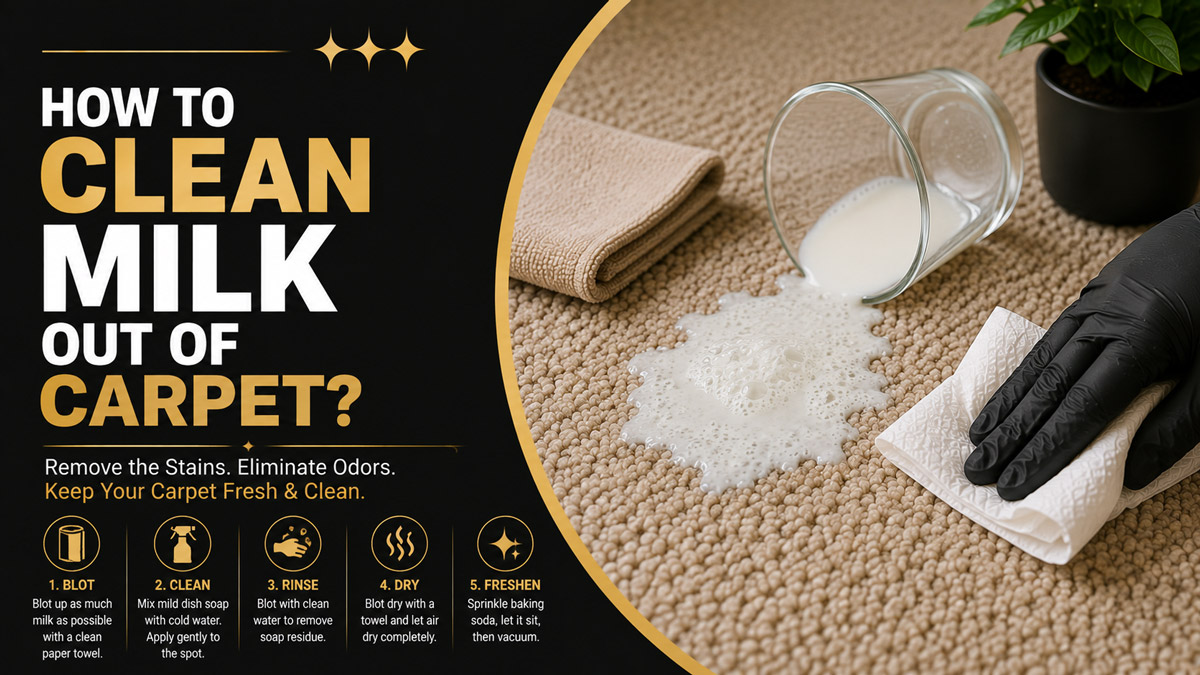
Learning how to clean milk out of carpet means removing the liquid, milk proteins, detergent residue, and odor source before the spill dries into the backing. Use seven steps: inspect, blot, wash, rinse, deodorize, dry with baking soda, then vacuum. Expect about 25-35 minutes of active work plus 8-24 hours of drying. Fast extraction determines success most.
Before You Start
Milk is an organic spill containing water, fats, proteins, and sugars. A fresh spill is usually straightforward. Once milk dries or reaches the carpet padding, cleaning becomes more difficult because odor can remain below the visible fibers.
Do not begin by pouring cleaner over the spot.
First identify the affected area and gather enough absorbent towels to extract liquid instead of spreading it.
Time, Difficulty, and Cost
- Active cleaning time: 25-35 minutes
- Drying and deodorizing time: 8-24 hours
- Difficulty: Easy for fresh surface spills, moderate for dried or deep spills
- Typical DIY material cost: About $2-$10 if basic household supplies are already available
- Professional help: Consider it when a large amount of milk has reached the carpet pad or odor returns repeatedly
Tools and Materials
| Item | Quantity or specification | Typical cost | Purpose |
| White cloths or paper towels | 5-10 pieces | $1-$5 | Absorb milk and cleaner |
| Cold water | 1-2 cups | Minimal | Dilutes and rinses residue |
| Liquid dish soap | 1 tsp per cup | $1-$4 | Loosens milk residue |
| White vinegar | About 1/4 cup | $1-$3 | Helps control lingering odor |
| Baking soda | 1/2-1 cup | $1-$3 | Absorbs moisture and odor |
| Spray bottle or small bowl | 1 | $1-$4 | Controls liquid application |
| Soft-bristled brush | 1 | $2-$5 | Loosens dried residue if needed |
| Dry vacuum cleaner | Standard setting | Existing equipment | Removes dry baking soda |
| Fan, optional | 1 | Existing equipment | Speeds drying |
Use a bleach-free, dye-free dishwashing liquid where possible. Avoid laundry detergent because it is difficult to rinse fully from carpet fibers.
White towels are preferable because transferred milk and soil remain visible, and there is no colored dye to bleed into light carpet.
Test the Carpet First
Test any cleaning solution in a hidden area before treating the visible spill.
Apply a few drops of your diluted solution to an inconspicuous section, such as carpet inside a closet or beneath furniture. Blot it after several minutes with a white cloth.
Continue only if no carpet color transfers and the fiber appearance remains unchanged.
This precaution becomes especially important with wool, natural-fiber rugs, handmade rugs, and carpets with uncertain dye stability.
Milk Removal at a Glance
| Step | Action | Active time | Common mistake |
| 1 | Inspect and test | 2-3 min | Wetting before checking depth |
| 2 | Blot excess milk | 5-10 min | Scrubbing |
| 3 | Apply soap solution | 5-8 min | Using too much detergent |
| 4 | Rinse and extract | 5 min | Leaving soap behind |
| 5 | Treat odor | 2-5 min | Saturating the backing |
| 6 | Add baking soda | 2 min plus drying | Vacuuming while damp |
| 7 | Vacuum and inspect | 5 min | Assuming odor means surface dirt |
Step 1: Inspect the Spill and Test the Carpet
Determine how far the milk spread, then test your cleaner on a hidden section before wetting the visible stain.
Look at the boundaries of the spill under good lighting. Press a folded dry white towel firmly against the center for 5-10 seconds. If the towel becomes heavily wet, significant liquid remains in the pile.
Next, gently separate the carpet fibers with your fingers. Check whether the base of the pile feels wet. A very wet base suggests milk may have traveled toward the backing.
Do not pull up fitted carpet unless you already know how it is installed. Your goal is simply to determine whether you have a light surface spill or a deeper contamination problem.
Perform the colorfastness test described above before applying soap or vinegar.
You’ll know it worked when you understand the approximate spill boundary, depth, and whether the carpet tolerates your cleaning solution.
The main mistake here is assuming the visible mark equals the entire spill. Liquid often spreads slightly farther underneath than it appears to on top.
Step 2: Blot Out as Much Milk as Possible
Press clean white towels firmly into the spill until little or no milk transfers to a fresh towel.
Start at the outer edge and work toward the center. This helps prevent the wet area from spreading.
Fold a towel into several layers and press vertically into the carpet for 5-10 seconds. Lift it straight upward. Rotate to a dry section and repeat.
For a small fresh spill, continue for about 5 minutes. A larger spill may require 10 minutes and several towels.
Use firm downward pressure, but never rub the towel sideways.
If a considerable amount of milk was spilled, place a thick stack of absorbent towels over the spot and press down with your hand or knee. Replace the stack when saturated.
The supplied Google AI Overview similarly emphasizes blotting rather than rubbing and cites COIT and several carpet-cleaning sources for this stage.
You’ll know it worked when a fresh white towel comes away only slightly damp rather than visibly wet with milk.
Do not add cleaning solution while large amounts of milk are still transferring. Diluting a pool of milk with additional liquid can drive contamination deeper.
Step 3: Clean the Milk Residue With Dish Soap
Apply a controlled amount of diluted dish soap and gently work it through the stained carpet fibers.
Mix:
- 1 teaspoon bleach-free liquid dish soap
- 1 cup cold water
Stir gently instead of shaking vigorously, which creates unnecessary foam.
Apply only enough solution to dampen the affected fibers. For a palm-sized spill, begin with approximately 2-4 tablespoons rather than automatically using the entire cup.
Work from the perimeter toward the center with a clean white cloth. Blot and lightly press the solution into the carpet.
For dried residue, allow the solution to remain on the fibers for about 5 minutes. You can gently agitate the tips of the fibers with a soft-bristled brush, but avoid aggressive back-and-forth scrubbing.
Cold water is the safer default specified in the supplied cleaning process. The source material specifically warns against hot water because heating protein-based residue can make stain removal more difficult.
You’ll know it worked when the carpet no longer feels sticky or greasy and your blotting towel stops collecting obvious milky residue.
The most frequent mistake is using extra detergent because the stain seems stubborn. More soap does not necessarily improve extraction. It creates additional residue that must later be removed.
Step 4: Rinse and Extract the Soap
Rinse the treated fibers with a small amount of clean cold water, then blot repeatedly until detergent residue stops transferring.
Use approximately 1/4-1/2 cup of cold water depending on the size and thickness of the affected area.
Do not pour the entire amount in one place.
Apply a little water, blot immediately, then repeat. This controlled rinse-and-extract pattern removes both loosened milk residue and dish soap without unnecessarily soaking the backing.
Press firmly with a clean dry towel after each application.
Watch for foam. If the towel still produces obvious suds when compressed against the carpet, another light rinse is useful.
A proper rinse is more important than it looks. Detergent left in the fibers can dry sticky and attract soil, causing the cleaned patch to become dirty faster than the surrounding carpet.
You’ll know it worked when blotting produces almost no foam, the fibers do not feel slippery, and the towel shows little remaining contamination.
Avoid flooding the area. Most guides focus on the visible pile, but odor often becomes difficult when excessive cleaning liquid transports milk into the carpet pad.
Step 5: Treat Any Remaining Milk Odor
Apply a light 1:1 solution of white vinegar and cold water when a milk smell remains after washing and rinsing.
Mix approximately:
- 1/4 cup white vinegar
- 1/4 cup cold water
You will rarely need all of it for a small spill.
Lightly mist or dab enough solution onto the affected fibers to make them damp. Do not saturate them.
Blot gently with a clean cloth for 1-2 minutes. Then press a dry towel firmly over the area to remove excess liquid.
The supplied AI Overview includes diluted white vinegar as its odor-neutralizing stage and cites several carpet-cleaning sources for the method.
Vinegar itself has a noticeable smell while wet. That does not necessarily mean the carpet is getting worse. Its odor normally falls substantially as the treated area dries.
However, vinegar is not appropriate for every carpet or rug. Follow manufacturer care instructions when you are dealing with wool, natural fibers, handmade rugs, or specialty flooring.
You’ll know it worked when the sour milk odor becomes substantially weaker after blotting and continues decreasing as the carpet dries.
Do not repeatedly soak a persistent odor with vinegar. If the smell disappears briefly and returns after drying, contamination may be below the surface.
Step 6: Cover the Area With Baking Soda
Sprinkle baking soda over the damp carpet and leave it undisturbed until both the powder and carpet are completely dry.
After extracting as much liquid as possible, spread approximately 1/2-1 cup of baking soda over the affected area.
The supplied overview recommends a relatively thick covering, approximately 1/4 inch over the damp section.
Use enough powder to cover the fibers consistently, but there is no benefit to creating an excessively deep mound.
Leave the area untouched for 8-24 hours. A small, lightly damp spot may dry toward the shorter end. Thick carpet, high indoor humidity, or a deeper spill can require substantially longer.
Increase airflow with a fan if available. Aim the fan across the carpet rather than adding heat directly to the spot.
Keep children and pets away from the powder while it sits.
You’ll know it worked when the baking soda feels completely dry and loose instead of damp, clumped, or paste-like.
Never vacuum damp baking soda with a standard dry vacuum. Moist powder can clog filters and remain embedded in carpet fibers.
Step 7: Vacuum and Perform the Final Inspection
Vacuum the completely dry baking soda slowly, then inspect the carpet for odor, residue, discoloration, and returning moisture.
Use the vacuum’s normal carpet setting and make several slow passes in different directions.
If powder remains deep in the pile, gently separate the fibers with your fingers or a soft dry brush and vacuum again.
Now inspect the cleaned section from several angles.
Check four things:
- Does it still smell sour?
- Does the carpet feel sticky or crunchy?
- Has a brown or darker mark appeared?
- Does pressing a dry towel against the area reveal moisture?
The final inspection determines your next move.
You’ll know the cleaning worked when the carpet is fully dry, feels similar to the surrounding pile, produces no obvious milk odor, and shows no returning stain.
Do not judge odor while the carpet is still damp. Moisture temporarily changes how both vinegar and organic odors smell.
If everything looks clean but the milk smell returns the next day, move to the troubleshooting section rather than repeatedly repeating the same surface treatment.
Common Mistakes and How to Fix Them
The Sour Milk Smell Comes Back
A returning odor usually indicates that milk remains deeper in the carpet, backing, or pad.
The supplied AI Overview identifies this as a major failure mode and recommends an enzyme-based cleaner for remaining organic material.
Choose an enzyme cleaner whose label specifically permits use on your carpet type. Follow its label dilution, dwell-time, and extraction instructions rather than assuming every enzyme product works identically.
The overview gives one hour as an example dwell period, but product directions should take priority.
If the smell repeatedly disappears while wet and returns after drying, stop adding random household solutions. A professional extraction may be necessary if the pad is contaminated.
The Carpet Feels Crunchy
Crunchiness normally points to dried detergent, excessive baking soda, or both.
First vacuum thoroughly.
If detergent residue remains, lightly mist the fibers with clean water and blot firmly. Repeat with very small amounts until the fibers no longer feel stiff or slippery.
Do not solve residue by soaking the area.
After the carpet is completely dry, use a soft brush to lift compressed fibers and vacuum again.
The Stain Returns After Drying
This is commonly called wicking.
Moisture and dissolved residue from lower parts of the carpet migrate upward as the surface dries. The mark can therefore appear to have been removed, then return several hours later.
Lightly re-clean the affected fibers and extract them thoroughly.
During drying, place several layers of white absorbent towels over the spot and apply moderate weight with a waterproof barrier between the towels and the weight. Replace the towels if they become damp.
The goal is controlled upward absorption, not crushing a wet carpet indefinitely.
The Carpet Still Feels Wet the Next Day
Improve air movement immediately.
Run a fan across the affected section and reduce indoor humidity if possible. Avoid covering the wet carpet with plastic or furniture because trapped moisture dries more slowly.
If a small spill remains noticeably wet after 24 hours despite airflow, excessive water may have reached the backing or padding.
At that point, additional surface cleaning is usually counterproductive.
The Spot Is Lighter Than the Rest of the Carpet
A newly cleaned patch may simply be cleaner than the surrounding carpet.
Let the section dry fully before deciding that permanent discoloration occurred.
If actual bleaching or dye loss is visible, cleaning cannot restore missing carpet pigment. Do not apply stronger chemicals in an attempt to darken it.
The Milk Spread Beyond the Original Stain
This commonly happens when too much liquid is poured directly into the pile.
Stop adding cleaner.
Use dry towels to extract as much moisture as possible, working from the expanded perimeter inward. Once the area is only damp, increase airflow and allow it to dry before deciding whether another targeted treatment is necessary.
Variations for Different Milk Spills
How to Clean Fresh Milk From Carpet
Fresh milk is the easiest situation because most contamination can still be physically extracted.
Spend more time on Step 2.
Blot until fresh towels barely pick up moisture before introducing soap. A small fresh spill may need only dish soap, a careful rinse, complete drying, and a final odor check.
Do not automatically use every chemical available. If no odor remains after proper washing and rinsing, additional treatment may be unnecessary.
How to Clean Dried or Sour Milk From Carpet
Dried milk needs controlled rehydration before extraction.
Apply a small amount of the diluted dish-soap solution and let it sit for approximately 5 minutes. Gently loosen hardened surface material with a soft-bristled brush.
Blot rather than scrub.
Rinse carefully and evaluate the odor after extraction. If sour odor persists after drying, an enzyme cleaner labeled for carpet is often a more logical next treatment than repeatedly adding soap.
Old spills are more likely to have reached the backing, particularly if a large quantity was originally spilled.
How to Clean Milk From Wool Carpet
Use greater caution with wool.
Check the manufacturer’s cleaning instructions or rug care label before using vinegar, enzyme products, or household spot cleaners. Always perform a hidden colorfastness test.
Blot quickly and minimize moisture.
Avoid aggressive brushing because wet wool fibers can distort or fuzz more easily than many synthetic carpet fibers.
For an expensive wool rug, handmade rug, unstable dye, or substantial spill, professional rug cleaning is safer than experimenting with increasingly strong DIY mixtures.
How Long Does Milk Carpet Cleaning Take?
A typical fresh household spill requires about 25-35 minutes of active work.
Most of the total process is drying time.
| Situation | Active work | Drying time | Likely difficulty |
| Small fresh spill | 20-25 min | 8-12 hr | Easy |
| Medium fresh spill | 25-35 min | 12-24 hr | Easy to moderate |
| Dried milk | 30-45 min | 12-24 hr | Moderate |
| Sour odor present | 30-60 min | 12-24+ hr | Moderate |
| Padding affected | Varies | 24+ hr | Difficult |
Humidity, carpet thickness, spill volume, room airflow, and how much cleaning solution you apply all affect drying.
Do not use smell alone to shorten the drying phase. Wait until the carpet is genuinely dry before judging whether the treatment succeeded.
How Much Does It Cost?
Most small spills cost very little to treat because the required quantities are small.
If you already own a vacuum, towels, dish soap, vinegar, and baking soda, your additional cost may be almost zero.
Buying basic supplies specifically for the job generally costs only a few dollars. An enzyme-based carpet cleaner adds another product cost.
Professional carpet-cleaning prices vary widely by location, room size, minimum service charges, cleaning method, and whether the pad requires treatment. Request a specific quote when a large spill has penetrated below the carpet surface.
The more important cost decision is whether repeated DIY attempts are making the affected area wetter without removing the underlying contamination.
Frequently Asked Questions
Can milk permanently stain carpet?
Milk can leave visible residue or discoloration when its fats, proteins, sugars, and associated soil remain in the fibers. Fast blotting improves the chance of complete removal. Older spills are harder because residue dries in the pile and liquid may have reached the backing. Clean the spill before it develops a persistent sour odor.
Does baking soda get milk smell out of carpet?
Baking soda can absorb moisture and reduce remaining odor, but it does not replace removal of the milk itself. First blot, clean, rinse, and extract the contamination. Apply baking soda only after those stages. Leave it for 8-24 hours and vacuum only when the carpet and powder are completely dry.
Can I use vinegar on a milk stain?
Diluted white vinegar is included in the supplied cleaning process as an odor-control step. A 1:1 vinegar and cold-water mixture can be applied lightly after washing and rinsing. Test it first. Specialty rugs, wool carpets, and unstable dyes may require different care, so follow the manufacturer’s instructions.
Why does my carpet smell like sour milk after cleaning?
The most likely reason is incomplete extraction. Milk may remain near the base of the pile, in the backing, or in the carpet pad. Surface deodorizing can temporarily mask the problem while moisture is present. If odor returns after complete drying, use a carpet-compatible enzyme cleaner or consider professional extraction.
Can I clean spilled milk without a carpet cleaner?
Yes. Small and moderate spills can often be treated using white towels, cold water, diluted dish soap, vinegar when appropriate, baking soda, and a normal dry vacuum. The important part is controlled extraction. Avoid flooding the carpet because hand cleaning becomes much less effective once milk penetrates deeply into the padding.
Should I use hot or cold water for spilled milk?
Use cold water for the process described here. The supplied Google AI Overview specifically warns against hot water for milk residue and consistently specifies cold water for its detergent, rinse, and vinegar stages. More importantly, use small controlled quantities regardless of temperature so the carpet backing is not unnecessarily saturated.
Final Checklist
Before considering the job complete, verify that:
- No milk transfers to a clean towel.
- No detergent foam remains after rinsing.
- The carpet is fully dry.
- Baking soda has been completely vacuumed.
- The fibers do not feel sticky or crunchy.
- No dark mark reappears after drying.
- No sour milk odor returns after several hours.
If the visible carpet looks clean but sour odor keeps returning, assume deeper contamination is possible. Repeatedly adding household products to the surface can create more moisture without reaching the source.
Conclusion
The safest approach to how to clean milk out of carpet is extraction first and deodorizing second. Blot aggressively without rubbing, clean with 1 teaspoon of dish soap in 1 cup of cold water, rinse away the detergent, treat remaining odor carefully, then use baking soda during an 8-24 hour drying period.
The key checkpoint is what happens after the carpet dries. If it feels clean and the odor stays gone, the process worked. If sour milk smell or discoloration returns, treat the problem as deeper contamination rather than continuing to soak the surface.