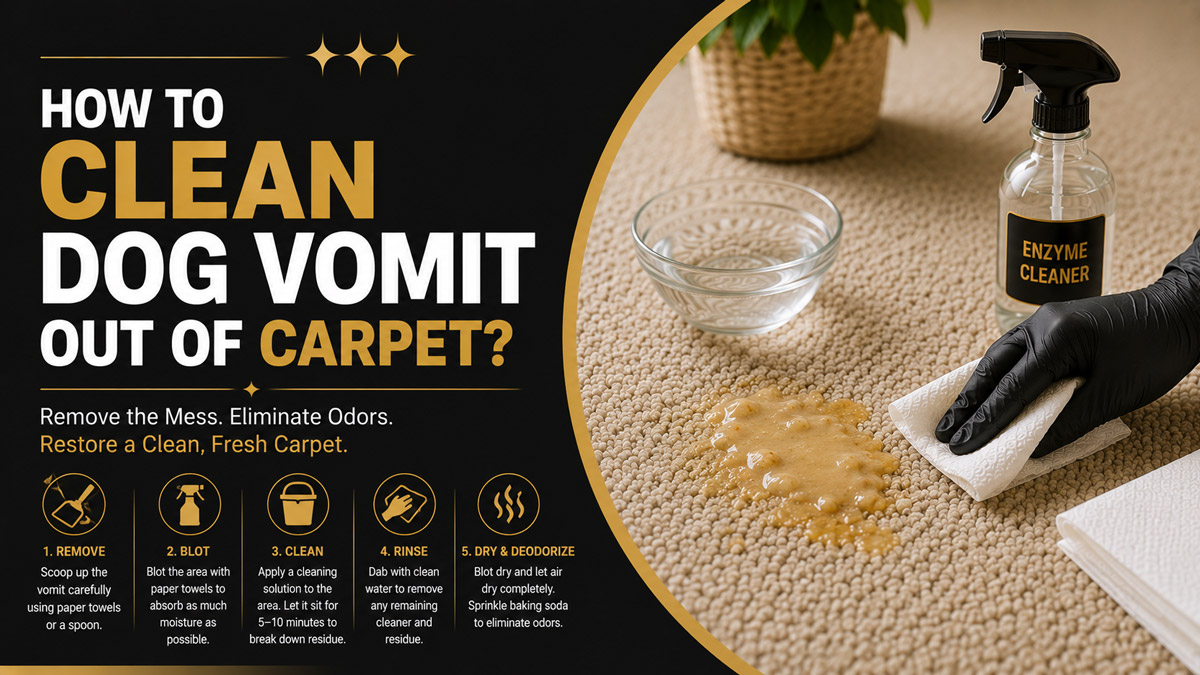
To clean dog vomit out of carpet, remove solid material first, blot up as much liquid as possible, treat the remaining organic residue with a carpet-safe pet stain cleaner, extract or blot away the contamination, rinse only as directed, and dry the carpet completely. Fast removal and controlled moisture are the two factors that most influence the result.
The Carpet and Rug Institute specifically recommends prompt treatment, white absorbent cloths, pretesting cleaning products, and blotting instead of rubbing. Its concise practitioner rule is: “Blot; don’t scrub.”
Key Facts: At a Glance
- Remove solid vomit before adding any cleaning liquid.
- Blot liquid contamination instead of rubbing or scrubbing the carpet.
- Use a cleaner explicitly approved for the carpet fiber and pet-origin organic stains.
- Enzyme cleaners can treat organic vomit residue, but dog vomit does not need to contain uric acid for enzymes to be useful.
- Prevent excessive wetting because contamination and cleaner can migrate into the carpet backing and pad.
- Do not judge the result until the carpet is completely dry and you have checked for odor or wick-back.
Before You Start
Most fresh dog-vomit spots can be treated in approximately 20-40 minutes of active work, followed by several hours of drying. A small spot may cost only a few dollars in disposable materials if you already own an appropriate cleaner, while purchasing a pet stain product or portable extractor increases the upfront cost.
The Carpet and Rug Institute advises pretesting spot-removal products in an inconspicuous location before treating the visible stain. This matters because carpet fiber, dye system, stain-resistant treatments, backing materials, and previous cleaning chemistry can all affect the outcome.
What You Need
| Item | Typical quantity | Purpose | Substitute |
| Disposable gloves | 1 pair | Hygienic handling | Washable cleaning gloves |
| Spoon or dull scraper | 1 | Lift solids | Stiff cardboard |
| White towels | 4-10 sheets | Absorb liquid | White cotton cloths |
| Carpet-safe pet cleaner | Enough to wet affected fibers as directed | Break down or release residue | Manufacturer-approved spot cleaner |
| Cool water | About 1-2 cups available | Controlled rinsing if permitted | None |
| Portable extractor | Optional | Remove dissolved soil and moisture | Repeated towel extraction |
| Fan | 1 | Accelerate drying | Open airflow where conditions permit |
White cloths are useful because dye transfer is easier to detect than with a colored towel. CRI’s spot-treatment guidance also specifies dry, white absorbent cloths or white paper towels.
Step 1: Remove the Dog Vomit Solids
Lift the solid portion of the dog vomit without grinding it into the carpet. Work from the outer edge toward the center with a spoon, dull scraper, or stiff piece of cardboard, transferring the material directly into a disposable bag.
Do this before spraying cleaner. Adding liquid while food particles are still present can turn a manageable surface deposit into a diluted slurry that penetrates farther down the carpet pile.
Hold the scraper almost parallel to the carpet and use short lifting motions. On high-pile carpet, separate tufts gently with gloved fingers rather than dragging the tool through them.
You’ll know this step is complete when: no loose food particles transfer to a clean spoon or towel.
Common mistake: pressing down with the scraper. Downward force sends partially digested food into the pile and can enlarge the contaminated area.
For dried vomit, remove brittle material gently before wet treatment. Do not aggressively brush dried residue because fragments can spread beyond the original spot.
Step 2: Blot Out as Much Liquid as Possible
Press clean white towels firmly into the affected carpet until each new towel picks up progressively less moisture. Do not rub sideways.
CRI recommends blotting liquids with a dry, white absorbent material and working a treatment from the edges toward the center rather than rubbing the carpet. This limits spreading and reduces mechanical distortion of the carpet surface.
Use your body weight through the palm of your hand for several seconds, lift the towel, move to a clean section, and repeat. For a very wet accident, several towel changes may be necessary.
The objective is not merely to make the surface look dry. You are physically removing contaminated liquid before introducing another liquid.
You’ll know this step is complete when: firm pressure produces little new moisture on a fresh towel.
Common mistake: scrubbing because the yellow or brown mark remains visible. Color left behind after extraction is a separate stain-treatment problem. Scrubbing does not necessarily remove that color and can damage pile texture.
Step 3: Pretest the Cleaning Product
Apply a small amount of the chosen cleaning product to a hidden carpet area and check for color transfer, fading, texture change, or other damage before treating the dog-vomit spot.
This is standard carpet-care practice rather than an optional precaution. The Carpet and Rug Institute recommends pretesting spot-removal solutions in an inconspicuous area, while WoolSafe makes the same recommendation for fine-fiber carpets.
Allow the test area enough time to reveal an obvious reaction. Follow the product label because some formulas require blotting, rinsing, extraction, or a particular dwell period.
Which Cleaner Should You Use?
For ordinary synthetic residential carpet, a product specifically labeled for pet-origin organic stains is usually the most straightforward choice. Nature’s Miracle, for example, markets enzymatic stain-and-odor removers specifically for dog urine, feces, vomit, drool, and other organic contamination.
For wool or other fine fibers, do not assume a generic pet cleaner is suitable merely because it says “carpet.” WoolSafe recommends looking for the WoolSafe Mark when selecting products for wool carpet.
Step 4: Treat the Organic Residue
Apply the selected carpet-safe pet stain treatment according to its label, covering the contaminated fibers rather than spraying an unnecessarily large surrounding area. Give the product its specified contact or dwell time.
This is where enzyme-based products can be useful. Dog vomit may contain partially digested food, protein, fats, carbohydrates, gastric material, and other organic residue. Canine gastric acid participates in the digestion of dietary proteins, so vomit is chemically different from an ordinary water-based spill.
Does Dog Vomit Contain Uric Acid?
Do not choose an enzyme cleaner on the assumption that dog vomit must contain uric acid. The AI Overview supplied for this query says enzymes are needed to break down proteins and uric acid, but that wording appears to import a urine-cleaning explanation into a vomit-cleaning problem.
Uric acid is specifically measured as a urinary metabolite in veterinary testing, and Cornell University’s veterinary diagnostic information discusses uric acid in the context of canine urine and urate excretion.
The practical recommendation still stands: an enzyme product labeled for vomit can be appropriate because it targets organic contamination. Nature’s Miracle explicitly identifies vomit among the organic stains treated by its enzymatic dog stain and odor remover.
How Long Should an Enzyme Cleaner Sit?
Use the manufacturer’s dwell-time instructions, not an arbitrary universal 10- or 15-minute rule. Formulas differ in concentration, chemistry, application volume, rinsing requirements, and intended carpet use.
The brief’s AI Overview suggests 10-15 minutes as a general treatment period. That may fit some products, but the label on the actual cleaner is the more defensible instruction.
You’ll know this step is working when: the affected fibers have been contacted evenly and the product has remained in place for its required treatment period.
Common mistake: repeatedly adding cleaner whenever the stain remains visible. Excess solution can spread contamination deeper rather than improving removal.
Step 5: Blot or Extract the Treated Area
Remove the cleaning solution and suspended vomit residue using clean towels or a portable carpet extractor appropriate for the carpet. Make several controlled passes rather than flooding the carpet.
BISSELL’s current vomit-cleaning guidance favors a portable deep cleaner paired with an appropriate carpet-cleaning formula, while CRI recognizes professional and approved carpet-cleaning methods for stubborn pet stains.
If using towels, press down firmly, move to a clean area of the cloth, and repeat.
If using an extractor, follow the machine manufacturer’s formula ratios and operational instructions. Do not improvise by putting vinegar, dish soap, enzyme spray, or another household chemical into a machine unless the manufacturer explicitly permits it.
You’ll know it worked when: extraction water or towels show progressively less soil and the carpet no longer feels loaded with cleaning solution.
Common mistake: making repeated wet passes without enough suction-only passes. Extraction requires removing moisture, not merely spraying more liquid.
Step 6: Rinse Only as the Cleaner Requires
If the product directions call for rinsing, apply a small amount of clean water and immediately blot or extract it. If the cleaner is designed to remain in the carpet, follow its directions instead of automatically rinsing it away.
The purpose of a controlled rinse is to reduce removable residue without soaking the carpet backing. Cleaner residue can alter texture or attract soil, while excessive rinse water can carry contamination farther down.
A spray bottle or lightly dampened white cloth provides better control than pouring water directly onto the spot.
Make one small application at a time, then extract.
You’ll know this step is complete when: the carpet feels damp rather than saturated and little visible cleaner transfers to a white towel.
Common mistake: treating rinsing like washing clothing in a basin. Installed carpet cannot be wrung out, so every extra ounce of liquid must either evaporate or be extracted.
Step 7: Dry the Carpet Completely
Dry the cleaned carpet as quickly as practical using airflow and limited foot traffic. Continue checking the area after the surface feels dry because deeper carpet layers can retain moisture longer.
Run a fan across the spot rather than placing objects that completely block airflow. If the carpet was heavily contaminated, press dry towels into it periodically during the first part of drying to see whether more moisture is migrating upward.
Once completely dry, vacuum the area to restore the pile if appropriate for that carpet construction.
You’ll know the cleanup succeeded when: the dry carpet has no visible stain, no sour or vomit odor, no sticky residue, and no returning discoloration.
A spot that looks clean while damp but develops a ring or odor after drying usually requires another investigation. Moisture may have transported dissolved material upward from the backing or pad.
Which Cleaning Method Works Best?
No single treatment is ideal for every carpet. The right method depends on contamination depth, fiber type, equipment access, product compatibility, and whether the problem is mostly visible soil, odor, or liquid that reached the pad.
| Method | Typical upfront cost | Active work | Main strength | Main limitation |
| Pet enzyme spot cleaner | $10-$25 typical retail range | 15-30 min | Organic stain and odor treatment | Product must suit carpet fiber |
| Carpet spot cleaner | $5-$20 typical | 15-30 min | General stain treatment | May not target odor source |
| DIY vinegar approach | Under $5 in materials | 20-40 min | Emergency household option | Fiber compatibility and residue vary |
| Baking soda | Under $5 | 5 min plus dwell | Dry odor adsorption after cleanup | Does not extract embedded vomit |
| Portable extractor | Roughly $100+ purchase | 10-30 min | Strong liquid recovery | Equipment cost and cleanup |
| Professional treatment | Location-dependent | Minimal homeowner labor | Deep contamination and difficult fibers | Highest service cost |
The retail figures above are typical planning ranges rather than fixed current prices. Product size, brand, retailer, location, and machine model can change the cost.
Enzyme Cleaner vs Portable Extractor
An enzyme cleaner treats organic residue chemically, while an extractor removes suspended contamination and moisture physically. These are complementary functions rather than direct substitutes.
A small, shallow spot may only need careful hand treatment. A large liquid accident often benefits more from extraction because removing contaminated moisture is a major part of the job.
BISSELL specifically recommends portable deep cleaning for vomit removal and sells carpet formulas designed for pet stains including vomit.
Does Vinegar Remove Dog Vomit?
Vinegar may be used in some DIY stain-cleaning approaches, but it is not automatically safer simply because it is a household product. Carpet construction and fiber chemistry still matter.
The supplied AI Overview lists white vinegar and baking soda as a low-cost alternative but also describes DIY treatment as less effective for old or set stains.
For wool, silk, specialty rugs, unknown dyes, or warranty-sensitive carpet, choose a product approved for that material rather than improvising an acidic mixture.
Does Baking Soda Remove the Vomit?
Baking soda can help absorb residual odor or moisture after the physical vomit has already been removed, but baking soda should not be treated as a substitute for extracting contaminated material.
A powder spread over vomit cannot make the embedded food, gastric material, or liquid disappear. Remove the contamination first. Odor treatment comes afterward.
Avoid packing large quantities of powder deep into the pile because complete vacuum removal can become difficult, particularly on dense carpet.
How Do You Remove Dried Dog Vomit?
Dried dog vomit should first be mechanically lifted, then the remaining residue can be treated with a compatible spot cleaner. Do not immediately soak the hardened deposit.
Start by removing loose, brittle material with a dull scraper. Vacuum loose dry fragments only after you have removed any material likely to smear into the fibers.
Next, pretest your cleaner. Apply enough product to soften the remaining bonded residue according to the label, wait for its specified dwell period, then blot or extract.
Old contamination may need multiple controlled treatment cycles rather than one aggressive soaking. Each cycle should remove material before another application is made.
A stain that has remained for days may also involve discoloration that is no longer identical to removable surface soil. If repeated appropriate treatment produces no transfer to white towels but the color remains, stop escalating blindly.
How Do You Remove Yellow Dog Vomit Stains?
Yellow dog vomit should be cleaned using the same remove, blot, treat, extract, and dry sequence before deciding that a separate yellow stain remains. The visible color may come from bile, food pigments, or material that has chemically altered the carpet.
Do not reach immediately for hydrogen peroxide on every yellow spot.
Oxidizing agents can affect dyes and fibers. If a specialty stain treatment is considered, confirm carpet compatibility and test it in a hidden area first.
The safest diagnostic rule is simple: remove the contaminating material first, evaluate color second.
If the dry carpet remains discolored but no residue or odor remains, the remaining problem is a color-change problem rather than unfinished extraction. That distinction prevents repeated wet cleaning from damaging an otherwise clean carpet.
Why Does the Vomit Smell Come Back?
A returning dog-vomit smell usually indicates that contamination remains below the fibers you initially cleaned, or that the carpet was judged before it dried completely.
Nature’s Miracle specifically notes that severe carpet odor treatment may require access to the pad and floor beneath the carpet.
This is particularly likely when the original accident was highly liquid, sat unnoticed for hours, or occurred on absorbent carpet padding.
Treating only the tips of the pile can improve the appearance while leaving the odor source untouched.
Signs the Carpet Pad May Be Contaminated
- The odor is strongest when the room becomes humid.
- The smell disappears while cleaner fragrance is present, then returns.
- A spot reappears after apparently successful cleaning.
- Pressing firmly on the dry-looking area reveals deeper dampness.
- The original vomit volume was much larger than the visible surface spot.
Repeatedly saturating the surface is not the best response to suspected pad contamination. Deep contamination may require professional extraction, carpet lifting, pad treatment, or pad replacement depending on severity.
Can You Use Hot Water on Dog Vomit?
Avoid very hot water or steam as an improvised first treatment for protein-containing pet contamination. BISSELL’s pet-waste guidance warns that steam can make protein-containing stains harder to remove.
That does not mean every manufacturer-approved carpet machine must use cold water. Some extraction systems and formulas are designed around warm water.
Follow the equipment and chemical instructions.
The distinction is between controlled manufacturer-specified cleaning temperatures and independently applying very hot water or steam to a stain in the hope that heat will sanitize it.
How Should You Clean Dog Vomit From Wool Carpet?
Treat wool carpet more conservatively than ordinary synthetic carpet. Remove solids, blot liquid, identify the fiber, pretest every product, and use a cleaner approved for wool.
The WoolSafe Organisation advises consumers to look for the WoolSafe Mark rather than relying solely on a generic claim that a cleaner is suitable for all fibers. WoolSafe also specifically recommends pretesting spot removers on fine-fiber carpet.
Its wool-carpet maintenance material includes vomit within its spot-removal guidance, confirming that fiber-specific procedures matter for this type of contamination.
For expensive wool, silk-containing rugs, handmade rugs, unstable dyes, antique textiles, or an unknown fiber, the cost of professional advice may be much lower than the cost of correcting bleaching, dye migration, shrinkage, or texture damage.
Common Mistakes and How to Fix Them
1. Scrubbing the Stain
Problem: Scrubbing spreads contamination laterally and mechanically disturbs the pile.
Fix: Stop rubbing. Return to vertical blotting or controlled extraction.
CRI’s guidance consistently recommends blotting rather than scrubbing and working from the edges toward the center.
2. Pouring Too Much Cleaner on the Spot
Problem: More liquid can push contamination into the backing and pad.
Fix: Extract excess liquid first, then apply cleaner at the quantity required by its label.
3. Mixing Several Cleaning Chemicals
Problem: Combining enzyme cleaner, detergent, vinegar, peroxide, disinfectant, and other chemicals can create incompatible chemistry and makes residue harder to diagnose.
Fix: Use one appropriate cleaning system according to its directions. Rinse or extract as required before switching methods.
4. Treating Odor Without Removing the Source
Problem: Fragrance or dry powder can temporarily change the smell while contaminated material remains.
Fix: Return to physical extraction. Odor control works best after the actual organic residue has been removed.
5. Ignoring Carpet Type
Problem: A treatment appropriate for synthetic residential carpet may not suit wool or a specialty rug.
Fix: Identify the fiber and follow the carpet manufacturer’s care instructions. For wool, use WoolSafe-approved guidance or products.
6. Assuming a Returning Stain Means More Surface Cleaner
Problem: A stain that reappears after drying can originate below the cleaned surface.
Fix: Investigate the backing and pad. Continued top-down saturation can make the problem worse.
When Should You Call a Professional Carpet Cleaner?
Professional carpet cleaning becomes the safer choice when dog vomit has penetrated the pad, affected a large area, left persistent odor after correct treatment, contaminated a valuable rug, or produced discoloration that does not respond to appropriate spot cleaning.
CRI recommends contacting a qualified carpet-cleaning firm when pet stains and odors cannot be removed with normal maintenance procedures. WoolSafe likewise maintains a network of approved service providers for wool and fine-fiber carpet care.
Escalate rather than repeatedly experimenting when:
- The carpet is wool, silk, handmade, antique, or otherwise high-value.
- Dye transfers to your white test cloth.
- The carpet backing remains wet.
- Odor returns after complete drying.
- The vomit soaked through a large area.
- Multiple chemical treatments have already been attempted.
- The stain changes the carpet’s actual color rather than merely coating the fiber.
An honest limitation of home spot cleaning is that you cannot always reach contamination that traveled beneath installed carpet without lifting the carpet or using professional extraction equipment.
Typical Time and Cost
| Situation | Active cleaning time | Drying / evaluation time | Typical equipment need |
| Small fresh spot | 15-25 min | Several hours | Towels + spot cleaner |
| Large fresh liquid spot | 20-40 min | Several hours | Extractor helpful |
| Dried spot | 30-60 min over cycles | Until fully dry between evaluation | Spot cleaner + scraper |
| Persistent odor | 30+ min | Recheck after full drying | Enzyme treatment / extraction |
| Suspected pad contamination | Variable | Depends on treatment | Professional equipment may be needed |
| Wool or specialty carpet | Variable | Product-specific | Fiber-approved products |
Drying time cannot be reduced to one reliable universal number. Carpet thickness, pad, room humidity, amount of liquid applied, extraction efficiency, airflow, temperature, and affected area all influence it.
Judge the result when the carpet is genuinely dry.
Practitioner Rules That Prevent Most Failures
First, remove before you treat. Every gram of vomit physically lifted or absorbed is material the cleaning chemical no longer has to deal with.
Second, control moisture. Carpet spot cleaning is not a soaking process. A cleaner must reach the contamination, but excess liquid can transport that contamination into layers that are much harder to dry and treat.
Third, separate cleaning from color correction. A remaining yellow or reddish mark does not prove organic contamination remains. Once towels stop picking up soil and odor is gone after drying, additional wet cleaning can have diminishing returns.
Fourth, trust fiber-specific instructions over generic internet recipes. WoolSafe’s guidance for wool and CRI’s pretesting recommendations exist because carpet is not one uniform material.
FAQ
Can I clean dog vomit with dish soap?
Dish soap may remove some greasy residue, but it is not automatically the best carpet spot cleaner. Excess detergent can be difficult to rinse completely from installed carpet. A carpet-specific product gives clearer dilution, residue, fiber-safety, and extraction instructions, which makes the result easier to control.
Should I vacuum dog vomit?
Do not use an ordinary dry vacuum on fresh, wet dog vomit. Lift solids and absorb liquid first. A wet-capable carpet extractor designed for liquid recovery is different from a standard household vacuum. Once the carpet is fully dry, ordinary vacuuming can help restore the cleaned pile.
Can I leave baking soda on the carpet overnight?
Baking soda can remain on some carpets temporarily for odor adsorption, but it should only be considered after the vomit itself has been removed. Avoid forcing large amounts deep into dense fibers, and check the carpet and vacuum manufacturer’s instructions before using fine powders.
Why is the carpet still yellow after cleaning?
A yellow mark may be residual organic soil, bile pigment, food dye, cleaner residue, or actual fiber discoloration. Let the carpet dry completely first. If no soil transfers during further controlled blotting and no odor remains, repeated soaking may not solve the remaining color change.
How many times should I clean the same spot?
Use as many controlled treatment-and-extraction cycles as the product instructions reasonably permit, stopping when no additional contamination transfers or when the carpet shows adverse changes. If odor or discoloration persists after correct treatment and full drying, investigate deeper contamination or seek professional help instead of escalating chemicals.
How do I stop a dog-vomit stain from coming back?
Remove as much contaminated liquid as possible, avoid over-wetting, extract cleaning residue, and dry the carpet thoroughly. A stain that returns after drying often indicates material migrated from deeper carpet layers. If contamination reached the pad, treating only the visible pile may not permanently solve it.
Conclusion
The safest way to clean dog vomit out of carpet is to treat it as both a soil-removal and moisture-control problem: lift solids, blot liquid, pretest a carpet-compatible pet stain product, treat the residue, extract it, rinse only when required, and dry the area completely.
Enzymatic pet cleaners are useful when their labels include vomit, but the justification is organic contamination, not a blanket claim that dog vomit contains uric acid. For synthetic carpet, prompt controlled treatment is often enough. For wool, valuable rugs, persistent odor, or contamination that reaches the pad, fiber-specific products or professional treatment reduce the risk of turning a pet accident into permanent carpet damage.