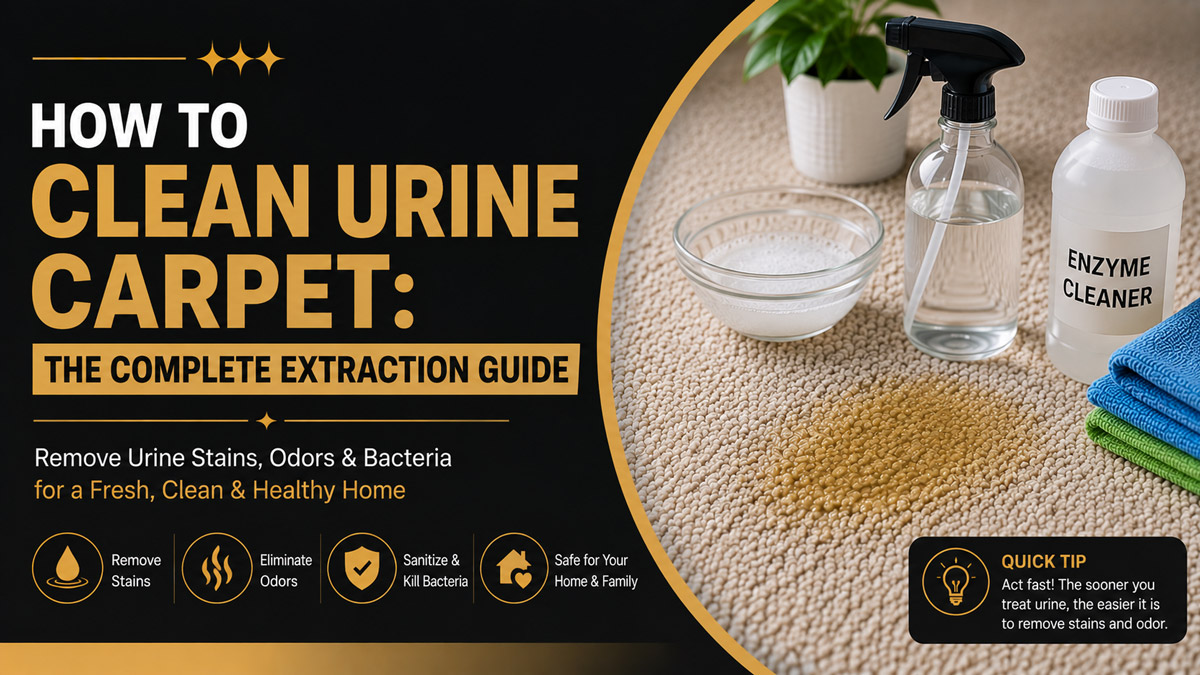
To clean urine carpet, you must extract the liquid, neutralize the alkaline ammonia salts, and digest the organic proteins. This process requires a targeted enzymatic cleaner, a heavy sub-surface application, extended dwell time, and mechanical liquid extraction. Surface scrubbing alone leaves uric acid crystals behind, causing odors to return permanently.
Key Facts / At a Glance
- Fresh urine has an acidic pH of 5 to 6 and transitions to a highly alkaline pH of 10 to 12 as it dries.
- Enzymatic cleaners require 8 to 24 hours of damp dwell time to completely consume organic waste molecules.
- Hydrogen peroxide oxidizing formulas work best on dark stains and human urine.
- Ammonia-based cleaning products invite animals to re-mark the exact same location.
- Ultraviolet blacklights in the 365-nanometer wavelength range reveal dried urine salts invisibly trapped in carpet fibers.
Before You Start
- Outcome: Complete removal of biological stains and ammonia odors from carpet fibers and the underlying foam padding.
- Step Count: 5 targeted steps.
- Total Time: 15 to 30 minutes of active labor, followed by 12 to 24 hours of mandatory drying time.
- Difficulty: Moderate.
- Critical Success Factor: You must apply a volume of chemical solution large enough to penetrate the primary carpet backing and saturate the foam pad underneath.
- Tools and Materials: One gallon of bio-enzymatic cleaner, 10 to 15 clean white cotton towels, a wet-dry vacuum or spotting machine, a 365-nanometer ultraviolet flashlight, a floor fan, and heavy flat weights (like books).
What Happens When Urine Dries in Carpet?
When urine dries in carpet, it undergoes a rapid chemical transformation from an acidic liquid into highly alkaline ammonia crystals. Environmental bacteria immediately feed on the organic urea, creating toxic gases that cause severe and permanent odor problems.
Fresh mammalian waste leaves the body as a warm liquid with a pH level between 5 and 6. This fluid contains urea, uric acid, proteins, water, and urochrome, the biological pigment that causes the yellow color. As the water content evaporates into the room, bacteria from the environment attack the remaining urea. This biological feeding process rapidly releases gaseous ammonia.
During this feeding phase, the pH level of the spot spikes to between 10 and 12. The originally acidic liquid becomes a highly alkaline salt. These newly formed alkaline salts behave like desiccants in your flooring. They actively absorb atmospheric moisture on humid days. This moisture restarts the bacterial feeding cycle, which releases fresh ammonia gas over and over again. Standard household soap cannot break down these alkaline salts. Only targeted chemical agents can dissolve the stubborn molecular bonds of dried uric acid.
Which Cleaning Products Actually Work?
Enzymatic cleaners and oxidizing agents remove urine effectively, while standard dish soaps and ammonia formulas fail completely. Choosing the correct chemical agent depends entirely on the age of the stain, the depth of the pad, and the source of the biological waste.
Carpet fibers act like a dense filter for chemical residues. Applying the wrong product sets the stain permanently. General carpet shampoos contain high-pH surfactants that clash violently with the high-pH urine salts. This chemical clash creates a sticky, unresolved residue that attracts dirt from foot traffic. You must use products formulated specifically to dismantle biological waste at the molecular level.
| Treatment Type | Active Mechanism | Ideal Application | Typical Cost per Unit |
| Bio-Enzymatic Cleaners | Live bacteria produce enzymes to digest urea and proteins. | Old dog urine, heavy cat urine, thick carpet padding. | $15 to $35 per gallon |
| Oxidizing Agents | Hydrogen peroxide releases oxygen to break organic stain bonds. | Fresh human urine, blood mixtures, dark visible stains. | $10 to $25 per bottle |
| Encapsulating Surfactants | Traps surface oils in a brittle polymer matrix for dry vacuuming. | Light foot traffic, residual surface cleaning. | $20 to $40 per bottle |
| Acidic Rinsing Agents | Lowers the pH of alkaline salts to neutralize the spot. | Pre-treating crusted stains, stopping wick-back issues. | $15 to $30 per gallon |
Step 1: Locate and Assess the Damage
Find the exact perimeter of the contamination before applying any chemical liquid. Human eyes consistently miss the true edges of a urine spot on carpet.
The visible yellow circle on the surface usually represents only 30 percent of the total contaminated area. The liquid spreads outward horizontally when it hits the dense primary carpet backing and the foam padding underneath. Turn off all lights in the room to create total darkness. Shine a 365-nanometer ultraviolet flashlight roughly two feet above the floor. Dried urine salts will fluoresce in a dull yellow or green color under this specific wavelength.
Place physical markers, such as coins or sticky notes, two inches outside the glowing perimeter. You must treat this entire marked zone to ensure success.
- Success Checkpoint: You will know the assessment is accurate when your treatment perimeter extends at least five inches past the visible surface stain.
- Common Mistake: Assuming the stain only exists where the carpet feels wet will result in untreated padding and a permanent odor.
Step 2: Blot and Extract the Fresh Liquid
Remove as much raw liquid as possible using heavy physical compression. Do not rub or scrub the fibers, because friction untwists the carpet yarns and damages the pile texture permanently.
Press clean white cotton towels or heavy-duty paper towels firmly into the marked zone. Stand directly on the towels. Your body weight forces the absorbent material to draw moisture up from the sub-floor backing. Leave the towels under compression for two full minutes to allow capillary action to work. Discard the wet towels and apply a fresh dry layer. Repeat this compression cycle three to five times until the transfer of liquid stops.
- Success Checkpoint: You will know this step is complete when a fresh paper towel shows zero dampness after you stand on it for thirty seconds.
- Common Mistake: Using colored bath towels transfers textile dye directly into the acidic urine stain, ruining the carpet color permanently.
Step 3: Apply the Treatment Solution
Saturate the entire contaminated area with your chosen enzymatic or oxidizing cleaner. Surface spraying fails to reach the foam padding where the most severe odor originates.
Pour the solution directly from the bottle onto the carpet. You must use a volume of cleaner equal to twice the estimated volume of the original urine deposit. For a typical medium-sized dog accident, pour at least 16 ounces of enzymatic solution into the fibers. Pour heavily along the outer perimeter first, working your way gradually toward the center. This specific pouring technique pushes the underlying urine inward rather than forcing it to spread wider across the subfloor. For extremely deep padding, use a specialized carpet syringe to inject the cleaner directly into the foam layer beneath the backing.
- Success Checkpoint: You will know the application is correct when the carpet feels spongy and the liquid visibly pools slightly when pressed with a gloved finger.
- Common Mistake: Misting the top of the carpet wastes the product and leaves the true source of the odor untouched in the pad.
Step 4: Dwell Time and Neutralization
Cover the wet zone and allow the chemical reaction to run its course. Enzymes require a constantly wet environment to consume organic matter effectively.
If the spot dries too quickly, the engineered bacteria die before finishing their work. Cover the saturated area completely with a damp white towel or a sheet of plastic wrap. Place a light weight on the edges of the plastic to seal out the ambient air. Oxidizing agents require a minimum of 30 to 60 minutes of dwell time to break structural bonds. Bio-enzymatic products require a massive 8 to 24 hours of undisturbed dwell time to digest thick urea crystals completely. Keep all foot traffic off the covered area during this period.
- Success Checkpoint: You will know the dwell phase is working when the sharp ammonia odor transitions into a mild, damp, earthy smell.
- Common Mistake: Rushing the dwell time stops the biological digestion prematurely, guaranteeing the odor will return during the next humid weather cycle.
Step 5: Final Extraction and Accelerated Drying
Extract the spent chemical solution and force the carpet to dry rapidly. Remove the plastic wrap or damp towel from the treatment zone.
Use a wet-dry vacuum or a dedicated carpet spotting machine to pull the suspended liquid out of the floor. Press the vacuum nozzle firmly into the carpet and pull backward slowly, moving at a rate of one inch per second. Make at least four dry passes over the entire zone to maximize extraction. Once you finish vacuuming, set up a high-velocity floor fan. Point the fan directly at the wet spot. The total drying time should take between 12 and 24 hours. Keep foot traffic off the area until the fibers feel completely crisp to the touch.
- Success Checkpoint: You will know extraction was successful when the vacuum hose no longer shows moisture droplets passing through the clear intake nozzle.
- Common Mistake: Leaving the carpet to air dry naturally without a fan allows trapped moisture to breed mold in the subfloor within 48 hours.
Common Mistakes and How to Fix Them
Even careful homeowners occasionally make procedural errors when panicking over a fresh pet accident. If you have already applied the wrong chemical or technique, you can often reverse the damage by following these recovery steps.
- Using Ammonia-Based Cleaners: Ammonia forms the chemical base of biological waste. Cleaning with ammonia signals to pets that this location is an approved bathroom. How to fix it: Flush the area entirely with clean, warm water and an extraction vacuum. Apply a heavy dose of acidic rinsing agent to neutralize the introduced ammonia.
- Aggressive Scrubbing and Friction: Scrubbing frays the carpet yarn and pushes the liquid sideways into clean areas. How to fix it: Stop scrubbing immediately. If the fibers are bloomed (untwisted), you cannot repair them. Limit future actions to vertical blotting and mechanical vacuum extraction only.
- Steam Cleaning Fresh Urine: High heat from a steam mop or professional truck-mount machine permanently sets the protein stains into the dye sites of the carpet fibers. How to fix it: Never apply heat above 120 degrees Fahrenheit to biological waste until you have completed a full enzymatic digestion cycle. If heat was already applied, switch to a strong oxidizing agent to bleach the set color out of the fibers.
Practitioner Insight: “The biggest failure point in pet odor removal is chemical conflict. If a homeowner has previously dumped baking soda, dish soap, and vinegar on a spot, the carpet fibers are choked with residue. An enzymatic cleaner cannot penetrate that barrier. You must flush the old chemicals out with hot water extraction before applying biological treatments.”
How Do You Fix Wick-Back and Returning Odors?
You fix wick-back by re-wetting the surface fibers with an acidic rinse and forcing rapid upward evaporation into a thick layer of paper towels. Wick-back happens when moisture trapped deep in the padding migrates up the carpet strands as the surface dries.
When the tips of the carpet yarn dry, capillary action pulls the underlying wetness upward from the pad. This rising liquid carries residual dirt, yellow urochrome dye, and alkaline salts back to the surface. To solve this, apply a light mist of an acidic rinsing agent to the visible spot. This lowers the pH of the salt ring. Lay down a half-inch stack of clean paper towels over the area. Place heavy books on top of the stack. Position a fan to blow across the books. As the moisture attempts to evaporate, the physical weight forces the liquid to wick into the disposable paper towels instead of stopping at the carpet tips. Leave the heavy stack in place for 24 hours.
How Does DIY Compare to Professional Extraction?
DIY methods cost less and use longer biological dwell times, while professional extraction utilizes high heat and massive vacuum pressure to flush zones instantly. Homeowners often struggle with thick padding, whereas professionals remove sub-surface liquids effortlessly.
Treating a small, fresh accident at home is highly effective using retail enzymes. Severe infestations covering large rooms require professional gear. A commercial truck-mount system generates vacuum pressure that a small wet-dry shop vacuum cannot physically match. Professionals also carry specialized sub-surface extraction tools, like a water claw, which compresses the carpet and padding simultaneously to pull gallons of liquid out without removing the carpet from the tack strips.
| Method Category | Primary Advantage | Main Drawback | Estimated Cost Factor |
| DIY Enzymatic Treatment | Safely digests organic odor molecules permanently. | Requires up to 24 hours of undisturbed dwell time. | $15 to $35 total |
| Portable Spotting Machine | Pulls liquid completely out of the upper backing layer. | High upfront gear cost for limited capacity. | $100 to $250 for unit |
| Professional Truck-Mount | Sanitizes large zones instantly with extreme suction. | High service cost and requires home driveway access. | $150 to $300 per room |
| Sub-Surface Upholstery Tool | Flushes the foam pad without tearing up the room. | Operator risks over-wetting wooden subfloors below. | $40 to $70 rental fee |
Situation-Specific Cleaning Strategies
Different urine sources require different chemical approaches. The diet and species of the mammal dictate the exact makeup of the biological waste, meaning a universal approach will fail on specialized stains.
- The Pet Owner (Cat and Dog Contingency): Cat urine contains higher concentrations of urea and specific pheromones compared to dog urine. It requires heavier, specialized enzymatic cleaners. Keep a gallon of bio-enzymatic cleaner ready at all times. Avoid generic store-bought carpet shampoos completely. Scan your baseboards monthly with a UV light, because male cats often spray vertically onto walls, allowing the liquid to run down under the carpet edge.
- The Parent (Toddler and Human Urine): Human urine is significantly less concentrated than animal urine. It responds instantly to fast sanitation. Opt for oxidizing peroxide-based formulas rather than slow-acting enzymes. A quick extraction and a light mist of oxidizer will resolve human accidents within thirty minutes, leaving the nursery safe and scent-free.
- The Renter (Move-Out Cleanup): Previous tenants often leave soap residue embedded in the carpet from failed cleaning attempts. Rent a commercial carpet extractor with a dedicated sub-floor hand tool. Run a strong acidic rinse through the machine to strip out the old soap layers before you attempt to apply any odor-neutralizing chemicals for your security deposit inspection.
When Should You Replace the Carpet Pad?
You should replace the carpet pad when urine has saturated more than twenty percent of the room’s total surface area or if the subfloor requires structural sealing. Deep saturation permanently compromises the foam density.
Sometimes chemical extraction is not enough. If an animal has used the corner of a room as a bathroom for several months, the sheer volume of uric acid will destroy the adhesive holding the carpet fibers together (known as delamination). In these extreme cases, you must pull back the carpet from the tack strips. Cut out the contaminated section of the rebond foam pad. Clean the bare concrete or wood subfloor beneath it. Paint the bare subfloor with a heavy-duty, oil-based stain-blocking primer to seal the trapped odors into the wood permanently. Once the primer dries, install a new section of foam pad and re-stretch the carpet over the corner.
Frequently Asked Questions (FAQ)
How long does urine take to dry on carpet?
Urine takes between 12 and 24 hours to dry completely on carpet, depending on the room’s ambient humidity and the thickness of the floor pad. Using a high-velocity fan reduces this drying window to roughly six hours.
Does steam cleaning set urine stains permanently?
Yes, applying temperatures above 120 degrees Fahrenheit to fresh urine sets the proteins directly into the carpet fiber dye sites. You must extract the biological waste completely using cool solutions before using any hot water extraction methods.
Why does the room smell worse on humid days?
Dried alkaline ammonia salts absorb moisture from the humid air. This moisture restarts the bacterial feeding cycle, which releases fresh ammonia gas into the room, causing the odor to spike noticeably during rainstorms.
Will baking soda remove the smell of dried urine?
No, baking soda only masks the surface odor temporarily. It does not possess the chemical ability to digest uric acid crystals or break down alkaline salts trapped deep within the carpet padding.
Can you use vinegar to clean pet accidents?
Vinegar provides a temporary fix for fresh stains because its low pH neutralizes alkaline ammonia. It fails to digest the sticky proteins and urochrome pigments, leaving a permanent yellow discoloration in the fibers.