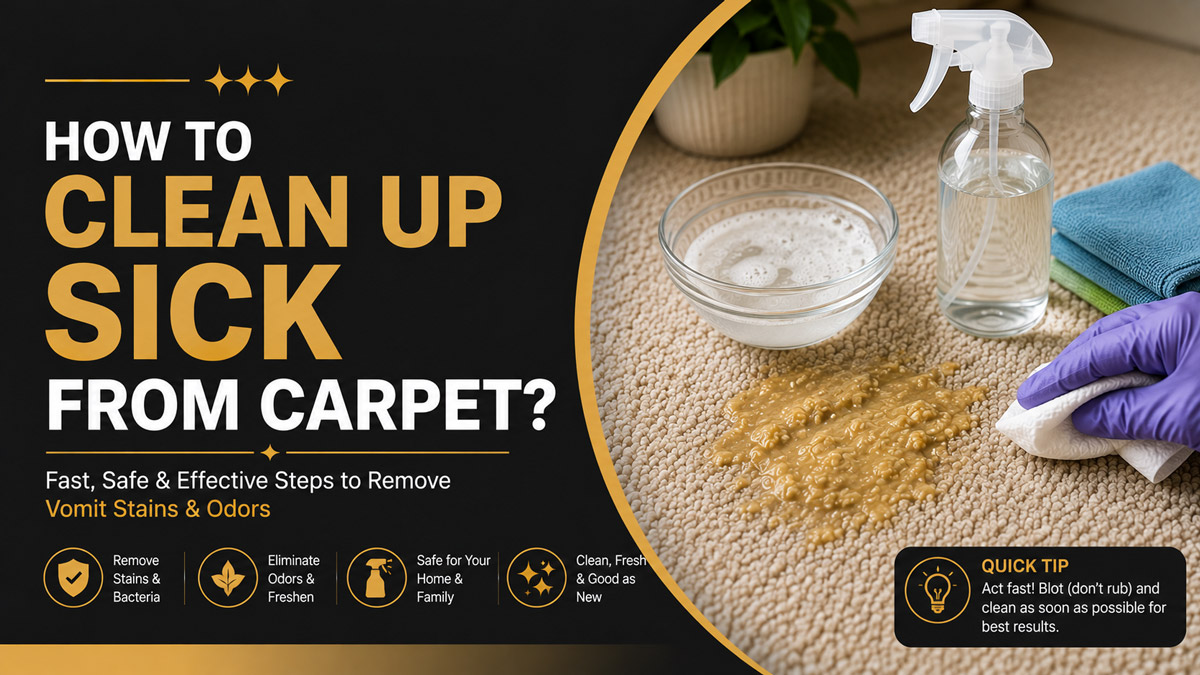
To clean up sick from carpet, you must immediately scrape away the solid matter using a dull edge, absorb the remaining liquid with a thick layer of baking soda for 30 minutes, and neutralize the area using a solution of equal parts white vinegar and warm water. Extract the remaining moisture under heavy pressure to prevent the gastric acids from permanently bleaching the synthetic fibers.
At a Glance
- Act within 10 minutes to prevent high-acidity stomach contents from permanently stripping carpet dye.
- Always scrape solids upward rather than pushing downward into the carpet backing.
- Apply baking soda for a minimum of 30 minutes to absorb residual moisture before introducing liquid cleaners.
- Never use hot water to rinse organic protein stains to avoid permanently setting the mess into the fibers.
- Saturate the underlying foam padding with a dedicated enzymatic cleaner to eliminate lingering bacterial odors.
- Avoid using a standard spinning vacuum over wet matter to prevent spreading pathogens through the air.
What supplies are necessary to remove vomit from flooring?
You need a dull scraping tool, highly absorbent powder, unbleached white paper towels, mild dish detergent, distilled white vinegar, and a wet vacuum to successfully remove vomit. Gathering these supplies before you begin prevents the acidic liquids from soaking deeper into the subfloor while you search for tools. Using the correct chemical agents ensures you neutralize the mess without destroying the carpet dyes.
Professional restoration technicians typically rely on a specific kit of non-reactive materials. Below is a breakdown of the required supplies and their exact functions during the extraction process.
| Supply Item | Required Specification | Primary Purpose | Dangerous Alternative to Avoid |
| Scraping Tool | Dull plastic edge (spatula or cardboard) | Lifts solids vertically away from the pile | Sharp kitchen knife (cuts fibers) |
| Absorbent | Pure baking soda or cornstarch | Desiccates the remaining surface moisture | Colored powders or cat litter (dyes the carpet) |
| Cleaning Cloths | Heavy-duty white paper towels | Blots liquids and prevents color transfer | Dyed dish towels (transfers color to carpet) |
| Detergent | Clear, bleach-free liquid dish soap | Breaks down fats and oily stomach contents | Dishwasher pods (contains extreme bleaching agents) |
| Neutralizer | 5 percent distilled white vinegar | Balances the pH level of the carpet fibers | Apple cider vinegar (leaves brown stains) |
| Extraction Tool | Wet/dry shop vacuum | Pulls liquid from the underlying foam pad | Standard upright vacuum (spreads bacteria) |
How do you apply the standard method to clean up sick from carpet?
You apply the standard method for how to clean up sick from carpet by executing a strict sequence of scraping, absorbing, vacuuming, treating, and pressure drying. Following this exact order prevents the organic proteins from bonding to the synthetic plastics in nylon or polyester carpets. Skipping directly to liquid cleaners will force the stomach acid deeper into the primary backing.
- Scrape the Surface: Slide a stiff piece of cardboard under the thickest part of the mess and lift directly upward.
- Blot the Liquid: Press white paper towels gently onto the damp area until the towels come away relatively dry.
- Apply Absorbent Powder: Pour a quarter-inch layer of baking soda over the entire circumference of the stain.
- Vacuum the Crust: Suck up the hardened baking soda using a hose attachment without a brush mechanism.
- Treat the Spot: Mix one tablespoon of clear dish soap, one tablespoon of white vinegar, and two cups of warm water. Blot this mixture repeatedly into the affected area.
- Rinse and Press: Blot the area with pure clean water. Place a stack of dry towels over the wet spot, place a heavy book on top, and leave it for three hours.
How do you scrape solid waste without pushing it deeper?
You scrape solid waste by sliding a piece of stiff cardboard horizontally under the matter and lifting it straight upward. Pressing downward or wiping side-to-side physically forces the particulate matter past the face yarns and into the woven backing of the carpet. The woven backing is incredibly difficult to clean without professional water extraction tools.
Always work from the outside edge of the mess toward the center. This perimeter approach prevents the stain from expanding outward. If the mess is highly liquid, use two pieces of cardboard in a scooping motion to trap the material before lifting it away. Place the solid matter immediately into a plastic bag to prevent drips.
How long should you leave baking soda on a wet stain?
You must leave baking soda on a wet stain for a minimum of 15 to 30 minutes to achieve full absorption. Baking soda acts as a powerful desiccant. The chemical structure of sodium bicarbonate naturally draws moisture out of the surrounding environment, pulling the liquid stomach acid up and out of the carpet fibers.
Removing the powder before it forms a hard crust means you are leaving acidic moisture behind. If the vomit puddle was exceptionally deep, the first layer of baking soda may turn into a wet paste within five minutes. In this scenario, scrape away the wet paste and apply a second dry layer, leaving that second application for the full 30 minutes.
Why does a standard upright vacuum spread bacteria?
A standard upright vacuum spreads bacteria because the spinning brush roll physically flings organic particles across the room while the exhaust vent blows unchlorinated air over the wet mess. The internal filters in domestic vacuums are rarely rated for biohazardous liquids. When you suck wet vomit into a standard machine, the moisture binds to the paper filters and internal tubing.
This trapped moisture creates a permanent breeding ground for odor-causing bacteria. Every time you turn the machine on in the future, it will heat up and blow the smell of stomach acid throughout your home. You must only use a wet/dry shop vacuum designed specifically to handle liquids, and you must wash the canister with a bleach solution immediately after use.
How do you treat wool, silk, and plant fiber carpets?
You treat wool, silk, and plant fibers by avoiding acidic solutions entirely and using minimal moisture combined with specialized dry cleaning compounds. Standard synthetic carpets (like nylon and polyester) can withstand vinegar and heavy water extraction. Natural fibers possess entirely different cellular structures that react violently to standard household cleaning chemicals.
Using the standard vinegar and dish soap method on a high-end natural rug will often cause irreversible damage. Wool will dissolve under high acidity, while silk will lose its texture entirely when exposed to water.
| Fiber Material | The Chemical Risk | The Safe Cleaning Solution |
| Wool | Acids destroy the protein bonds in wool; excess water causes shrinking and mildew. | Mix one teaspoon of mild laundry detergent with one cup of lukewarm water. Blot with minimal moisture. |
| Silk or Viscose | Water permanently distorts the pile texture and weakens the delicate threads. | Scrape solids dry, apply baking soda, vacuum the powder, and immediately call a professional. Do not apply liquid. |
| Sisal or Seagrass | Plant fibers act like sponges, absorbing water rapidly to create brown rot rings. | Dry clean only. Use an absorbent powder, scrape gently, and apply a specialized dry-cleaning host powder. |
| Jute | Alkaline soaps turn jute yellow, while water causes immediate physical shrinkage. | Use a specialized low-moisture encapsulation chemical designed specifically for cellulosic natural fibers. |
What should you do if the sick stain turns pink, red, or yellow?
If the spot turns pink or yellow, you must apply a 3 percent hydrogen peroxide solution to neutralize added dyes, or accept that the stomach acid has permanently bleached the carpet. The discoloration occurs for two distinct reasons. Either the sick contained artificial food coloring from sports drinks, candy, and wine, or the intense gastric acid physically stripped the factory dye out of your carpet fibers.
To test which issue you are facing, wipe the area with a damp white cloth. If color transfers to the cloth, you are dealing with an added dye stain. You can treat an added dye stain by targeting the pigment molecules. If no color transfers, the acid has likely removed the carpet dye entirely. No amount of cleaning will bring bleached color back. You will need to hire a professional to patch the carpet or re-dye the specific fibers.
Does hydrogen peroxide bleach colored flooring materials?
Yes, hydrogen peroxide can bleach colored flooring materials if left on the surface for longer than 30 minutes or exposed to direct sunlight. Hydrogen peroxide is an oxidizing agent. It destroys stains by breaking the chemical bonds of the chromophores (the part of a molecule that produces color).
While a 3 percent solution is generally safe for brief applications on synthetic carpets, leaving it unattended allows the oxidation process to attack the carpet dyes themselves. You must always test hydrogen peroxide on an inconspicuous area, such as inside a closet, before applying it to the middle of your living room floor. Always rinse the area thoroughly with pure water to stop the chemical reaction.
How do you eliminate the overwhelming smell of stomach acid?
You eliminate the smell of stomach acid by saturating the affected area and the underlying padding with a dedicated commercial enzymatic cleaner. Normal surface sprays and household deodorizers only mask odors temporarily. The smell of sick originates from complex organic proteins that have seeped past the carpet fibers and settled into the porous sponge padding underneath.
Enzymatic cleaners contain live bacteria that literally consume organic waste. When you pour these cleaners onto the carpet, the enzymes seek out the proteins and digest them, turning the waste into harmless carbon dioxide and water. You must pour enough of the cleaner to reach the subfloor, cover the wet spot with plastic wrap to prevent evaporation, and let it sit for 12 to 24 hours.
Which enzymatic cleaner ingredients work best for organic odors?
Protease and amylase are the specific enzymatic ingredients that work best to break down the protein and carbohydrate structures found in stomach contents. Not all enzymatic cleaners are formulated identically. A cleaner designed for pet urine may focus on uric acid, which will not effectively dismantle human vomit.
When purchasing a commercial cleaner, look for the following specific enzyme classes on the ingredient label to ensure maximum effectiveness against gastric messes.
- Protease: Breaks down dense protein chains found in meat, dairy, and blood.
- Amylase: Dismantles complex carbohydrates and starches present in processed foods.
- Lipase: Targets and dissolves lipids, fats, and cooking oils.
- Cellulase: Helps release trapped dirt and particulate matter from cellulosic plant fibers.
How do you rehydrate and remove a stain that is 24 hours old?
You rehydrate a hardened stain by placing a warm, damp white towel directly over the crusted area for 10 to 15 minutes to soften the bonded proteins. Attempting to scrape or pull dry vomit from carpet fibers will physically tear the face yarns out of the backing, destroying the texture of the flooring permanently.
Once the organic matter has dried, the proteins act like a rigid glue. The heat and moisture from the damp towel will slowly break down this hardened matrix. Check beneath the towel every five minutes. Once the matter feels soft and pliable to the touch, you can proceed with the standard scraping, absorbing, and vinegar treatment steps as if the mess were fresh. Never use boiling water for this step, as extreme heat will cook the proteins permanently into the synthetic plastic.
How much liquid should you use when rinsing a treated area?
You should use exactly one cup of clean water per square foot of affected carpet when rinsing a treated spot. Over-wetting the carpet is a primary cause of mold growth and structural delamination. The goal of rinsing is to dilute the sticky dish soap and vinegar residue without pushing that residue deeper into the floorboard.
Apply the water using a spray bottle or a lightly saturated sponge rather than pouring it directly from a cup. Pouring liquid creates a funnel effect that shoots water straight through the backing. Spraying evenly distributes the moisture across the surface fibers where the soap residue actually lives. Immediately follow the rinse application with heavy dry towel blotting.
Why do liquid stains reappear a week after initial treatment?
Stains reappear a week later due to a process called wicking, where trapped liquids deep in the carpet padding travel up the dry fibers to the surface. Carpet fibers act like microscopic straws. When the surface of the carpet dries, capillary action pulls the remaining moisture up from the soaked padding beneath.
If you did not extract enough liquid during your initial cleaning, the stomach acid sitting in the padding simply rides the water back to the surface. To fix a wicking problem, you must thoroughly re-wet the surface with an enzymatic cleaner, place a half-inch stack of white towels on top, and place a heavy 10-pound weight on the towels overnight. The liquid will wick upward into the disposable towels instead of stopping at the tips of your carpet fibers.
How do you sanitize an area after a Norovirus infection?
You sanitize an area exposed to Norovirus by using a professional steam cleaner that reaches at least 160 degrees Fahrenheit (71 degrees Celsius), as the virus resists standard household chemicals. Norovirus is an incredibly durable pathogen. Standard dish soap, white vinegar, and even high-proof alcohol hand sanitizers cannot penetrate its protective viral shell.
If a steam cleaner is unavailable, you must purchase a hospital-grade chemical disinfectant explicitly certified by environmental protection agencies to destroy Norovirus on porous surfaces. These are typically heavy-duty quaternary ammonium compounds. Apply the disinfectant according to the manufacturer’s exact dwell time (usually 5 to 10 minutes of wet contact) before extracting the liquid. Be aware that strong disinfectants carry a high risk of bleaching residential carpets.
How does cleaning dog vomit differ from human messes?
Cleaning dog vomit differs from human messes because canine gastric acid has a significantly lower pH, requiring faster neutralization, and often contains dense particulate matter like grass, bone fragments, or raw hide. Dogs digest raw proteins rapidly, meaning their stomach environment is intensely acidic. This high acidity will strip carpet dye much faster than a human mess.
Canine vomit also frequently contains intact foreign objects that cannot be vacuumed or easily scraped without damaging the flooring. You must adjust your cleaning approach to account for these specific biological differences.
| Characteristic | Human Mess | Canine Mess | Required Adjustment |
| pH Level | Moderately acidic (pH 1.5 to 3.5) | Highly acidic (pH 1.0 to 2.0) | Requires immediate vinegar dilution within 5 minutes |
| Particulate Size | Partially chewed foods | Large chunks of grass, bones, or toys | Requires manual picking with gloved hands before scraping |
| Odor Profile | High carbohydrate/sugar smells | Heavy meat protein and bile smells | Requires protease-heavy enzymatic cleaners |
| Reoccurrence | Isolated event | Often recurrent in the same spot | Requires heavy odor elimination to stop remarking behavior |
When is a professional extraction service strictly required?
A professional extraction service is strictly required when the liquid has penetrated a wooden subfloor, the affected area exceeds three square feet, or the carpet is composed of pure viscose. Residential cleaning methods are designed for surface-level spills. When a large volume of liquid bypasses the secondary backing of the carpet, household tools lack the mechanical suction power required to remove it.
According to standard procedures outlined by the Institute of Inspection, Cleaning and Restoration Certification (IICRC), any biohazard spill larger than a dinner plate carries a high risk of subfloor contamination. Professional technicians use truck-mounted extraction units that generate hundreds of pounds of vacuum pressure. They can also lift the carpet, replace the contaminated foam padding, seal the wooden subfloor against lingering odors, and reinstall the flooring seamlessly.
What household products permanently ruin carpet fibers?
Chlorine bleach, ammonia, and high alkaline degreasers will permanently ruin carpet fibers by dissolving the structural bonds and stripping the synthetic dye. In a panic to sanitize a biohazard, many homeowners reach for the strongest chemicals under their sink. This is a costly mistake.
Chlorine bleach will instantly melt the color out of nylon and polyester, leaving bright white or yellow spots. Ammonia introduces high heat through chemical reactions that can permanently set protein stains into the fibers, essentially cooking the sick into the carpet. High alkaline degreasers (like oven cleaners or heavy driveway washes) leave a sticky residue that acts as a dirt magnet. Even if you clean the initial mess, the degreaser residue will turn the spot black with trapped foot traffic dirt within a week.
The Bottom Line
To successfully clean up sick from carpet, you must prioritize speed and chemical neutrality. Always scrape upward to protect the backing, use baking soda to draw out the acidic moisture, and neutralize the remaining residue with a simple vinegar and dish soap solution. Ensure you rinse the area lightly and apply heavy, weighted pressure to extract the liquid and prevent long-term wicking. For lasting odors or suspected Norovirus contamination, skip the household pantry entirely and rely on targeted enzymatic cleaners or high-heat steam extraction to truly sanitize the environment.