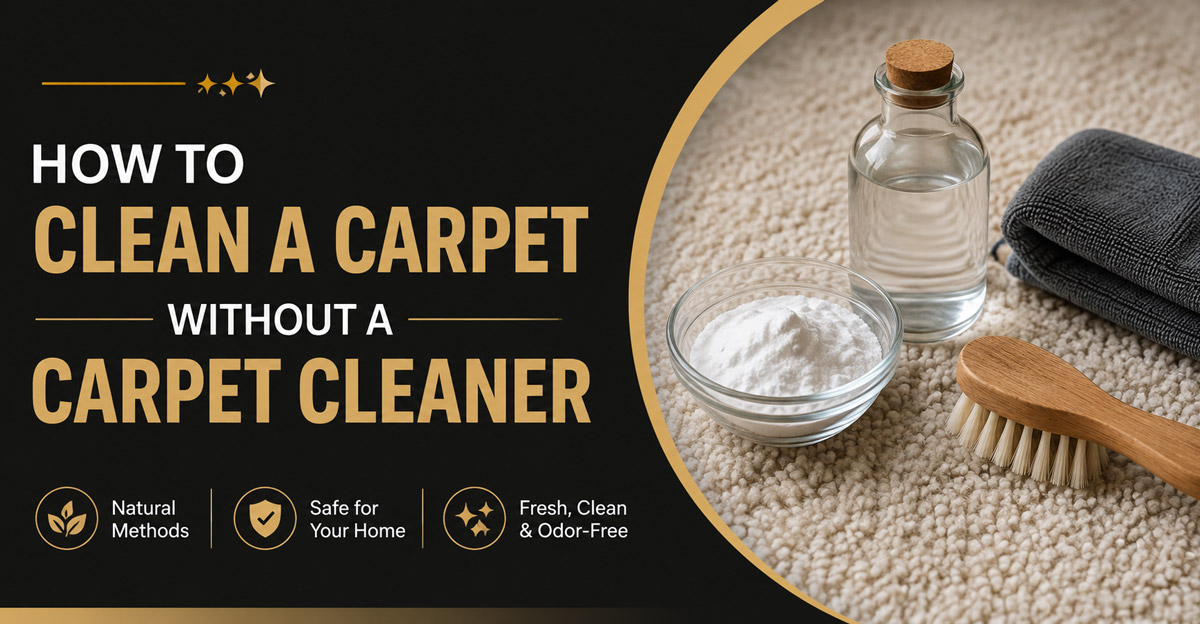
You can clean a carpet without a carpet cleaner by applying a mixture of clear dish soap, white vinegar, and warm water, scrubbing the fibers with a nylon brush, and blotting the area completely dry with white towels. This manual extraction process removes dirt and sanitizes synthetic fibers effectively.
At a Glance
- Pure baking soda requires 20 minutes of dwell time to absorb and neutralize deep carpet odors.
- Standard laundry detergent leaves a sticky residue that rapidly attracts new dirt to carpet fibers.
- Wool and silk carpets suffer permanent damage from highly alkaline cleaners like baking soda.
- Carpets must dry completely within 24 hours to prevent dangerous mold and mildew growth in the padding.
- A wet/dry shop vacuum significantly accelerates drying time when used without the internal paper filter.
What household items effectively remove carpet stains?
You can remove carpet stains using pure baking soda, clear liquid dish soap, and distilled white vinegar. These three household items create specific chemical reactions that break down dirt, neutralize odors, and sanitize fibers without requiring industrial machinery.
Different types of carpet messes require specific chemical ratios to break down stains without damaging the fibers. The standard formulation for general spot cleaning requires mixing one-quarter teaspoon of clear dish soap with one cup of warm water. Clear dish soap (like Dawn) suspends grease and dirt particles in the water.
For deep sanitizing and heavy stain removal, mix one part white vinegar with three parts warm water. You can add one tablespoon of baking soda per cup of liquid to this vinegar mixture for tough stains. The reaction between the acetic acid in the vinegar and the sodium bicarbonate physically lifts debris from the base of the carpet pile. For simple odor removal, sprinkle 100 percent pure baking soda generously over the carpet at a rate of one cup per 10 square feet.
How do you manually deep clean an entire carpet step by step?
You deep clean a whole carpet manually by pre-treating stains, applying a cleaning solution, agitating the fibers with a brush, and repeatedly blotting the area with dry towels. This sequence mimics the action of an extraction machine using physical labor.
- Clear and Vacuum: Remove all furniture from the room. Vacuum the entire area twice in crisscross directions to lift dry particulate matter.
- Pre-treat Stains: Spray your specific vinegar-water or soap-water solution directly onto visible spots.
- Apply Fresh Solution: Spray the entire carpet lightly with the vinegar-water mixture. The carpet should become damp but never soaked.
- Agitate the Fibers: Use a medium-bristle nylon scrub brush to work the solution into the pile. Scrub in a circular motion while working in tight 3×3 foot sections.
- Blot and Rinse: Press clean white towels heavily into the carpet to absorb loosened dirt. Mist the area lightly with pure water and blot again to remove any remaining soap residue.
- Dry the Room: Open all windows and turn on ceiling or floor fans.
What is the optimal water temperature for hand scrubbing synthetic carpets?
The optimal water temperature for manually scrubbing synthetic nylon or polyester carpets is between 105 and 115 degrees Fahrenheit. Water in this temperature range accelerates the chemical action of dish soap without melting the synthetic fibers or permanently setting protein-based stains.
Cold water fails to activate the surfactants in most liquid soaps. Boiling water will permanently warp synthetic carpet backing and dissolve the glue holding the carpet pad together. You should heat your water until it feels very warm to the touch but not hot enough to burn your skin. Practitioner data indicates that cleaning efficiency increases by 10 percent for every 10 degrees of heat added above room temperature (up to the 115-degree safety limit).
What carpet materials will baking soda and vinegar permanently damage?
Baking soda and heavy water saturation will permanently damage wool and silk carpets. Baking soda is highly alkaline and strips the natural protective proteins found in natural animal fibers.
Applying standard DIY cleaning solutions can permanently ruin high-end or specialized carpets. Wool fibers become brittle, snap easily, and experience severe color bleeding when exposed to high-pH cleaners. Silk carpets lose their structural integrity entirely when exposed to standard household vinegar.
| Carpet Material | Safe DIY Cleaners | Dangerous Cleaners | Max Water Level |
| Nylon | Vinegar, Dish Soap, Baking Soda | Bleach | Damp |
| Polyester | Vinegar, Dish Soap, Baking Soda | Oil-based solvents | Damp |
| Wool | pH-neutral wool detergent only | Baking Soda, High-pH soaps | Light Mist |
| Silk | Dry cleaning solvents only | Vinegar, Heavy Water | None |
What is the best alternative to baking soda for natural wool carpets?
The best alternative to baking soda for neutralizing odors on wool carpets is a commercially formulated, pH-neutral wool-safe detergent applied with minimal moisture. This protects the natural keratin structure of the sheep fiber.
If you must treat a wool carpet using only household supplies, you can use a highly diluted mixture of one tablespoon of white vinegar per quart of cold water. The slight acidity of the vinegar safely aligns with the natural pH of wool. You must strictly avoid working baking soda into the pile. The abrasive powder acts like microscopic glass on delicate wool yarns, physically shredding the fibers every time someone walks on the rug.
How do you clean pet urine accidents without a machine?
You clean pet urine from a carpet manually by flooding the spot with a biological enzymatic cleaner and blotting it repeatedly until dry. You must never use ammonia-based cleaners on pet accidents under any circumstances.
Ammonia smells chemically identical to urine to dogs and cats. Using it induces the animal to remark the exact same spot immediately. Pet urine contains uric acid crystals that standard soap and water cannot dissolve. Enzymatic cleaners contain live bacteria that physically eat the uric acid crystals. You must pour the enzyme cleaner heavily over the spot, let it sit for 15-20 minutes to digest the proteins, and then press heavily with folded towels to extract the liquid.
How do you lift oil and grease stains from carpet fibers?
You lift oil and grease stains by applying a heavy dusting of dry cornstarch directly to the spill before introducing any water. Water-based solutions will fail entirely if applied to fresh grease.
Let the dry cornstarch or baking soda sit on the grease stain for at least four hours. The dry powder acts as a sponge and absorbs the lipids directly out of the carpet fibers. Once the powder turns yellow or brown, vacuum it up completely. After you extract the bulk of the oil with the dry powder, you can spot-treat the remaining shadow using highly concentrated clear dish soap and warm water. The dish soap will encapsulate the remaining grease molecules.
How do you remove blood and red wine from carpets?
You remove blood and red wine by treating the stain exclusively with ice-cold water or a 3 percent hydrogen peroxide solution. You must never use warm or hot water on these spills.
Heat permanently sets proteins and natural pigments into synthetic carpet dyes. For fresh blood, blot the area with a towel soaked in ice water until the transfer stops. If the stain has dried, apply 3 percent hydrogen peroxide directly to the spot. The peroxide causes an oxidation reaction that chemically destroys the color structure of the blood or wine. You must only use peroxide on light-colored carpets, as it acts as a mild bleaching agent and can strip the dye from dark carpets.
How long does a manually cleaned carpet take to dry?
A manually cleaned carpet typically takes 6 to 12 hours to dry completely if you blotted the area properly and utilized room fans. Over-saturated carpets can take up to 48 hours to dry.
The Carpet and Rug Institute (2022) guidelines dictate that any carpet must dry entirely within 24 hours to prevent mold growth. Manual cleaning inherently leaves more moisture behind than machine extraction. To hit the 6-12 hour window, you must stand on dry bath towels over the wet area to press out maximum moisture using your body weight. You must also maintain active air circulation across the surface of the carpet during the entire drying period.
Can you use a wet/dry shop vacuum to dry a carpet?
Yes, you can use a standard wet/dry shop vacuum to pull residual moisture out of a manually cleaned carpet. This method significantly speeds up drying times and removes more deep-seated dirt than towel-blotting alone.
Before using the vacuum, you must open the canister and completely remove the pleated paper dry filter. Leaving the paper filter inside will ruin the motor when water hits it. Press the flat plastic nozzle firmly into the carpet pile and pull it slowly backward in straight, overlapping lines. Typical practitioner figures show that a 5-horsepower shop vacuum extracts up to 60 percent more water than heavy manual towel blotting.
Can you use laundry detergent to hand wash carpets?
No, you cannot use laundry detergent to hand wash carpets because it is engineered for complete submersion and is extremely difficult to rinse out manually.
Laundry detergent leaves a sticky, invisible residue on carpet fibers. This remaining soap acts as a literal dirt magnet. Within three weeks of cleaning, the detergent residue will attract dust from the air and dirt from shoes, leaving the carpet looking significantly worse than before you cleaned it. You must stick to highly diluted clear dish soap, which rinses away easily with a light water mist.
Will vinegar leave a permanent smell on your carpet?
No, the pungent smell of white vinegar is completely temporary and dissipates entirely as soon as the liquid dries.
Vinegar is composed of acetic acid and water. As the water evaporates, the volatile acid compounds evaporate with it. Furthermore, vinegar acts as a natural deodorizer. As it evaporates from the carpet fibers, it chemically neutralizes and carries away trapped ambient odors. If your carpet still smells like vinegar after 24 hours, the room lacks sufficient ventilation and the carpet pad is still holding liquid.
Why do carpet stains reappear a few days after manual cleaning?
Carpet stains reappear a few days after manual cleaning due to the wick-back effect. This happens because the original spill seeped completely through the carpet backing and into the sponge-like underlayment padding.
Manual cleaning only scrubs the top layer of the carpet pile. When you clean the surface, the visible stain disappears. However, as the surface dries, capillary action draws the remaining spilled liquid up from the padding and back into the tips of the carpet fibers. Standard practitioner data indicates wick-back occurs in 15-20 percent of manual spot treatments. To fix this, you must clean the spot again and immediately place a stack of dry paper towels weighed down by a heavy book over the wet area. The paper towels will absorb the wicking liquid as it rises.
How do you fix a crunchy carpet after using liquid dish soap?
You fix a crunchy carpet by aggressively re-rinsing the stiff area with pure water or a highly diluted vinegar solution to strip the remaining soap residue.
A crunchy texture after drying indicates that you used too much dish soap or failed to blot the area sufficiently. To break down the hardened soap, mix one part white vinegar with four parts warm water. Spray this stripping solution over the crunchy fibers. Agitate the area lightly with a brush to dissolve the soap cast, and then press heavily with clean, dry towels until no more suds appear on the cloth.
What is the cost difference between manual cleaning and renting a machine?
Manual carpet cleaning costs less than 10 dollars in basic household supplies, while renting a commercial carpet cleaner typically costs between 35 and 60 dollars per day.
While the financial cost of manual cleaning is nearly zero, the physical labor cost is exceedingly high. Hand-scrubbing a standard 12×12 foot room takes roughly two hours of intense physical exertion, whereas a rental machine can complete the same room in 20-30 minutes.
| Cleaning Method | Average Cost | Time for One Room | Best Used For |
| DIY Manual Method | $5 – $10 | 120 minutes | Spot treatments, single rooms |
| Rental Machine | $35 – $60 | 30 minutes | Whole houses, seasonal cleaning |
| Professional Service | $150 – $300 | 15 minutes | Deep stains, warranty requirements |
How often should you manually clean high-traffic carpet areas?
You should manually clean high-traffic carpet areas, such as entryways and hallways, every 3-6 months to prevent abrasive dirt from permanently scratching and dulling the synthetic fibers.
Routine maintenance extends the lifespan of a carpet significantly. You should vacuum these high-traffic lanes twice a week to remove dry soils. You only need to apply the wet manual soap-and-vinegar method when the traffic lanes begin to look visibly darker than the surrounding carpet. Cleaning more frequently than every 3 months with wet solutions increases the risk of soap buildup and premature fiber wear.
When should you hire a professional instead of hand washing a carpet?
You must pivot to a professional service if your carpet develops a sour, musty odor after cleaning or if you are dealing with biohazards like heavy blood or sewage backups.
A musty odor indicates that the carpet remained wet for more than 48 hours and mold has colonized the padding underneath. Manual cleaning cannot fix mold. Additionally, most major carpet manufacturers require you to hire a certified professional extraction service every 12-18 months to keep the warranty valid. The Institute of Inspection, Cleaning and Restoration Certification (IICRC, 2023) standards state that manual hand-washing does not satisfy these warranty requirements because it fails to extract soils from the lowest level of the carpet backing.
The Bottom Line
You can achieve excellent results cleaning a carpet without a machine by utilizing the chemical reactions of dish soap, white vinegar, and baking soda. The success of this manual process relies entirely on your willingness to agitate the fibers thoroughly and blot the area completely dry. You must always match your cleaning solution to the specific stain type and strictly avoid saturating the carpet pad to prevent mold growth.