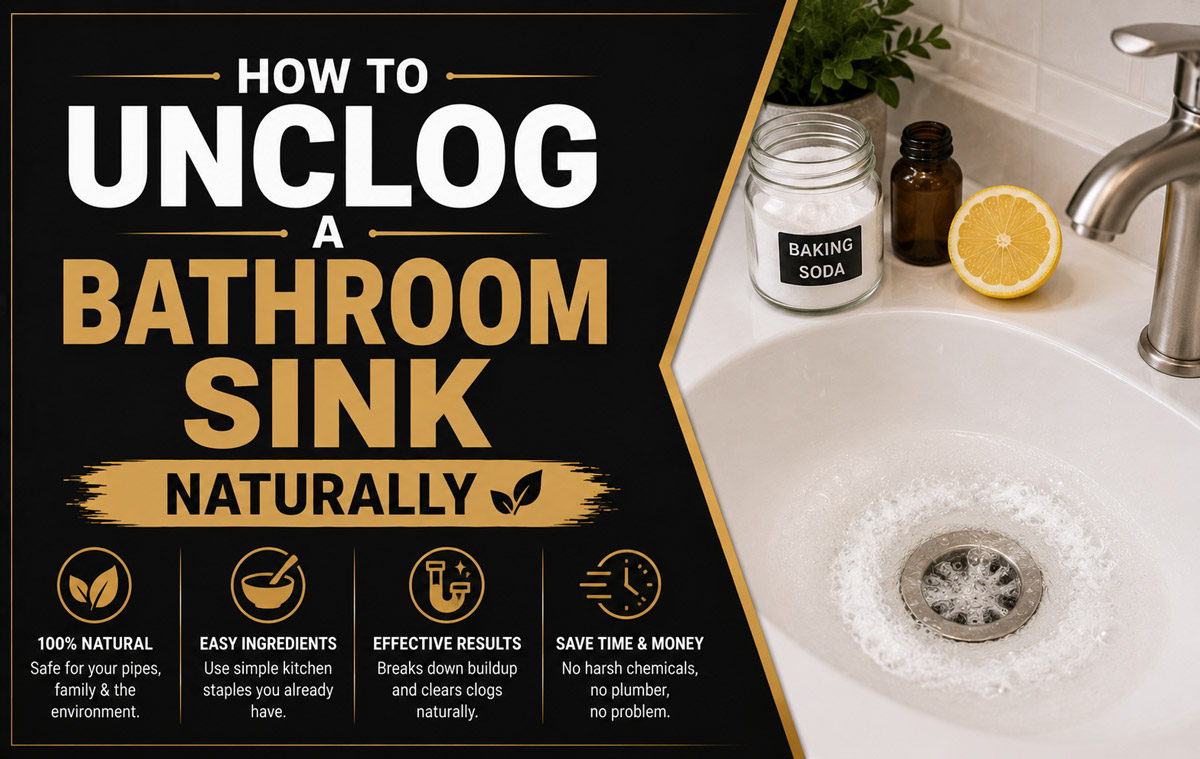
To unclog a bathroom sink naturally, remove visible debris and trapped hair first, then plunge the drain with the overflow sealed. Flush loosened residue with hot tap water, and use baking soda followed by vinegar only for light soap buildup or odor. A physical drain tool usually works better than a homemade mixture on dense hair clogs.
Key Facts at a Glance
- Hair and soap residue cause most clogs located near a bathroom sink stopper.
- A plastic drain snake is usually more effective than baking soda and vinegar for a hair blockage.
- Covering the overflow opening is necessary to create useful plunging pressure.
- Hot tap water can soften soap residue, but it cannot dissolve a compact mass of hair.
- Baking soda and vinegar produce carbon dioxide, water, and sodium acetate, but the reaction does not create a powerful drain solvent.
- A clog that affects several fixtures usually requires professional drain inspection.
Before You Start
Most natural bathroom sink unclogging jobs take 15-45 minutes and cost $0-$20. The job is beginner-friendly when the blockage is in the stopper, drain opening, or P-trap. Success depends mainly on matching the method to the material causing the obstruction.
| Item | Typical requirement | Purpose |
| Rubber gloves | 1 pair | Protect hands from dirty water and sharp debris |
| Bucket or bowl | 1-2 gallons | Catch standing water and trap contents |
| Old towels | 2-3 | Protect the vanity and floor |
| Plastic drain snake | 18-25 inches | Extract hair near the drain opening |
| Sink plunger | 4-6 inch flat cup | Dislodge compact material with pressure |
| Baking soda | 1/2 cup | Loosen light residue and absorb odor |
| White vinegar | 1 cup | React with baking soda and loosen mineral film |
| Dish soap | 2-4 tablespoons | Lubricate sticky soap and oily product residue |
| Hot tap water | 1-2 gallons | Flush loosened material |
| Adjustable pliers | 1 pair | Loosen P-trap slip nuts when necessary |
Check for chemical drain cleaner first
Do not add vinegar, baking soda, bleach, or another cleaner if a commercial drain opener was recently poured into the sink. Some drain cleaners contain highly corrosive chemicals, and Poison Control advises against mixing household cleaning products because incompatible combinations can release dangerous fumes or cause splashing reactions.
Wear gloves and ventilate the room if the drain history is uncertain. Tell a plumber exactly what product was used before anyone opens the trap or inserts a powered snake.
Remove as much standing water as possible
Scoop standing water into a bucket before adding any dry material. Baking soda cannot reach the clog effectively when it floats or clumps in a basin full of water.
Leave approximately 1-2 inches of water only when preparing to plunge. That shallow layer helps the plunger cup form a hydraulic seal.
Which Natural Method Should You Use?
Choose the method according to the clog’s likely composition and location. Bathroom sink blockages are usually made from hair, soap, toothpaste, shaving residue, skin oils, cosmetics, or a combination of these materials.
| Method | Best use | Typical time | Typical cost | Main limitation |
| Remove stopper debris | Visible hair and sludge | 5-10 minutes | $0 | Reaches only the upper drain |
| Plastic drain snake | Hair within 6-20 inches | 5-15 minutes | $3-$10 | May not pass a sharp trap bend |
| Sink plunger | Soft compact clog | 5-10 minutes | $5-$15 | Requires a sealed overflow |
| Dish soap and hot water | Sticky soap or grooming products | 15-20 minutes | $0-$3 | Weak against dense hair |
| Baking soda and vinegar | Light film and odor | 20-40 minutes | $1-$4 | Limited mechanical force |
| Baking soda and salt | Mild soap residue | 30-60 minutes | $1-$3 | Slow and unreliable on complete clogs |
| Clean the P-trap | Material lodged under sink | 20-40 minutes | $0-$10 | Can leak if reassembled incorrectly |
| Hand auger | Deeper branch-line clog | 30-60 minutes | $20-$50 | Requires care and more skill |
Practitioner rule: If the sink contains standing water, begin with physical removal or plunging. Do not begin by pouring several household ingredients into water that cannot drain.
Step 1: Diagnose the Clog Before Treating It
Run a small amount of water and observe where, how quickly, and under what conditions it backs up. A drain that slows gradually usually contains accumulating hair and soap near the stopper, while a sudden complete blockage may involve a dropped object or compact plug.
Use these symptoms to narrow the cause:
| Symptom | Most likely cause | First method |
| Water drains slowly but continuously | Hair and soap near stopper | Remove stopper and use drain snake |
| Water stops completely | Dense hair plug or foreign object | Extract debris, then plunge |
| Drain gurgles after emptying | Partial downstream clog or vent issue | Clean trap, then assess other fixtures |
| Odor appears without slow drainage | Overflow-channel biofilm or dry residue | Clean stopper and overflow |
| Sink and tub drain slowly together | Shared branch-line blockage | Stop DIY treatment and call a plumber |
| Water leaks inside vanity | Loose joint, cracked trap, or failed seal | Repair leak before unclogging |
| Clog returns within days | Material remains deeper in line | Clean P-trap or use hand auger |
You will know the diagnosis is useful when one method clearly matches both the symptom and likely clog location. Avoid cycling randomly through several mixtures because each extra substance makes later disassembly messier.
Step 2: Remove the Stopper and Pull Out Hair
Remove the stopper and extract visible hair before using any liquid treatment. In many bathroom sinks, the entire clog is wrapped around the stopper stem or packed directly beneath it.
Lift-out, push-and-pull, and twist-and-lock stoppers may come out from above. A standard pop-up stopper usually connects to a horizontal pivot rod beneath the sink. Place a towel under the plumbing, loosen the retaining nut, pull the pivot rod back gently, and lift the stopper from the basin.
Wipe the stopper with paper towels or an old cloth. Insert a barbed plastic drain snake 6-18 inches into the drain, rotate it slightly, then pull it upward slowly. Repeat until the tool returns with little or no hair.
Do not force the plastic tool around a solid obstruction. Aggressive pushing can wedge debris more tightly or leave a disposable tool stuck in the bend.
Success checkpoint: Run one cup of water. The drain should empty faster, without immediately rising around the opening.
Common mistake: Pulling extracted hair across the sink surface. Place it directly into a trash bag because rinsing it back down another drain recreates the problem.
Step 3: Plunge the Sink With the Overflow Sealed
A sink plunger dislodges soft clogs by alternating pressure and suction. The method works only when the overflow opening is blocked, since an open overflow allows air to escape instead of directing force into the drain.
Cover the overflow hole with a wet cloth, strong waterproof tape, or the palm of a gloved hand. Add enough water to cover the plunger rim, usually 1-2 inches.
Center a flat-cup sink plunger over the drain. Press down slowly to release trapped air, then make 10-15 firm vertical strokes while maintaining the seal. Pull up sharply on the final stroke.
Repeat the cycle two or three times. Remove any debris that rises into the basin rather than allowing it to wash back down.
Success checkpoint: The water forms a fast vortex and empties without pooling.
Common mistake: Using a toilet flange plunger without folding the flange inward. A flat cup seals more reliably against a sink basin.
Expert insight: Controlled strokes work better than violent plunging. Sideways movement breaks the seal, while extreme pressure can loosen aging slip-joint plumbing under the vanity.
Step 4: Flush With Dish Soap and Hot Tap Water
Dish soap and hot tap water work best after hair has been removed. The soap’s surfactants can loosen greasy grooming products, skin oils, toothpaste binders, and sticky soap residue coating the pipe.
Poison Control describes hand dish soaps as surfactant-based products that help break down grease. That property makes dish soap useful as a lubricant and residue remover, but it does not make it a hair-dissolving chemical.
Pour 2-4 tablespoons of liquid dish soap into the open drain. Wait 10 minutes, then flush with 1-2 gallons of hot tap water in several stages.
Use hot tap water rather than a kettle of aggressively boiling water. Very hot water offers little additional benefit against hair, and extreme temperature changes can stress certain plastic fittings, seals, porcelain surfaces, or older plumbing repairs.
Success checkpoint: Water continues flowing freely after a full basin is released.
Common mistake: Using a large amount of soap. Excess detergent creates foam, slows observation, and may leave another sticky residue if the drain still moves poorly.
Step 5: Use Baking Soda and Vinegar for Light Buildup
Baking soda and vinegar can loosen light surface residue and reduce odor, but the mixture is less effective against a dense hair plug. Use it after manual hair removal, not as the automatic first treatment for a completely blocked sink.
Pour 1/2 cup of baking soda into the mostly dry drain. Follow it with 1 cup of white vinegar, then cover the opening with a stopper or damp cloth. Wait 15-30 minutes and flush with hot tap water.
The American Chemical Society explains that sodium bicarbonate and vinegar react to form carbon dioxide gas, water, and sodium acetate. The visible fizz confirms a chemical reaction, but fizzing alone does not prove that a compact clog is being dissolved.
In an open drain, much of the carbon dioxide escapes through the drain opening, overflow passage, or vent system. The mixture may agitate loose film, yet it cannot match the pulling action of a barbed tool or the hydraulic movement created by a correctly sealed plunger.
Success checkpoint: Odor decreases and water drains faster after the final flush.
Common mistake: Assuming more ingredients create more force. Oversized quantities often react in the basin rather than at the blockage.
The limitation of baking soda and vinegar
Baking soda and vinegar partially neutralize each other. Their reaction is useful for fizzing agitation, but the final mixture is not a strong acid or strong alkali capable of rapidly decomposing hair.
That limitation matters. A method can be natural and still be poorly matched to the clog. For bathroom drains, mechanical extraction is usually the more reliable natural approach because it removes the obstructing material rather than attempting to dissolve it.
Step 6: Try Baking Soda and Salt Without Vinegar
Baking soda and salt offer a vinegar-free option for a slow drain coated with mild soap residue. The method is inexpensive, but it should not be expected to clear a fully stagnant basin.
Combine 1/2 cup of baking soda with 1/2 cup of table salt. Pour the dry mixture into the drain, let it sit for 30-60 minutes, then flush with hot tap water.
The salt provides mild abrasion where water movement carries the crystals against residue. Baking soda helps absorb odors and can loosen some surface grime. Neither ingredient dissolves hair efficiently.
Success checkpoint: A slow drain improves enough that a full basin empties without stopping.
Common mistake: Repeating the method many times. If one application produces no measurable improvement, switch to trap cleaning or a hand auger.
Step 7: Remove and Clean the P-Trap
Clean the P-trap when upper-drain methods fail or when you can feel a hard obstruction below the sink. The curved trap often collects jewelry, toothpaste caps, hardened sludge, hair, and objects that a short plastic tool cannot reach.
Turn off the faucet and clear the vanity cabinet. Place a bucket directly beneath the trap and spread towels around it.
Loosen the two slip nuts by hand. Use adjustable pliers gently if the nuts are tight, taking care not to crush plastic fittings or scratch plated metal. Lower the curved trap and empty its contents into the bucket.
Push a flexible bottle brush or cloth through the removed trap. Inspect the washers for cracks, flattening, or distortion. Reinstall the trap in its original orientation, seat each washer correctly, and tighten the nuts by hand before adding a small quarter-turn where necessary.
Run water for 30 seconds while wiping each connection with dry tissue. Tissue reveals small leaks sooner than a dark cabinet floor.
Success checkpoint: The sink drains quickly and both trap joints remain dry.
Common mistake: Overtightening plastic slip nuts. Excess force can distort the washer, crack the nut, or create the leak the user was trying to avoid.
What Should You Do If the Sink Is Still Clogged?
A sink that remains blocked after stopper cleaning, plunging, and trap cleaning probably contains material farther down the branch line. Use a manual hand auger only when no corrosive drain product is present and the plumbing can be accessed safely.
Feed the cable into the wall-side drain after removing the P-trap. Advance it gradually while rotating the drum. When resistance appears, work the cable back and forth rather than forcing it.
Retract the cable, clean away debris, and repeat until the line accepts the cable more freely. Reassemble the trap and test the drain with a small amount of water before filling the basin.
Stop if the cable will not advance, repeatedly returns clean, or appears to enter another fixture’s line. Those signs may indicate a fitting transition, venting issue, damaged pipe, or obstruction requiring professional equipment.
Common Mistakes and How to Fix Them
| Mistake | Why it fails or creates risk | Recovery |
| Pouring ingredients into standing water | The treatment becomes diluted before reaching the clog | Scoop out water and begin with extraction |
| Ignoring the overflow while plunging | Air escapes and pressure never reaches the blockage | Seal the overflow completely |
| Mixing vinegar with bleach | Acid and bleach can release hazardous chlorine gas | Leave the area, ventilate, and seek poison guidance |
| Adding natural products after drain cleaner | Unknown reactions and corrosive splashing may occur | Stop work and inform a plumber |
| Using boiling water automatically | Extreme heat may stress seals or plastic components | Use hot tap water |
| Forcing a plastic snake | The tool may break or compact the clog | Withdraw, rotate gently, or clean the trap |
| Overtightening trap nuts | Washers distort and joints leak | Loosen, reseat the washer, and hand-tighten |
| Repeating vinegar treatments indefinitely | Dense hair remains physically lodged | Switch to extraction or trap cleaning |
| Ignoring several slow fixtures | The blockage may be in a shared line | Arrange professional drain service |
Never mix bleach with vinegar or another acidic cleaner. Poison Control warns that combining bleach with an acid can produce chlorine gas, which may cause eye, throat, and respiratory irritation.
Why Is the Bathroom Sink Still Draining Slowly?
Continued slow drainage usually means part of the clog remains, the P-trap contains buildup, or the blockage sits beyond the trap. Test the sink after each method so that partial improvement is not mistaken for a complete repair.
The drain improved but remains slow
Repeat the plastic snake once, preferably after removing the stopper completely. Hair often accumulates in layers around the pivot rod and upper tailpiece.
Do not repeat every liquid treatment. Physical inspection gives more useful information than another round of fizz.
The sink drains, then backs up again
A drain that works briefly and then rises may have an obstruction farther down the branch line. Water passes through the local trap but reaches the deeper restriction faster than the pipe can carry it away.
Check whether the bathtub, shower, or another sink shows similar symptoms. More than one affected fixture points away from a simple stopper clog.
The drain gurgles
Gurgling can occur when water squeezes past a partial blockage and pulls air through the trap. It can also reflect a venting problem that natural cleaners cannot correct.
Clean the trap and observe other fixtures. Persistent gurgling, sewer odor, or trap-water loss requires a plumbing assessment.
The odor remains after the clog clears
A bathroom sink overflow passage can hold biofilm even when the main drain is open. Clean the overflow opening with a narrow brush, mild dish-soap solution, and controlled amounts of warm water.
Also clean the underside of the stopper and the pivot-rod opening. Lemon juice may mask odor temporarily, but fragrance does not remove trapped organic material.
Special Situations
Pop-up bathroom sink stoppers
Pop-up assemblies trap hair around the pivot rod, so cleaning only the visible stopper head may leave most of the clog behind. Remove the horizontal rod beneath the sink and inspect both the rod and tailpiece.
Take a photo before disassembly. The reference helps restore the correct rod position and stopper movement.
Vessel sinks without an overflow
A vessel sink without an overflow is easier to seal for plunging because there is no secondary air path. Use shallow water and moderate strokes to reduce splashing.
Confirm that the drain is designed without an overflow. Some decorative basins hide the opening beneath the rim.
Rental properties
Renters can usually remove visible hair, use a plastic drain tool, and plunge without altering permanent plumbing. Review the lease before dismantling the trap, particularly when the building has shared drainage or maintenance rules.
Document recurring problems. Frequent backups may result from a building line rather than tenant use.
Septic systems
Mechanical methods, dish soap in small quantities, baking soda, and ordinary household vinegar generally introduce less corrosive material than strong drain openers. However, no homemade mixture will fix a full tank, damaged baffle, blocked building sewer, or saturated drain field.
A bathroom sink problem that appears alongside toilet or shower backup requires system-level diagnosis.
Older metal plumbing
Old chrome-plated brass, galvanized steel, and corroded slip-joint traps can crack during disassembly. Examine the pipe for green staining, rust, pinholes, or severe flaking before applying pliers.
Stop if a joint twists together with the pipe. Replacing deteriorated components is safer than forcing them apart.
How Much Do Natural Unclogging Methods Cost?
Most surface-level bathroom sink clogs cost $0-$20 to clear when the household already owns basic tools. P-trap cleaning may cost nothing, while a reusable hand auger commonly raises the DIY cost to approximately $20-$50.
| Approach | Supply cost | Working time | Likely extra cost |
| Stopper cleaning | $0-$3 | 5-10 minutes | None |
| Plastic drain snake | $3-$10 | 5-15 minutes | Replacement tool |
| Sink plunger | $5-$15 | 5-10 minutes | None |
| Dish soap flush | $0-$3 | 15-20 minutes | None |
| Baking soda and vinegar | $1-$4 | 20-40 minutes | None |
| P-trap cleaning | $0-$10 | 20-40 minutes | $3-$15 for washers |
| Manual hand auger | $20-$50 | 30-60 minutes | Possible trap parts |
| Professional service | Varies by location | Often 30-120 minutes | Camera inspection or pipe repair |
A low supply cost does not justify unlimited DIY attempts. Water damage from a leaking trap or overflowing vanity can cost much more than timely professional service.
When Should You Call a Plumber?
Call a plumber when several fixtures are slow, wastewater returns through another drain, the clog repeatedly returns, or the pipe leaks. These conditions indicate a deeper obstruction, damaged component, venting problem, or shared-line issue that household mixtures cannot resolve.
Professional help is also appropriate when:
- A solid object fell into the drain and cannot be retrieved.
- The hand auger repeatedly stops at the same distance.
- The wall-side pipe contains standing water after the trap is removed.
- Sewage odor persists despite a full trap.
- Corroded metal plumbing begins twisting during disassembly.
- A commercial drain cleaner is trapped behind the blockage.
- Water appears inside a wall, floor, or vanity base.
- The clog returns within several days after complete trap cleaning.
Stop using the sink until the cause is identified if water leaks into cabinetry or building materials.
How Can You Prevent Another Bathroom Sink Clog?
Prevent bathroom sink clogs by intercepting hair, cleaning the stopper regularly, and limiting thick grooming products that enter the drain. Small maintenance actions are more effective than monthly chemical reactions performed after a large plug has already formed.
Use a removable drain screen where the stopper design permits it. Brush loose hair from the basin and place it in the trash rather than rinsing it away.
Once a week, remove visible material from the drain opening. Once a month, clean the stopper, pivot rod, and overflow opening with dish soap and a narrow brush.
Run warm water for 15-20 seconds after toothpaste, shaving cream, facial masks, or oily products enter the basin. The extra flow carries diluted residue beyond the trap before it can combine with hair.
Avoid flushing dental floss, cotton fibers, contact lenses, paper, medication packaging, or cosmetic applicators. These items do not break down reliably and can anchor a larger obstruction.
Frequently Asked Questions
Can you unclog a bathroom sink without vinegar?
Yes. Remove the stopper, pull out hair with a plastic drain snake, seal the overflow, and plunge the drain. Dish soap followed by hot tap water can flush sticky residue after the hair is removed. Cleaning the P-trap is the strongest vinegar-free option when the blockage sits beneath the sink.
Will baking soda alone unclog a bathroom sink?
Baking soda alone may absorb odor and loosen light surface film, but it will not reliably remove a compact hair clog. Pouring baking soda into standing water also dilutes and clumps the powder. Use a drain snake or plunger first, then apply baking soda only as a secondary cleaning treatment.
Can salt unclog a bathroom sink?
Salt may provide mild abrasive action when combined with baking soda and flushed through a slow drain. It cannot cut through a dense bundle of hair or retrieve a dropped object. If one salt treatment produces no improvement, clean the stopper or P-trap instead of repeating it.
Should you use bleach to unclog a bathroom sink?
No. Bleach is a disinfectant, not a dependable hair-clog remover, and it should never be mixed with vinegar, acids, ammonia, or unknown drain products. Poison Control warns that incompatible cleaning mixtures can produce hazardous fumes. Use mechanical removal and keep bleach out of a blocked drain.
Why does my bathroom sink clog so often?
Recurring bathroom sink clogs usually result from hair collecting around the stopper or pivot rod, combined with soap, toothpaste, cosmetics, and skin oils. A clog that returns immediately after complete stopper and trap cleaning may be farther down the branch line or related to poor venting or damaged plumbing.
Can a natural drain cleaner damage pipes?
Ordinary quantities of baking soda, vinegar, dish soap, and hot tap water are generally less aggressive than corrosive drain openers, but misuse can still create problems. Excess solids may settle in a stagnant drain, extreme heat may stress components, and any product can be unsafe when mixed with previously used chemicals.
The Bottom Line
The most reliable way to unclog a bathroom sink naturally is to remove the obstruction physically. Clean the stopper, pull out hair with a plastic drain snake, seal the overflow, and plunge before using homemade mixtures.
Dish soap and hot tap water can flush sticky residue, while baking soda and vinegar are better suited to light film and odor than dense hair. Clean the P-trap when surface methods fail, and call a plumber when several fixtures are affected, leaks appear, or the blockage repeatedly returns.