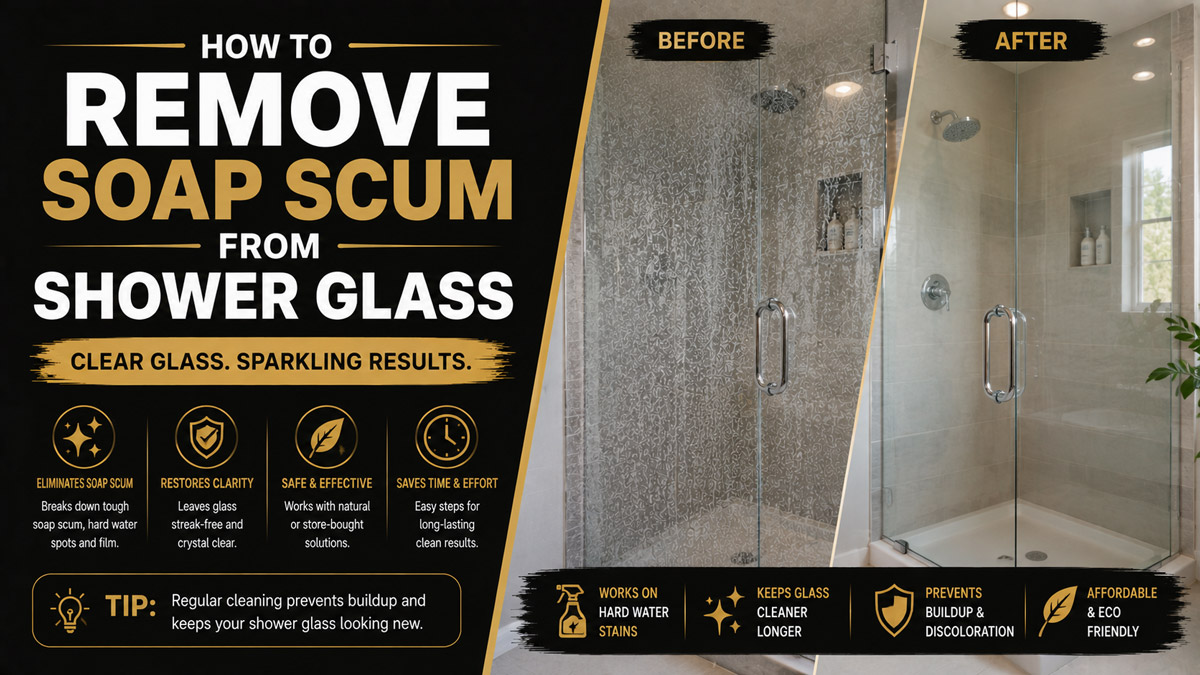
The most effective way to remove soap scum from shower glass is applying a heated mixture containing equal parts white vinegar and water, plus one tablespoon of liquid dish soap. Spray the solution onto the glass panel. Let the acidic mixture sit for 15 minutes before scrubbing gently with 0000-grade steel wool.
At a Glance
- Soap scum chemically bonds with glass minerals permanently if left untreated for more than 14 days.
- White vinegar with a 5 percent acidity level breaks down alkaline mineral deposits effectively.
- Only 0000-grade steel wool is soft enough to scrub glass without causing permanent micro-scratches.
- Acidic cleaners will instantly etch and ruin natural stone tile adjacent to shower enclosures.
- Switching to a liquid body wash produces 90 percent less scum buildup than using traditional bar soap.
What is the exact chemical composition of shower soap scum?
Shower soap scum is a white solid precipitate formed when the fatty acids in bar soap react with calcium and magnesium ions present in hard water. This chemical reaction creates an insoluble compound called calcium stearate or magnesium stearate. The resulting compound binds aggressively to vertical surfaces and hardens as the ambient water evaporates.
Understanding this composition explains why basic water and cloth wiping fails to clean the glass. Calcium stearate is entirely insoluble in water. You must introduce a mild acid to break the mineral bonds and a strong surfactant to cut through the hardened animal fats. Professional glass restoration specialists typically observe that an average household of four produces enough calcium stearate to cover a standard glass enclosure in an opaque layer within just ten days of regular use. The dual nature of this compound requires a dual-action cleaning approach.
What is the difference between hard water stains and soap scum?
Hard water stains are purely mineral deposits left behind when water evaporates, whereas soap scum is a chemical compound of those minerals bound together with animal fats and talc from soap. You can identify the difference visually. Hard water leaves distinct white spots with defined edges that feel chalky to the touch. Scum creates an opaque, continuous waxy film that feels slick when wet and slightly sticky when dry.
The distinction determines your removal strategy. Pure mineral spotting responds immediately to mild acids like lemon juice. Fatty acid compounds require heavy-duty degreasers alongside the acid. If your shower enclosure shows chalky rings near the top and an opaque white haze near the bottom, you are dealing with both issues simultaneously. The top layer is pure evaporation residue. The bottom layer is the heavy, gravity-fed accumulation of fats and minerals mixed together during the bathing process.
What is the most effective homemade solution for shower glass?
The most effective homemade solution for cleaning shower enclosures combines one cup of white vinegar, one cup of distilled water, and one tablespoon of heavy-duty grease-cutting dish soap. The acetic acid present in the vinegar dissolves the hardened mineral components. Simultaneously, the dish soap surfactants break down the lipid layers and fatty acid binders holding the residue to the glass.
This specific chemical pairing outperforms many commercial products because it tackles both the alkaline and lipid structures of calcium stearate simultaneously. Distilled water is a necessary ingredient because tap water introduces more of the exact minerals you are trying to dissolve.
| Cleaner Type | Active Ingredient | Application Time | Estimated Cost per Ounce | Best Use Case |
| Vinegar and Dish Soap Mix | Acetic Acid (5%) | 15 minutes | $0.08 | Weekly maintenance and light buildup |
| Sulfamic Acid Spray | Sulfamic Acid | 5 minutes | $0.45 | Heavy mineral scaling and neglected glass |
| Baking Soda Paste | Sodium Bicarbonate | 30 minutes | $0.12 | Enclosures adjacent to natural stone |
| Cerium Oxide Slurry | Rare-earth mineral | Machine buffing | $1.20 | Permanent physical etching repair |
How do you prepare the vinegar and dish soap mixture?
You prepare the chemical cleaning mixture by heating the vinegar first to increase its reactivity, then combining the ingredients carefully to avoid excessive foaming. Heating the acid increases the kinetic energy of the molecules and allows the solution to penetrate hardened calcium stearate much faster than a cold liquid.
- Measure exactly one cup of standard white vinegar (5 percent acidity) into a microwave-safe container.
- Heat the vinegar in the microwave for 30 seconds until warm, but not boiling.
- Pour the heated liquid into a standard 16-ounce plastic spray bottle.
- Add one cup of distilled water to the bottle.
- Add exactly one tablespoon of heavy-duty liquid dish soap last.
- Shake the bottle gently side to side. Shaking vigorously will fill the container with useless foam.
Applying the mixture while it is still warm dramatically improves the immediate dissolving power against heavy fats. Standard industry practice dictates making a fresh batch every month, as the dish soap eventually neutralizes some of the acid during long-term storage.
How long should vinegar sit on glass before scrubbing?
Vinegar should sit on shower glass for exactly 15 minutes before you begin scrubbing with an abrasive pad. This specific timeframe allows the acetic acid sufficient time to chemically break the calcium stearate bonds without allowing the liquid to evaporate completely.
If you spray and wipe the glass immediately, you rely entirely on mechanical force rather than chemical alteration. The acid never gets a chance to work. Conversely, if you wait 45 minutes, the solution dries out. The dissolved minerals simply re-adhere to the surface in a harder state. If your bathroom is particularly warm or poorly ventilated, you must lightly mist the glass with extra solution at the ten-minute mark to keep the active ingredients in a liquid state. The glass must remain continuously wet for the entire 15-minute chemical dwell time.
What grade of steel wool is safe for shower glass?
Only 0000-grade steel wool is safe for scrubbing shower enclosures. Any coarser grade (such as 000, 00, or 0) will inflict permanent micro-scratches across the transparent surface of the glass panel.
The safety of 0000-grade steel wool comes down to the Mohs hardness scale. Standard tempered shower glass has a hardness rating of roughly 5.5 on the scale. The ultra-fine steel alloy used in 0000-grade wool is significantly softer than the glass, meaning it can sheer off the calcified minerals without biting into the silica below. For highly concentrated nodules of buildup that resist ultra-fine steel wool, use a fresh razor blade held at a strict 45-degree angle. You must ensure the glass remains thoroughly lubricated with soapy water before applying any metal tool to the surface. Dry scrubbing will cause heat friction and guaranteed scratching.
Can you use melamine foam sponges on shower doors?
Yes, you can use melamine foam sponges on shower doors as a mild mechanical abrasive for light buildup. The microscopic structure of the foam acts like ultra-fine sandpaper to shave away the top layer of topical accumulation.
Melamine foam operates strictly through physical abrasion rather than chemical breakdown. Because the foam is highly porous and brittle, it wears down rapidly against heavy calcification. Cleaning an entire glass enclosure with melamine foam requires significant physical elbow grease and will likely destroy three or four sponges in a single session. Professional cleaners use melamine foam for quick touch-ups on minor water spots, but they abandon it for heavy-duty acids and steel wool when facing Stage 2 or Stage 3 hardened scaling.
How do you clean soap scum without scrubbing?
To remove soap scum from shower enclosures without scrubbing, you must apply a specialized heavy-duty chemical compound like Bio-Clean Hard Water Stain Remover or an industrial acidic foaming spray. A “no scrub” approach requires strong chemical alteration to completely dissolve the calcium stearate into a liquid state.
These specialized products use concentrated acids and mild abrasive pastes that do the physical work on a microscopic level. You apply the paste, allow a longer dwell time of 20 to 30 minutes, and rinse with high-pressure hot water. The tradeoff for avoiding manual labor is exposing your bathroom to harsher chemicals. If you choose this route, you must wear heavy gloves and ensure the bathroom exhaust fan runs continuously. Airborne acidic droplets from heavy-duty industrial cleaners irritate lung tissue rapidly.
How do you clean glass near marble or natural stone tile?
When cleaning glass adjacent to marble or natural stone, you must use a pH-neutral cleaner instead of vinegar or lemon juice. Acidic solutions will instantly and permanently etch the calcium carbonate present in natural stone tiles, leaving dull, white chemical burns across your expensive masonry.
Natural stone framing requires precision cleaning techniques. You should apply a thick, alkaline-based paste cleaner specifically formulated for stone-safe use. Paste formulations cling tightly to the vertical glass panel and do not drip down onto the marble baseboard. Before beginning any restorative work, standard protocol involves taping a plastic drop cloth over the lower stone tiles to catch any accidental runoff. If a vinegar solution does drip onto travertine or limestone, you must flood the area immediately with cold water to dilute the acid before the chemical burn sets in.
Is vinegar safe for frosted or factory-coated shower glass?
Vinegar is not universally safe for specialized shower panels and will strip the hydrophobic factory coatings found on modern doors. Harsh acids permanently damage the specialized finishes applied to high-end bathroom installations.
Modern glass panels often feature factory-applied protective layers (like Clean-Coat or EnduroShield) designed to repel water naturally. The low pH of acetic acid degrades these chemical polymers quickly. For coated panels, manufacturers mandate using only mild, pH-neutral dish soap and a soft microfiber cloth. If your bathroom features frosted or etched privacy glass, you must only use abrasives and acids on the smooth side of the pane. Scrubbing the textured, frosted side with acidic solutions or steel wool will smooth out the microscopic pits that create the frosted effect, leaving permanent patchy clear spots on the door.
How do you remove fused silicate mineral scaling from glass?
You remove fused silicate mineral scaling by applying a highly concentrated sulfamic acid cleaner or by physically shaving down the surface with a cerium oxide polishing compound. When general advice fails, you are dealing with Stage 3 buildup where the alkaline minerals have chemically fused with the silica matrix of the pane.
Standard household cleaners cannot reverse this fusion process. Sulfamic acid provides a much lower pH than household vinegar and breaks down severe crystalline structures. You must apply the acid carefully in small sections. If chemical approaches completely fail to clarify the panel, the only remaining option is mechanical removal. The glass is no longer just dirty. The surface architecture is physically altered, and you must literally grind away the microscopic top layer of the pane to reveal clear glass underneath.
How do you physically polish etched shower doors?
You polish etched shower doors by attaching a rayon buffing pad to a rotary drill, applying a rare-earth cerium oxide slurry, and working the glass panel in overlapping horizontal passes. This process mirrors the techniques auto body shops use to polish scratched windshields.
- Tape off all metal hinges and track hardware to prevent polishing dust from entering the mechanisms.
- Mix the cerium oxide powder with distilled water until it forms a thick paste resembling heavy cream.
- Apply the paste to a rayon or felt buffing pad attached to a standard rotary drill.
- Keep the drill speed firmly between 1200 and 1500 RPM to maintain control.
- Move the buffer in tight, overlapping circles across a small two-foot section.
- Stop frequently to mist the glass with water.
Heat management is the most critical factor during machine polishing. Allowing the glass to heat up from dry friction will cause the tempered panel to shatter instantly. The slurry must remain damp at all times.
How much does professional shower glass restoration cost?
Professional shower glass restoration typically costs between $200 and $500 depending on the severity of the mineral scaling and the overall square footage of the enclosure. Hiring a specialist makes financial sense when the required time and equipment costs of DIY polishing exceed the replacement value of the doors.
Glass restorers assess the damage in stages. Stage 1 topical cleaning sits at the lower end of the pricing spectrum. Stage 3 silicate fusion requires expensive machine polishing and raises the final bill substantially.
| Service Level | Condition of Glass | Typical Removal Method | Estimated Cost Range |
| Basic Detailing | Topical haze, under 2 months old | Acid wash and manual scrub | $100 – $175 |
| Deep Descaling | Hardened nodules, 6 months old | Heavy compound and razor scraping | $200 – $300 |
| Machine Polishing | Etched glass, fused silicate scaling | Rotary drill with cerium oxide | $350 – $500 |
| Complete Replacement | Structural damage, permanent clouding | Complete tear-out and new installation | $800 – $2,500 |
Why does shower glass look cloudy immediately after drying?
If shower glass looks cloudy immediately after drying despite aggressive cleaning, you are observing permanent hard water etching rather than topical residue. Hard water minerals physically pit the glass surface over time, leaving microscopic craters that diffuse light.
Water naturally finds the lowest level. Micro-droplets settle into the microscopic pores of the glass. When the water evaporates, it leaves sharp mineral crystals behind. Over years of repeated wetting and drying, these crystals act like microscopic chisels, breaking down the smooth silica surface. Cleaning cannot fix etching because etching is the absence of material. You are seeing physical damage to the pane, much like cloudiness in an old drinking glass run through a dishwasher hundreds of times. Only mechanical machine polishing will restore transparency to an etched panel.
How often should you clean shower glass to prevent mineral bonding?
You should deep clean your shower glass every 7 to 14 days to prevent the residue from permanently bonding with the surface. Beyond a two-week window, the alkaline minerals in the water begin to cross-link and fuse with the silica structure of the pane.
The fourteen-day mark represents a critical threshold in bathroom maintenance. During the first week, calcium stearate rests lightly on top of the pane. You can wipe it away with basic soap. During the second week, the compound hardens into a topical crust. By week three, the chemical bonds drop below the microscopic surface layer of the glass. Sticking to a strict weekly cleaning schedule eliminates the need for harsh acids, razor blades, and heavy physical labor entirely.
Does bar soap cause more shower scum than liquid body wash?
Yes, traditional bar soap causes significantly more buildup than liquid body wash. Switching entirely to a liquid cleanser reduces shower residue accumulation by up to 90 percent.
The mechanism behind this difference lies in the ingredients. Traditional bar soaps rely on animal fats, specifically tallow and various long-chain fatty acids, to create their solid shape and lather. These specific fats bind instantly with the heavy minerals in hard water to form insoluble calcium stearate. Liquid body washes, conversely, rely entirely on synthetic surfactants and synthetic detergents. Synthetic detergents do not undergo the same saponification reactions with hard water minerals. Therefore, liquid soaps rinse cleanly down the drain without leaving a sticky lipid film on your vertical surfaces.
How do you prevent soap scum from returning?
You prevent soap scum from returning by squeegeeing the glass after every single use and applying a hydrophobic coating like Rain-X Shower Door Water Repellent every three to four months. Prevention relies on removing the water before it can evaporate and leave minerals behind.
Keeping a small silicone squeegee hanging inside the enclosure makes daily maintenance simple. A proper wipe-down takes exactly 15 seconds after turning off the water. For an added layer of defense, you should treat the dry glass quarterly with an automotive or bathroom-specific water repellent. These chemical polymer coatings fill in the microscopic pores of the glass, creating an ultra-smooth surface that causes water to bead up and roll off instantly. You must also run the bathroom exhaust fan for 20 minutes after bathing. Lowering the ambient humidity forces the enclosure to dry faster, giving stray minerals less time to attach.
The Bottom Line
Removing heavy soap scum requires breaking both mineral bonds and fat layers simultaneously. The most reliable method combines a heated 1:1 mixture of white vinegar and water with a tablespoon of dish soap, allowed a 15-minute dwell time before scrubbing with 0000-grade steel wool. If you have natural stone framing, you must abandon vinegar entirely in favor of pH-neutral pastes to avoid permanent acid etching. To stop the cycle of endless scrubbing, switch to synthetic liquid body washes and apply a hydrophobic glass coating four times a year.