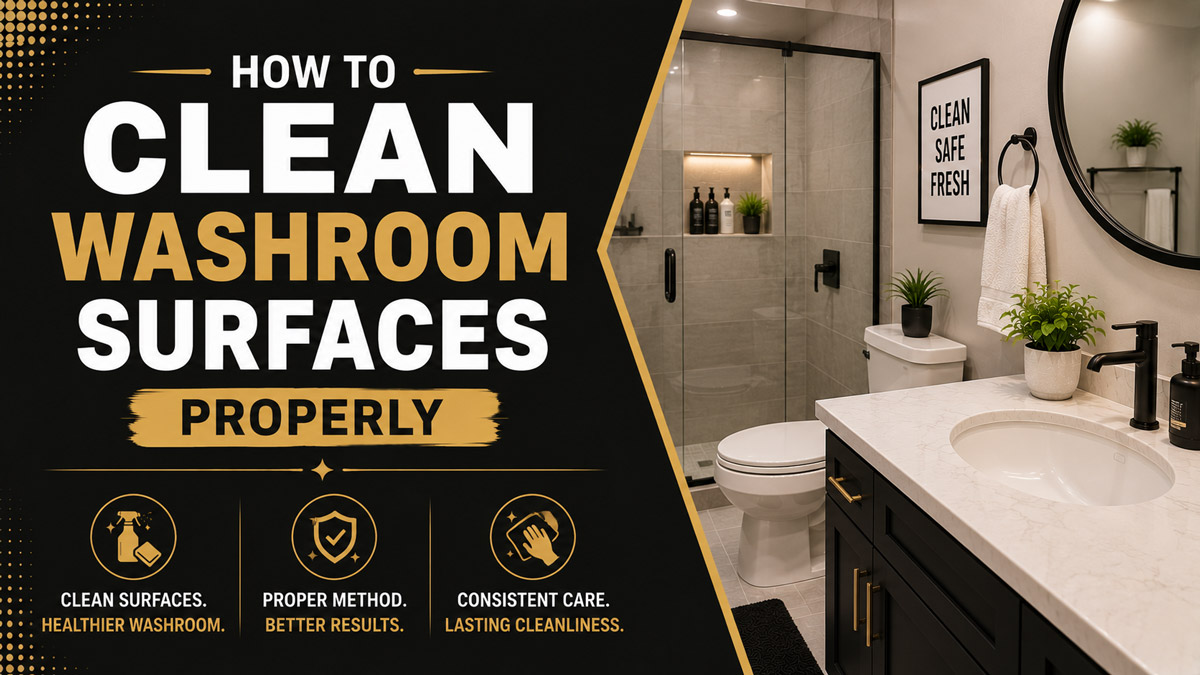
To clean a washroom, remove loose items, dust from top to bottom, apply suitable cleaners, allow the required dwell time, scrub the toilet, sink, shower, and fixtures, then rinse, dry, and mop toward the doorway. Use separate cloths for toilet areas and never mix bleach with other cleaning chemicals.
At a Glance
- Clean a washroom from top to bottom and from dry surfaces to wet surfaces.
- Remove visible dirt with detergent before applying a disinfectant.
- Keep disinfected surfaces visibly wet for the contact time printed on the product label.
- Use separate cloths for the toilet, sink, and shower to limit cross-contamination.
- Never mix bleach with vinegar, ammonia, toilet cleaner, or another disinfectant.
- Test cleaners on an inconspicuous area before treating natural stone, acrylic, coated metal, or colored grout.
What Supplies Do You Need to Clean a Washroom?
A basic washroom-cleaning kit should include gloves, microfiber cloths, a toilet brush, a non-scratch sponge, a small detail brush, detergent, a surface-compatible bathroom cleaner, and a mop. Add a squeegee, bucket, vacuum, and disinfectant when the washroom’s surfaces or hygiene conditions require them.
Use color-coded cloths where possible. A practical system is red for the toilet, blue for sinks and taps, and yellow for showers or general surfaces. The colors matter less than keeping the cloths separate.
Essential washroom-cleaning supplies
| Supply | Recommended quantity | Primary use | Important limitation |
|---|---|---|---|
| Microfiber cloths | 3-5 cloths | Fixtures, counters, glass | Do not reuse the toilet cloth elsewhere |
| Cleaning gloves | 1 pair | Skin protection | Replace torn or contaminated gloves |
| Toilet brush | 1 dedicated brush | Bowl and under-rim cleaning | Never use on another surface |
| Non-scratch sponge | 1-2 sponges | Tub, shower, sink | Avoid rough pads on acrylic or coatings |
| Detail brush | 1 small brush | Grout, hinges, tap bases | Use soft bristles on delicate finishes |
| Mild detergent | 1 product | Removing soil and residue | Cleaning does not always disinfect |
| Disinfectant | As needed | High-touch surfaces | Follow the label and contact time |
| Squeegee | 1 | Shower glass and walls | Dry the blade after use |
| Mop and bucket | 1 set | Floor cleaning | Use fresh solution for heavily soiled floors |
Choose products by surface rather than by fragrance or cleaning strength. A stronger chemical can create more damage without producing a cleaner result.
Natural stone usually needs a pH-neutral product. Acrylic tubs need non-abrasive liquid cleaners. Matte black taps generally respond best to mild detergent and a soft cloth.
What Should You Do Before Cleaning a Washroom?
Before cleaning a washroom, ventilate the room, remove movable items, put on gloves, inspect the surfaces, and read each product label. Dry preparation makes the wet-cleaning stage faster and prevents dirt from turning into muddy residue.
Start by opening a window or switching on the exhaust fan. The CDC recommends good ventilation when cleaning products are used indoors, such as opening windows and doors or operating a fan.
Remove bathmats, towels, bins, toiletries, brushes, scales, and countertop items. Place washable fabrics in the laundry and empty the trash.
Next, identify the materials in the room. Look for natural stone, acrylic, fiberglass, porcelain, ceramic tile, glass, chrome, brass, coated metal, or colored grout. The same cleaner may be safe for one material and destructive to another.
Vacuum or sweep loose hair and dust before spraying anything. Dry debris is easier to collect than wet hair stuck to a floor or shower wall.
Finally, check cleaner labels for dilution instructions, ventilation requirements, protective equipment, incompatible surfaces, and contact time. EPA guidance states that a disinfectant’s directions explain where it can be used, how it should be applied, and how long it must work.
What Is the Correct Order for Cleaning a Washroom?
The correct order is to clear the room, remove dry debris, pretreat heavily soiled areas, clean high surfaces, wash fixtures, clean the toilet, disinfect high-touch points when necessary, and finish with the floor. This sequence prevents dirty water and dust from falling onto already-cleaned surfaces.
Professionals use three basic rules:
- Work from high to low.
Dust vents, shelves, mirrors, walls, and counters before cleaning the floor. - Work from cleaner areas to dirtier areas.
Clean mirrors and sinks before handling the toilet base or surrounding floor. - Work from dry methods to wet methods.
Vacuum hair and dust before applying water or cleaning spray.
A sensible room sequence is mirror, shelves, taps, sink, shower, bathtub, toilet exterior, toilet bowl, door handles, switches, and floor.
Cleaning the toilet last limits the chance that a contaminated glove or cloth will touch the sink. Change gloves or wash gloved hands after completing the toilet area.
Do not spray every surface at once. Some cleaners can dry before their required contact time, and others may damage finishes if left too long. Pretreat only the areas you can complete within the label’s working window.
How Do You Clean a Washroom Step by Step?
Clean a washroom by clearing the room, dusting dry surfaces, applying appropriate cleaners, cleaning each fixture from least contaminated to most contaminated, rinsing residue, drying water-prone areas, and mopping the floor toward the exit.
- Ventilate and prepare the room.
Open a window or run the exhaust fan. Put on gloves and remove towels, rugs, bins, and toiletries. - Remove dust, hair, and loose debris.
Dust vents and shelves, then vacuum or sweep the floor, corners, and areas behind the toilet. - Pretreat the toilet bowl.
Apply toilet-bowl cleaner under the rim according to its label. Let the cleaner work while you clean other fixtures. - Apply cleaner to the shower and sink.
Use products compatible with the surfaces. Give soap-scum cleaner several minutes to soften buildup, but never exceed the label’s limit. - Clean the mirror and higher surfaces.
Wipe the mirror, shelves, cabinet fronts, wall marks, and light-switch area. - Clean the sink and taps.
Scrub the basin, drain area, overflow opening, tap base, handles, and backsplash. Rinse and dry polished metal to reduce water spots. - Clean the shower or bathtub.
Work from upper walls downward. Scrub corners, grout lines, fittings, doors, tracks, and the tub or shower floor. - Clean the toilet exterior.
Use a dedicated cloth. Wipe the flush control, tank, lid, seat, hinges, rim, exterior bowl, base, and surrounding floor. - Scrub the toilet bowl.
Brush under the rim and throughout the trap area. Flush according to the product directions. - Disinfect selected surfaces if needed.
Apply an appropriate disinfectant to cleaned high-touch surfaces. Keep them wet for the label’s full contact time. - Rinse and dry.
Remove cleaner residue where the label requires rinsing. Dry glass, taps, and metal trim. - Mop toward the doorway.
Start at the farthest corner and finish at the entrance. Allow the floor to dry before replacing mats and bins.
How Do You Clean a Toilet Hygienically?
Clean a toilet hygienically with dedicated tools, moving from the least contaminated parts to the most contaminated parts. Clean the flush button, tank, lid, seat, hinges, exterior bowl, base, and surrounding floor before finishing the inside of the bowl.
Apply bowl cleaner under the rim first so it has time to work. Do not combine toilet-bowl cleaner with bleach. Many toilet cleaners contain acids, and acid mixed with bleach can release dangerous chlorine gas.
Use a separate toilet cloth or disposable paper. Fold a microfiber cloth into sections and expose a clean section for each new area. Do not dip a used cloth back into a bucket of clean solution.
A practical cleaning order is:
- Flush handle or button
- Tank top and sides
- Lid top and underside
- Seat top and underside
- Hinges and rim
- Exterior bowl
- Pedestal and floor connection
- Bowl interior
Brush under the rim, down the bowl sides, and into the waterline. A persistent brown or gray ring may be mineral scale rather than ordinary dirt. Use a product labeled for mineral deposits and compatible with porcelain.
After cleaning, wash reusable cloths at the hottest suitable fabric setting and allow the toilet brush to dry before returning it to its holder.
How Do You Clean a Washroom Sink and Taps?
Clean a washroom sink with mild detergent or a surface-compatible bathroom cleaner, concentrating on the drain, overflow opening, tap base, handles, backsplash, and underside of the rim. Rinse away residue and dry the taps to prevent water spots.
Remove hair and debris from the drain stopper. Apply cleaner to the basin and let it work for the label’s recommended time.
Use a soft sponge on porcelain, ceramic, solid-surface material, or acrylic. A small brush can loosen grime around the tap base, drain flange, overflow opening, and seams.
For chrome taps, wipe with diluted mild detergent, rinse, and buff dry with microfiber. Avoid steel wool, abrasive powder, and rough scouring pads.
White mineral deposits around taps are usually caused by hard water. Vinegar may dissolve those deposits on acid-resistant glass or some chrome surfaces, but vinegar should not contact marble, limestone, travertine, or acid-sensitive sealers. The Natural Stone Institute warns that vinegar should never be used on calcareous stones such as marble, limestone, and travertine.
For matte black, brushed, plated, or specialty finishes, follow the fixture manufacturer’s instructions. Mild dish detergent and a soft cloth are usually safer than acidic descalers.
How Do You Clean a Shower, Bathtub, and Glass?
Clean a shower or bathtub from the upper walls downward, using a non-abrasive cleaner suited to the enclosure material. Allow the cleaner to soften soap scum, scrub corners and fittings, rinse thoroughly, then squeegee or dry glass and metal.
Shower-cleaning sequence
- Remove bottles, razors, soap dishes, and mats.
- Rinse loose hair and residue from the walls.
- Apply cleaner to soap-scum areas.
- Let the product work for its stated dwell time.
- Scrub walls, corners, fittings, tracks, and the floor.
- Rinse from top to bottom.
- Squeegee glass and wipe metal dry.
Soap scum contains body oils, soap residue, minerals, and soil. It often needs dwell time more than aggressive force. A non-scratch sponge generally works better than a stiff abrasive pad, especially on acrylic and fiberglass.
Use a soft brush for grout lines and textured shower floors. Pay attention to bottle shelves, door seals, showerhead joints, drain covers, and sliding-door tracks.
Cleaner selection by shower material
| Surface | Suitable routine cleaner | Avoid | Typical method |
| Tempered glass | Glass-safe detergent or approved descaler | Metal scrapers and harsh abrasives | Apply 3-5 minutes, rinse, squeegee |
| Ceramic tile | Neutral tile cleaner | Excessively abrasive powders | Scrub with soft pad, rinse |
| Acrylic tub | Mild liquid detergent | Acetone, solvents, gritty scrub | Soft sponge, light pressure |
| Fiberglass | Non-abrasive bathroom cleaner | Stiff brushes and abrasive paste | Short dwell, gentle scrub |
| Marble shower | pH-neutral stone cleaner | Vinegar, lemon, acidic descaler | Soft cloth, rinse, dry |
| Coated metal trim | Mild detergent | Strong acids and rough pads | Wipe gently and dry |
How Do You Clean Washroom Walls, Grout, and Floors?
Clean washroom walls and grout before cleaning the floor, using a cleaner compatible with the wall covering and grout type. Finish by mopping from the farthest corner toward the doorway with fresh solution.
Painted walls usually need only a damp microfiber cloth and a small amount of mild detergent. Test washable paint in a concealed area because flat or low-quality paint can burnish, fade, or lift.
For ceramic tile, apply a neutral tile cleaner and wipe from upper sections downward. Use a soft brush on grout. Excessive scrubbing can erode weakened grout, while repeated strong bleach use may fade colored grout.
Vacuum the floor before mopping. Hair and dust become difficult to collect once wet.
Apply floor cleaner according to the flooring material. Ceramic and porcelain tile tolerate many neutral cleaners, while natural stone requires a stone-safe product. Avoid flooding joints, cabinet bases, and transitions.
Give extra attention to the floor around the toilet, behind the door, under freestanding bins, and along skirting or baseboards. These areas collect splash residue and hair.
Use a separate mop solution for a heavily contaminated floor. Replacing dirty water is faster than spreading gray water across the room and later trying to remove the resulting film.
Should You Clean or Disinfect a Washroom?
Clean every washroom routinely, but disinfect selectively when illness, bodily-fluid contamination, shared use, or a high-risk occupant makes germ reduction necessary. Cleaning removes soil and many germs, while disinfecting uses a registered chemical to kill remaining microorganisms.
The CDC states that soap and water can remove most germs in ordinary household situations. Routine disinfection is generally unnecessary unless someone is sick or a sick person has recently visited.
Cleaning must come first. Dirt, soap film, and organic residue can shield microorganisms and reduce a disinfectant’s performance. EPA guidance also notes that antimicrobial products work best on clean surfaces.
Cleaning versus disinfecting
| Situation | Cleaning needed | Disinfection needed | Priority surfaces |
| Normal private household use | Yes, routinely | Usually no | Sink, toilet, shower, floor |
| Household member has vomiting or diarrhea | Yes | Yes | Toilet, flush control, taps, handles |
| Shared office washroom | Yes, frequently | Often appropriate | High-touch points and toilet areas |
| Visible bodily-fluid spill | Yes, immediately | Yes, after cleaning | Spill area and nearby touchpoints |
| Mold caused by persistent moisture | Yes, plus moisture correction | Product-dependent | Affected material and moisture source |
| Delicate natural-stone washroom | Yes | Only with stone-compatible product | High-touch stone and fixtures |
Do not treat disinfection as a substitute for cleaning. A disinfectant applied over grime can leave both residue and contamination behind.
How Long Should Disinfectant Remain on Surfaces?
A disinfectant must remain visibly wet for the exact contact time printed on its label, commonly from 1 to 10 minutes. Do not assume that spraying and immediately wiping provides disinfection.
The EPA defines contact time as the period a product must remain on a surface to be effective. The agency evaluates contact times product by product, and many hard-surface products use times within a 10-minute window.
Follow this process:
- Remove visible dirt with detergent.
- Rinse or wipe away detergent residue if required.
- Apply enough disinfectant to wet the full surface.
- Keep the surface visibly wet for the stated time.
- Reapply product if part of the surface dries too early.
- Rinse afterward only when the label requires it.
For a homemade diluted bleach solution, CDC guidance says to follow the manufacturer’s instructions. When instructions are unavailable, the CDC advises leaving the solution on the surface for at least one minute before wiping or removing it.
Contact time is not the same as total cleaning time. A five-minute contact time starts after the surface has been completely wetted.
Can You Use Bleach to Clean a Washroom?
Yes, diluted household bleach can disinfect certain hard, nonporous washroom surfaces, but bleach is not necessary for every cleaning job. Use bleach only when the product label allows it, ventilation is adequate, and the surface is bleach-compatible.
Bleach does not replace detergent cleaning. First remove dirt, body oils, soap scum, and visible contamination.
CDC guidance specifies regular, unscented household bleach containing 5-9 percent sodium hypochlorite. When a product label provides no dilution instructions, the CDC’s general surface-disinfection formula is 5 tablespoons, or 1/3 cup, per gallon of room-temperature water.
Bleach-use reference
| Requirement | Practical rule |
| Bleach type | Regular, unscented household bleach |
| Sodium hypochlorite strength | 5-9 percent |
| General fallback dilution | 1/3 cup per 1 gallon of water |
| Water temperature | Room temperature unless label says otherwise |
| Minimum fallback contact time | At least 1 minute |
| Solution lifespan | Prepare fresh daily |
| Ventilation | Open window, door, or run exhaust |
| Mixing | Never combine with another cleaner |
The CDC states, “Never mix household bleach with any other cleaners or disinfectants.”
Bleach can fade fabrics, damage colored grout, corrode some metals, discolor finishes, and irritate the respiratory system. Do not use it casually on natural stone, specialty coatings, wood, or unsealed porous material.
Which Washroom Cleaners Should Never Be Mixed?
Never mix bleach with ammonia, vinegar, acidic toilet cleaner, descaler, alcohol, or another disinfectant. Mixing cleaning chemicals can produce toxic gases, corrosive compounds, heat, splashing, or unpredictable chemical reactions.
Dangerous cleaner combinations
| Combination | Main risk | Common washroom sources |
| Bleach plus ammonia | Toxic chloramine gases | Urine residue, glass cleaner, ammonia cleaner |
| Bleach plus vinegar | Chlorine gas | Vinegar spray, homemade descaler |
| Bleach plus acidic toilet cleaner | Chlorine gas | Toilet-bowl acid, limescale remover |
| Bleach plus rubbing alcohol | Hazardous chemical byproducts | Alcohol disinfectant |
| Two drain cleaners | Violent reaction or splashing | Acid and alkaline drain products |
| Two disinfectants | Unpredictable reaction | Bleach, peroxide, quaternary products |
EPA guidance states that cleaning products should never be mixed and that adding bleach to other chemicals can create toxic vapors.
Use one product at a time. Rinse the surface thoroughly and allow ventilation before changing products, but do not improvise a chemical sequence when labels do not explicitly permit it.
If chemicals are accidentally mixed, leave the area immediately, move to fresh air, and avoid trying to neutralize the mixture. Contact local emergency or poison-control services if anyone develops coughing, burning eyes, dizziness, breathing difficulty, chest tightness, or vomiting.
Which Cleaners Are Safe for Different Surfaces?
The safest cleaner depends on the washroom material. Use pH-neutral cleaner for natural stone, mild detergent for coated fixtures and acrylic, glass-safe products for shower doors, and non-abrasive bathroom cleaner for ceramic or porcelain.
| Washroom surface | Safer routine choice | Do not use | Likely damage |
| Marble | pH-neutral stone cleaner | Vinegar, lemon, acidic toilet cleaner | Etching and dull spots |
| Limestone | pH-neutral stone cleaner | Acidic descaler | Surface dissolution |
| Travertine | Stone-specific neutral cleaner | Vinegar and abrasive powder | Etching and scratches |
| Granite | Neutral stone cleaner | Unapproved acid or HF rust remover | Sealer damage or mineral attack |
| Acrylic tub | Mild liquid detergent | Acetone, solvents, gritty paste | Dulling, crazing, cracking |
| Fiberglass shower | Non-abrasive bathroom cleaner | Stiff pads and harsh solvent | Scratches and finish loss |
| Ceramic tile | Neutral tile cleaner | Metal scraper on glaze | Scratches |
| Colored grout | Mild alkaline or grout-safe cleaner | Repeated strong bleach | Fading and weakening |
| Matte black tap | Mild dish detergent | Abrasive powder and stiff brush | Scratched coating |
| Chrome tap | Mild detergent, approved descaler | Steel wool and harsh acid | Scratches and plating damage |
The Natural Stone Institute explains that products containing lemon, vinegar, or other acids may dull or etch calcareous stone. It also warns that some rust removers contain hydrofluoric acid, which can attack all stone types, including granite and quartzite.
When the material is unknown, begin with mild detergent and water. Test the cleaner behind a tap, under a vanity edge, or in another inconspicuous area.
How Do You Remove Mold, Limescale, Rust, and Odors?
Treat washroom stains according to their cause. Mold requires moisture control, limescale requires a material-safe mineral remover, rust requires a compatible rust treatment, and odors require cleaning the source rather than masking the smell.
Common washroom problems
| Problem | Likely cause | First treatment | Important exception |
| Black spotting on silicone | Surface mold or growth within sealant | Clean with approved mold product | Replace sealant if growth is embedded |
| White crust on taps | Calcium and magnesium deposits | Compatible descaler | No vinegar on marble or limestone |
| Orange stain | Iron in water or metal corrosion | Surface-safe rust remover | Bleach may worsen iron staining |
| Pink film | Moist biofilm | Detergent cleaning, then suitable disinfectant | Improve drying and ventilation |
| Musty odor | Damp textile, drain residue, hidden moisture | Clean source and dry room | Investigate leaks if odor returns |
| Toilet ring | Mineral scale | Porcelain-safe scale remover | Avoid dry pumice or aggressive scratching |
| Grout discoloration | Soil, mildew, worn grout, or staining | Grout-safe cleaner and soft brush | Cleaning cannot restore missing grout |
For mold, correct condensation, leaks, failed sealant, or weak ventilation. Surface treatment alone provides only temporary improvement when the material stays wet.
For limescale on acid-resistant fixtures, use a labeled descaler and follow its dwell time. Do not extend soaking time beyond instructions.
For orange rust stains, avoid automatically reaching for bleach. Bleach can oxidize iron and deepen some orange or brown discoloration.
Persistent sewage odors, recurring dampness, loose tiles, swollen cabinets, or stains returning within days may indicate a plumbing, waterproofing, or ventilation defect. Cleaning cannot repair those faults.
How Long Does Cleaning a Washroom Take?
A routine washroom clean usually takes 15-30 minutes, while a detailed weekly clean takes 30-60 minutes. A neglected washroom with heavy scale, mold, stained grout, or multiple fixtures may require 60-120 minutes or several treatment sessions.
Typical cleaning times
| Washroom condition | Approximate time | Main work |
| Daily refresh | 5-10 minutes | Wipe sink, toilet, mirror, and floor spots |
| Small routine clean | 15-25 minutes | All fixtures and quick floor cleaning |
| Standard weekly clean | 30-45 minutes | Shower, toilet, sink, touchpoints, floor |
| Large family washroom | 45-60 minutes | Multiple fixtures and heavier soil |
| Heavy soap scum or limescale | 60-90 minutes | Pretreatment, scrubbing, repeated rinsing |
| Neglected washroom | 90-120 minutes | Detailed cleaning and targeted stains |
| Mold or damaged sealant | Multiple sessions | Cleaning, drying, repair, or replacement |
The fastest method is not aggressive scrubbing. Apply the correct product, allow enough dwell time, and clean another section while the chemistry works.
Avoid wasting time by repeatedly scrubbing a stain whose cause has not been identified. Mineral scale, rust, damaged coating, permanent etching, and missing grout each need different responses.
A two-cloth system also slows work because the toilet cloth must be isolated. Three to five cloths make the sequence faster and safer.
How Often Should a Washroom Be Cleaned?
A frequently used household washroom should receive a quick clean several times per week and a thorough clean about once a week. High-use, shared, or illness-affected washrooms need more frequent attention.
| Task | Suggested frequency | Increase frequency when |
| Wipe sink and taps | Daily or every 2 days | Several people share the room |
| Squeegee shower glass | After each shower | Water is hard |
| Clean toilet seat and exterior | 2-3 times weekly | Children, guests, or illness are present |
| Clean toilet bowl | Weekly | Rings or deposits form quickly |
| Clean shower and tub | Weekly | Heavy product use or poor ventilation |
| Mop floor | Weekly | Hair, splashes, or outdoor footwear enter |
| Wash bathmats | Weekly | Mats remain damp |
| Clean exhaust grille | Monthly | Dust buildup reduces airflow |
| Deep-clean grout and tracks | Monthly | Visible residue develops |
| Inspect sealant and leaks | Every 1-3 months | Mold or damp odors recur |
Frequency should follow use and soil level rather than a rigid calendar. A guest washroom used twice a month needs less cleaning than a family washroom used twenty times a day.
After vomiting, diarrhea, a bodily-fluid spill, or infectious illness, clean and disinfect affected surfaces promptly. Follow the disinfectant label and use disposable or separately washable materials.
How Do You Keep a Washroom Clean Every Day?
Keep a washroom clean by removing water, improving airflow, controlling clutter, and wiping fresh residue before it hardens. A five-minute daily routine prevents most soap scum, odor, and mineral buildup.
Follow this daily reset:
- Squeegee shower walls and glass after bathing.
- Hang towels and mats so they dry completely.
- Wipe toothpaste, soap, and water from the sink.
- Dry standing water around taps and bottle bases.
- Put toiletries back in ventilated storage.
- Remove visible hair from the floor and drain.
- Check the toilet for splashes or marks.
- Run the exhaust fan during bathing and afterward.
- Empty the bin before it overfills.
- Leave the room dry and uncluttered.
Store only frequently used products in the shower. Too many bottles trap water, collect soap residue, and create additional edges to clean.
Use a small washable tray under soaps and bottles. Clean the tray weekly.
Fix dripping taps, leaking toilet seals, loose shower-door seals, and failed caulk early. Persistent moisture creates cleaning problems faster than any daily spray can solve them.
A professional rule of thumb is simple: remove water first. Dry surfaces collect less scale, develop less biofilm, and stay visually clean longer.
The Bottom Line
The best way to clean a washroom is to work from top to bottom, dry to wet, and from lower-risk surfaces toward the toilet area. Clean visible soil before disinfecting, keep disinfectants wet for the label’s full contact time, and use separate tools to prevent cross-contamination. Match every cleaner to the surface, especially on natural stone, acrylic, colored grout, and coated fixtures. Never mix bleach with vinegar, ammonia, toilet cleaner, or another chemical.