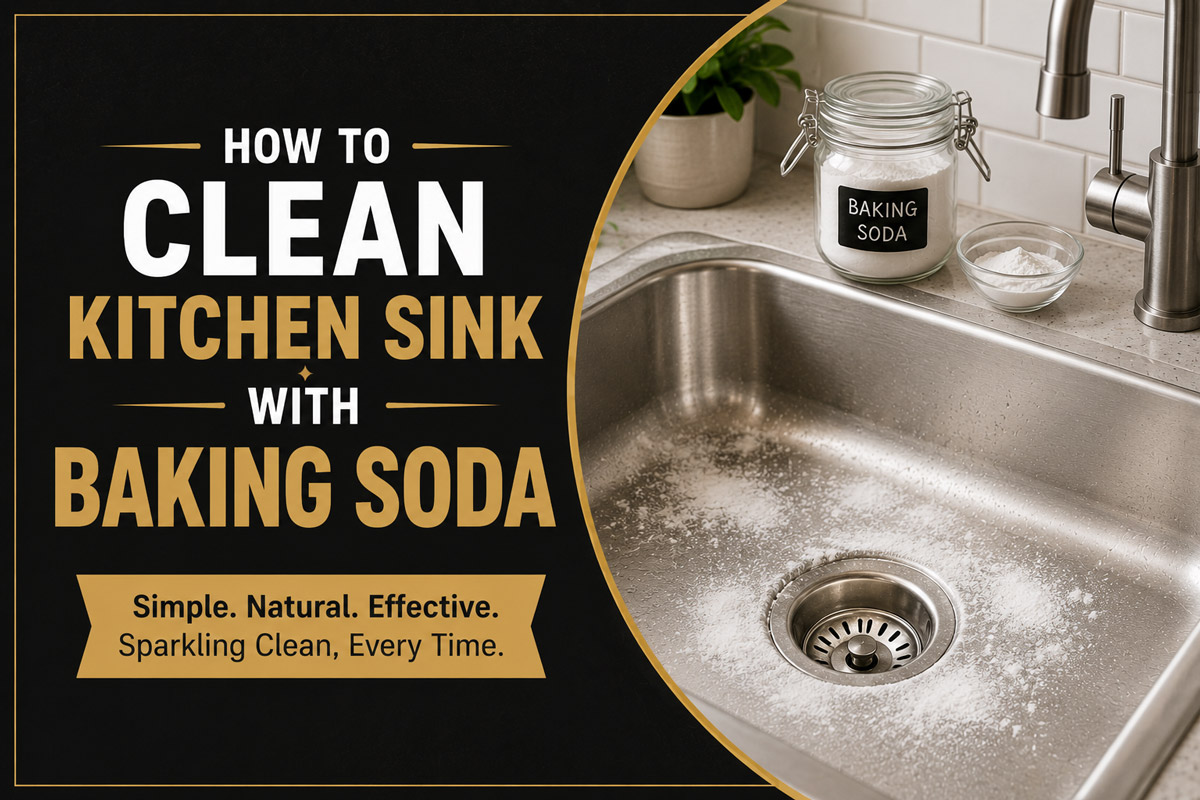
To learn how to clean kitchen sink with baking soda, you must apply the dry powder directly to a damp basin to activate its alkaline properties. Scrubbing sodium bicarbonate against surface materials removes organic kitchen grease without scratching the finish. The compound naturally neutralizes acidic food odors while acting as a mild, cost-effective abrasive.
Key Facts / At a Glance
- Baking soda (sodium bicarbonate) registers at a safe 2.5 on the Mohs hardness scale.
- The compound features a mildly alkaline pH ranging from 8.1 to 8.4 in water.
- Combining the powder with white vinegar creates carbon dioxide gas for mechanical lifting inside drains.
- The average material cost per standard basin application remains under 15 cents.
- Sodium bicarbonate chemically saponifies organic fatty acids into water-soluble soap compounds.
- The powder alters the pH of volatile odor molecules to neutralize rather than mask smells.
Before You Start: Prerequisites and Supplies
Executing a thorough basin scour requires minimal preparation but demands specific materials to ensure surface safety. Gathering the right supplies prevents premature chemical reactions and protects delicate sink glazes from unnecessary scratching.
- Active Time: 3-5 minutes for standard cleaning; 15 minutes for drain deodorizing.
- Total Dwell Time: 0 minutes for basin surfaces; up to 30 minutes for heavy drain clogs.
- Estimated Cost: Under $0.50 for all consumable materials combined.
- Difficulty: Beginner.
- Required Materials: 1 cup of dry baking soda, 1 cup of distilled white vinegar (5% acidity), 1 teaspoon of liquid dish soap, a non-scratch polyurethane or cellulose sponge, and a dry microfiber buffing cloth.
Why does sodium bicarbonate work on kitchen grease?
Sodium bicarbonate works on kitchen grease because its alkaline nature chemically converts acidic food fats into soluble soap through a process called saponification. The fine crystalline structure of the powder also provides mechanical friction to dislodge hardened food particles without damaging the underlying sink material.
The mechanical cleaning power relies entirely on the Mohs hardness scale. The Mohs scale measures mineral hardness from 1 (talc) to 10 (diamond). Baking soda registers at 2.5. Modern stainless steel sinks register between 4.0 and 4.5, while ceramic and porcelain glazes sit between 5.0 and 6.0. Because the powder is physically softer than the sink basin, it can apply aggressive friction to soft organic matter (like dried egg yolks or grease splatters) without ever leaving a micro-scratch on the metal or glass finish.
The chemical cleaning action relies on alkalinity. Kitchen grime consists heavily of lipids and fatty acids from cooking oils and animal proteins. Baking soda provides a pH of roughly 8.2. When you introduce this mild alkali to acidic kitchen grease, it breaks the triglyceride bonds. This chemical reaction converts stubborn fats into a crude, water-soluble soap that rinses freely down the drain.
Deodorization occurs through molecular neutralization. Most foul kitchen odors stem from acidic compounds, such as sour milk (lactic acid) or rotting vegetables. Instead of masking these smells with heavy synthetic perfumes, baking soda alters the pH of the volatile molecules until they achieve a neutral state. Once neutralized, the odor physically ceases to exist in the air.
How much time and money does this method require?
This method requires approximately two to five minutes of active labor and costs less than fifteen cents per standard surface application. Complex drain blockages demand longer dwell times reaching up to 30 minutes, though the active labor remains strictly under five minutes.
To quantify the exact efficiency of sodium bicarbonate against specific kitchen tasks, examine the standardized metrics below.
| Maintenance Task | Active Labor Time | Required Dwell Time | Material Cost | Recommended Frequency | Primary Action Mechanism |
| Everyday Basin Scour | 2-3 minutes | 0 minutes | Under $0.10 | 3 times per week | Mechanical abrasion |
| Deep Drain Refresh | 5 minutes | 15-30 minutes | Under $0.50 | 1 time per month | Gas expansion ($CO_2$) |
| Hard Water Scale Removal | 4 minutes | 10 minutes | Under $0.40 | As needed | Acid-base dissolution |
| Heavy Organic Stain Lifting | 8 minutes | 20 minutes | Under $0.60 | As needed | Saponification |
| Garbage Disposal Odor Trap | 3 minutes | 15 minutes | Under $0.30 | 2 times per month | pH neutralization |
Step 1: Prepare the Sink Basin and Clear Debris
Removing physical obstructions and establishing a damp working surface ensures the baking soda adheres properly to the vertical walls of the sink basin. A dry sink will cause the powder to slide directly into the drain, wasting the cleaning agent.
Remove all plates, silverware, sponges, and silicone sink mats from the basin. Pick up any large food scraps blocking the drain flange. Turn on the faucet and flush the entire surface with warm water (ideally around $100^\circ\text{F}$) to soften existing grease splatters. Turn off the water and let the excess drain away. The vertical walls of the basin must remain damp to touch, as this thin layer of moisture acts as the binding agent for the dry powder.
- Success Checkpoint: You will know the surface is prepped correctly when the basin walls have a visible sheen of water but no pooling water remains at the bottom of the sink.
- Common Mistake: Leaving pools of standing water near the drain opening will instantly dissolve the baking soda, eliminating its abrasive crystalline structure before you begin scrubbing.
Step 2: Distribute the Baking Soda Evenly
Applying an even layer of the alkaline powder dictates the consistency of your cleaning results. Heavy clumps will waste material, while bare patches will force you to scrub the sink with an unlubricated sponge.
Measure out exactly one-half cup of dry baking soda. Hold your hand roughly six inches above the sink surface. Sprinkle the powder in a sweeping motion, similar to dusting flour over a baking sheet. Start from the top rim of the sink and work your way down the vertical walls, allowing the moisture to catch and hold the powder. Finish by dusting the flat bottom of the basin and the metal rim surrounding the drain flange.
- Success Checkpoint: The entire sink basin should look frosted with a thin, opaque white layer of powder.
- Common Mistake: Dumping the powder directly from the cardboard box often results in heavy piles that fall straight down the drain. Always use a shaker or your fingers to achieve an even distribution.
Step 3: Scrub with the Correct Abrasive Pad
Activating the mechanical cleaning power requires steady, directional friction applied through a non-scratch matrix. The sponge you choose determines whether the powder lifts the grime or simply pushes it around the steel.
Apply three to four drops of standard liquid dish soap directly onto a damp, non-scratch polyurethane or cellulose sponge. The dish soap acts as a surfactant, breaking surface tension and binding the loosened grease. Press the sponge against the top rim of the sink. Scrub the vertical walls using small, tight circular motions. If you possess a stainless steel sink, look closely at the metal and follow the faint horizontal or vertical lines (the grain) as you scrub to prevent micro-marring. Work your way from the top of the walls down to the bottom basin.
- Success Checkpoint: The dry powder will combine with the damp sponge to form a thick, gray-tinted paste as it pulls oxidized metal and dark food grease away from the sink walls.
- Common Mistake: Using heavy-duty green scouring pads (which contain aluminum oxide) will permanently scratch stainless steel and dull ceramic finishes regardless of the baking soda’s low Mohs hardness.
Step 4: Rinse and Buff the Surface
Flushing the alkaline residue completely from the surface prevents the formation of a chalky white film. Thorough drying stops municipal tap water from leaving hard mineral deposits on the freshly cleaned basin.
Turn the faucet to the hottest comfortable setting (around $120^\circ\text{F}$). Use the pull-down sprayer or a clean cup to flush the paste away, starting from the top rim and chasing the residue down into the drain. Once the water runs clear and the basin feels smooth, turn off the tap. Take a clean, dry microfiber cloth and buff the entire sink completely dry. Microfiber absorbs standing water while simultaneously polishing the metal or ceramic surface to a high shine.
- Success Checkpoint: The sink should feel entirely smooth to the touch with zero friction, and a dry finger rubbed across the basin should produce a faint squeaking sound.
- Common Mistake: Allowing the sink to air dry leaves behind trace amounts of dissolved calcium and magnesium from the tap water, resulting in dull white water spots within an hour.
How do you clear a smelly kitchen drain?
Clearing a smelly kitchen drain requires combining baking soda with acetic acid (vinegar) in a controlled environment to utilize the rapid expansion of carbon dioxide gas. This gas forces blockages through the P-trap while neutralizing odor-causing bacteria clinging to the pipe walls.
Dump a generous half-cup of dry baking soda directly down the dark drain opening. Ensure the powder falls deep into the disposal chamber or pipe rather than sitting on the metal flange. Immediately pour one full cup of distilled white vinegar down the exact same opening. The moment the liquid hits the powder, an aggressive fizzing reaction will occur. You must instantly seal the drain opening with a rubber stopper or a dense, wet towel. Sealing the top forces the expanding carbon dioxide gas to push downward into the plumbing system rather than escaping up into the kitchen air.
Leave the stopper in place for exactly 15 minutes. During this dwell time, boil a kettle of water to a temperature between $140^\circ\text{F}$ and $160^\circ\text{F}$. Remove the stopper and pour the hot water rapidly down the drain. The thermal energy from the hot water melts the newly loosened grease trap, while the heavy flow volume flushes the organic debris completely out of the house’s plumbing lines.
Practitioner Rule of Thumb: Never use boiling water ($212^\circ\text{F}$) for the final flush if your home features thin PVC plastic plumbing pipes. Sustained boiling water can warp plastic joints and degrade the plumber’s putty sealing the sink flange. Keep the water hot, but distinctly below a rolling boil.
Which chemical combinations yield the best results?
Mixing sodium bicarbonate with secondary household acids or surfactants allows you to target specific types of stains. Understanding chemical byproducts ensures you choose the correct catalyst for organic grease versus hard mineral scale.
Combining chemicals carelessly can neutralize their effectiveness. For example, mixing an acid (vinegar) with a base (baking soda) in a bowl prior to cleaning simply yields water, salt, and harmless gas, leaving you with no active cleaning agents. You must always apply the powder first, use it to scrub, and then apply the secondary liquid.
| Chemical Combination | Primary Advantage | Major Drawback | Best Target Application | Resulting Byproduct |
| Baking Soda + Water | Maximum abrasive power. | Minimal fat-cutting ability. | Daily basin scuffs and loose food debris. | Diluted alkaline paste |
| Baking Soda + Dish Soap | Excellent surfactant binding. | Requires heavy water rinsing to remove suds. | Thick grease layers and frying pan splatters. | Saponified lipid suspension |
| Baking Soda + White Vinegar | $CO_2$ gas lifts deep debris. | Acids and bases neutralize each other rapidly. | Unclogging drains and dissolving hard water scale. | Sodium acetate + $CO_2$ |
| Baking Soda + Lemon Juice | Superior fresh scent. | Leaves a sticky sugar residue if unrinsed. | Foul-smelling garbage disposals. | Sodium citrate + $CO_2$ |
| Baking Soda + Hydrogen Peroxide | Bleaches organic color stains. | Highly drying to human skin (requires gloves). | Coffee and tea stains on light ceramic sinks. | Sodium percarbonate equivalent |
What common mistakes ruin the cleaning process?
Executing the correct steps with the wrong timing or water temperatures will compromise the cleaning mechanism and potentially damage the kitchen infrastructure. Several persistent myths regarding household cleaning lead homeowners to make costly errors.
Premature Chemical Neutralization
Many DIY cleaning recipes instruct users to mix baking soda and vinegar together in a spray bottle to create an all-purpose cleaner. This is a fundamental misunderstanding of basic chemistry. Combining an acid (acetic acid) and a base (sodium bicarbonate) triggers an immediate neutralization reaction. Once the fizzing stops, the resulting liquid is effectively just saltwater and dissolved sodium acetate. It possesses zero degreasing power and zero acidic descaling power. You must always use the powder independently for mechanical scrubbing before introducing vinegar solely as a rinsing and descaling agent.
Inducing Thermal Shock
Pouring a large pot of boiling pasta water or a boiling kettle over a cold sink basin creates massive temperature differentials. If you own a fireclay, porcelain, or ceramic sink, this sudden localized expansion causes thermal shock. The rigid glaze cannot flex with the underlying clay, resulting in spiderweb cracks across the bottom of the sink. Always temper boiling water by running the cold tap simultaneously, or let the kettle cool for ten minutes before flushing a drain.
Leaving Powder on Aluminum Surfaces
Allowing a baking soda paste to sit on an aluminum sink rim, or an aluminum frying pan resting in the sink basin, triggers rapid metal oxidation. Because the powder is highly alkaline, extended contact strips the protective oxide layer from the aluminum. This reaction leaves permanent, dark black tarnish marks etched directly into the metal that no amount of scrubbing can reverse.
How do you fix chalky residue and dry clogs?
Misjudging moisture levels during the application process leads to two common frustrating outcomes: a dull white film across the basin walls, or a dense plug of powder trapped inside the plumbing lines. Both issues require specific chemical interventions rather than brute force.
If your sink displays a hazy, chalky white residue after drying, you failed to rinse the microscopic salt crystals completely. Scrubbing it with a dry towel will only smear the powder. Instead, mix a solution of 50 percent white vinegar and 50 percent water in a spray bottle. Mist the hazy areas generously. The acetic acid in the vinegar will instantly dissolve the remaining alkaline minerals. Wait ten seconds, then wipe the surface clean with a damp microfiber cloth to reveal a perfectly clear finish.
If your drain clogs worse after applying baking soda, you likely dumped a massive amount of dry powder into the pipe without sufficient liquid to initiate a reaction. The powder absorbed the ambient moisture in the P-trap and solidified into a dense, concrete-like plug. Do not try to push it through with a mechanical snake. Instead, heat one gallon of white vinegar on the stove until it reaches roughly $120^\circ\text{F}$. Slowly pour this warm acid directly onto the blockage. The heat will accelerate the chemical reaction, aggressively dissolving the impacted alkaline plug layer by layer.
Practitioner Rule of Thumb: If a dry clog occurs in a garbage disposal, never turn the unit on to chop it up. The impacted powder will act like cement against the impellers, potentially burning out the disposal motor. Always dissolve alkaline clogs chemically.
How should you adjust methods for delicate sink materials?
Every kitchen sink demands a tailored approach based on its manufacturing process. Applying a universal cleaning method ignores the varying hardness levels, porosities, and chemical sensitivities of modern basin materials.
Stainless Steel Sinks
Modern kitchens rely heavily on stainless steel for its durability. The metal features microscopic directional lines created during the factory polishing process. Always scrub strictly parallel to these lines to avoid trapping powder in the cross-hatched grooves. After completing the standard rinse and dry process, place three drops of food-grade mineral oil onto a dry cloth. Buff the oil into the stainless steel following the grain. This microscopic oil barrier repels water droplets, prevents hard water spotting for up to a week, and restores the factory shine.
Fireclay and Porcelain Enamel
Traditional farmhouse sinks utilize thick fireclay coated in a delicate glass glaze. While the glaze easily resists the 2.5 Mohs hardness of baking soda, it is highly susceptible to dark tannin stains from coffee, tea, and red wine. Sprinkle the powder directly onto the dark stains. Cut a fresh lemon in half and use the exposed fruit as your scrubbing sponge. The gentle citric acid will bleach the organic tannins while the powder lifts the residue, removing the stain entirely without wearing down the expensive glass glaze.
Natural Copper Basins
Copper sinks develop a unique, living finish over time called a patina. This dark oxidation layer protects the metal and gives the sink its rustic aesthetic. Baking soda is mildly alkaline and can strip this delicate patina if left to dwell. Never let the powder sit on copper for more than one minute. Apply the powder, scrub gently with a soft sponge, and rinse immediately. Never mix vinegar or lemon juice with baking soda in a copper sink, as the combination of acid and abrasion will polish the metal back to a bright, shiny penny color in irregular patches.
Acrylic and Composite Granite
Composite sinks blend quartz dust with acrylic resins. While the stone dust is exceptionally hard, the acrylic resin binder is incredibly soft and prone to chemical hazing. Avoid vigorous scrubbing entirely on these surfaces. Create a wet paste of baking soda and dish soap in a separate bowl first. Apply the soft paste to the composite basin using only a microfiber cloth. The soap will handle the degreasing while the pre-wetted powder provides mild friction without risking micro-scratches on the acrylic binding agents.
What are the limits of cleaning with baking soda?
Understanding the precise limitations of sodium bicarbonate prevents homeowners from relying on it for dangerous public health applications. While exceptional at lifting grease, baking soda fails completely as a biocide.
Baking soda does not disinfect surfaces. According to established environmental health standards, a product must kill 99.9 percent of specific bacteria and viruses to qualify as a sanitizer, and 100 percent of targeted pathogens to qualify as a disinfectant. Sodium bicarbonate achieves neither. It possesses no antimicrobial properties capable of destroying robust pathogens like Salmonella, E. coli, or Staphylococcus aureus commonly found in raw chicken juices or ground beef blood.
If you prepare raw meat in your sink basin, scrubbing the area with baking soda will successfully remove the visible proteins and fats. However, the microscopic bacteria will survive the alkaline exposure and remain on the surface. To ensure true kitchen safety, you must first clean the physical soil away with baking soda, rinse thoroughly, and then apply an EPA-registered chemical disinfectant or a highly diluted bleach solution to destroy the invisible pathogens.
How does baking soda compare to commercial abrasive cleaners?
Evaluating sodium bicarbonate against store-bought commercial powders reveals distinct trade-offs between chemical safety, raw cleaning power, and environmental impact. Commercial alternatives utilize harsh chemical bleaches and stronger mineral abrasives to achieve faster results at a higher material cost.
| Product Name | Active Ingredient | Mohs Hardness Limit | pH Level | Average Cost Per Ounce | Best Used For |
| Baking Soda | Sodium Bicarbonate | 2.5 | 8.2 (Mild Base) | $\$0.06$ | Daily maintenance, odor control, food-safe zones. |
| Bar Keepers Friend | Oxalic Acid | 3.0 (Feldspar) | 1.5-2.5 (Strong Acid) | $\$0.16$ | Removing severe rust and heavy metal oxidation. |
| Comet Cleanser | Calcium Carbonate & Bleach | 3.0 (Calcite) | 10.5-11.5 (Strong Base) | $\$0.12$ | Bleaching deep organic stains and sanitizing. |
| Soft Scrub | Calcium Carbonate & Surfactants | 3.0 (Calcite) | 9.0-10.0 (Moderate Base) | $\$0.22$ | Clinging to vertical walls for prolonged stain lifting. |
Bar Keepers Friend utilizes oxalic acid, which aggressively attacks rust and hard water minerals far faster than baking soda. However, its high acidity can etch natural stone countertops if splashed. Comet introduces chemical bleach, offering superior whitening power for heavily stained porcelain, but it leaves behind toxic residues that require extensive rinsing before the sink is safe for food preparation. Sodium bicarbonate remains the only abrasive powder on this list that is completely non-toxic if accidentally ingested.
Frequently Asked Questions
Can I leave baking soda on the sink overnight?
You should never leave a baking soda paste on your sink overnight. While the powder is mild, prolonged moisture exposure can cause the alkaline salts to dry into a cement-like layer that requires heavy scraping to remove. It also risks oxidizing the metal rim around the drain flange.
Does baking soda remove rust from stainless steel?
Baking soda alone cannot remove heavy rust from stainless steel because it lacks the necessary acidity to dissolve iron oxide. To treat minor surface rust, you must create a thick paste using the powder and white vinegar, let it dwell for 20 minutes, and scrub vigorously.
Can I use baking powder instead of baking soda to clean the sink?
You cannot use baking powder to clean a sink effectively. Baking powder contains sodium bicarbonate mixed with powdered acids (like cream of tartar) and cornstarch. When activated by water, the built-in acids neutralize the base immediately, leaving behind a sticky starch residue rather than an abrasive cleaner.
How often should I scour my kitchen basin?
You should scour your kitchen basin two to three times per week to prevent severe grease accumulation and hard water calcification. High-traffic kitchens handling raw meats daily should increase this frequency to daily applications, followed by a true chemical disinfectant.
Is baking soda safe for septic systems?
Baking soda is entirely safe and highly beneficial for residential septic systems. The mild alkaline properties help buffer the pH levels inside the septic tank, which promotes the growth of the healthy bacteria required to break down solid waste effectively.