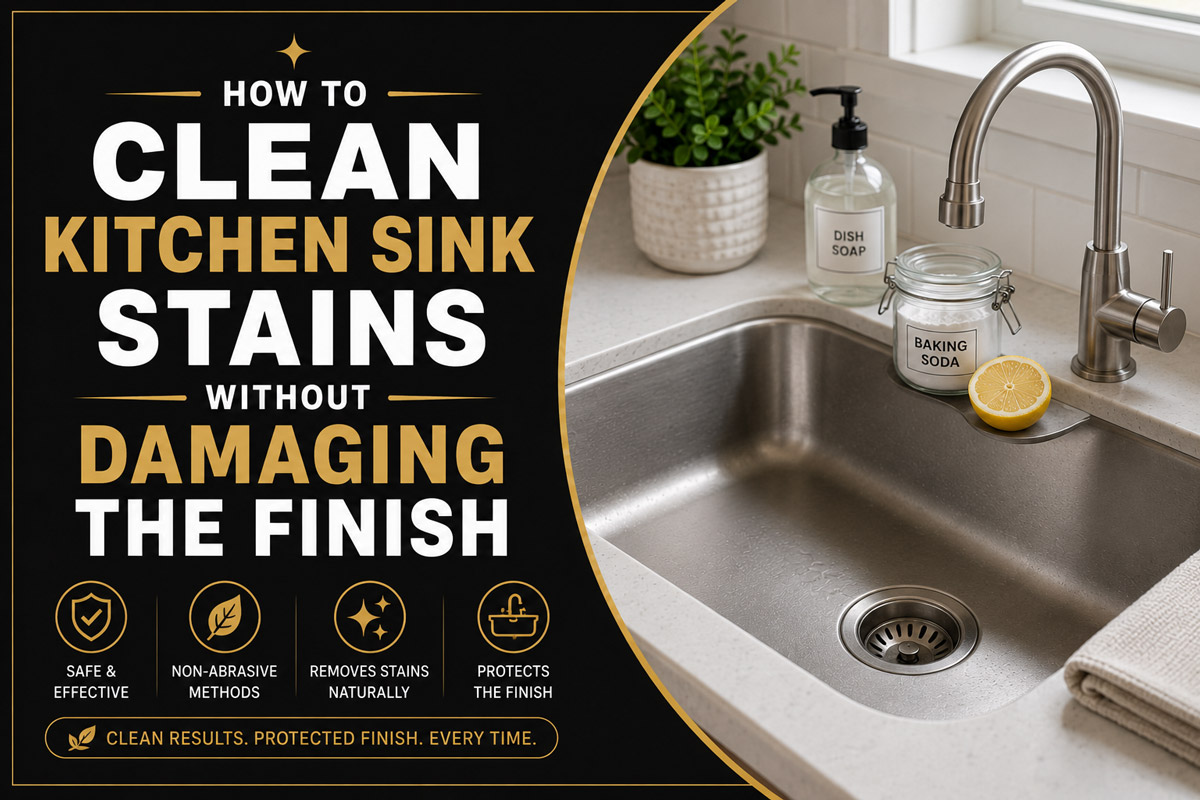
To clean kitchen sink stains, apply a paste of one cup baking soda and one-quarter cup warm water. Scrub the paste gently across the surface. Rinse the sink completely, spray the area with undiluted 5 percent white vinegar, and perform a final thorough rinse with warm water.
At a Glance: Critical Safety Bounds
- Baking soda and vinegar must be used sequentially instead of mixed together in a bottle.
- Hydrogen peroxide for sink cleaning must never exceed a 3 percent over-the-counter concentration limit.
- Liquid chlorine bleach dilution must never exceed one tablespoon per one gallon of water.
- White vinegar must never sit on any sink surface for more than 30 minutes to prevent chemical etching.
- Porous stone sinks require strictly pH-neutral cleaners to prevent permanent structural damage.
What causes stubborn stains to form in kitchen sinks?
Hard water mineral deposits, iron oxide accumulation, and organic pigment transfer cause the majority of stubborn sink discoloration. Calcium carbonate from municipal water supplies leaves a white, chalky residue that traps other contaminants. Iron particles from cast iron cookware react with moisture to form rust circles near the drain. Organic tannins from coffee, tea, and wine penetrate the microscopic pores of older ceramic or resin sinks.
The National Ground Water Association (2023) reports that 85 percent of American homes operate on hard water systems. This high mineral content acts as a binding agent for organic matter. When a homeowner pours dark liquids into a sink basin, the calcium deposits absorb the pigments immediately. A chemical reaction is required to break the mineral bond before the visual discoloration can be lifted away from the underlying material. Simple mechanical scrubbing with dish soap often fails because the soap cannot dissolve calcium carbonate or iron oxide.
What is the standard protocol for everyday sink discoloration?
The standard protocol involves an alkaline abrasive phase followed by an acidic dissolution phase. A homeowner must first apply an alkaline paste made from one cup of baking soda and one-quarter cup of warm water. The baking soda acts as a mild abrasive that physically shears through surface biofilm without scratching most metals. Once the physical barrier is disrupted, the operator rinses the paste away entirely.
After the initial rinse, the operator sprays undiluted 5 percent white vinegar directly onto the remaining discoloration. The acetic acid in the vinegar attacks the structural integrity of the alkaline mineral bonds that hold the mark to the surface. Leaving the vinegar in place for exactly two minutes allows sufficient chemical breakdown without risking damage to the underlying sealant. A final rinse with warm water washes away the dissolved compounds. This two-step process addresses both organic pigments and inorganic mineral deposits effectively.
How do you clean stainless steel sink stains?
To clean stainless steel sink marks, apply a baking soda paste and scrub exclusively in the direction of the metal grain lines. Stainless steel manufacturing processes leave microscopic linear grooves across the surface of the metal. Scrubbing in a circular motion forces debris deeper into these grooves while creating visible micro-scratches across the factory finish. The baking soda provides just enough mechanical friction to lift surface oxidation without damaging the chromium oxide layer.
After removing the alkaline paste, spray the metal with standard white vinegar. Allow the liquid to sit for a maximum of two minutes. Prolonged acid exposure will compromise the rust-resistant chromium barrier inherent to stainless steel alloys. Rinse the basin with cold water and dry the metal completely using a microfiber cloth. Drying the surface prevents immediate water spot formation caused by evaporating tap water.
How do you remove stains from porcelain and ceramic sinks?
To clear marks from porcelain and ceramic basins, scatter one-half cup of baking soda over the affected area and scrub the powder using a sponge saturated in 3 percent hydrogen peroxide. The hydrogen peroxide creates an oxidation reaction that chemically bleaches organic pigments trapped in the ceramic glazing. The operator should use gentle, circular motions to lift the organic matter out of the porous surface.
Leave the resulting mixture on the ceramic surface for exactly 10 minutes. This specific dwell time allows the peroxide to penetrate the microscopic fissures common in older porcelain without degrading the surrounding healthy glaze. Rinse the basin thoroughly with hot water to wash away the activated chemicals. Do not use concentrations of hydrogen peroxide higher than 3 percent. Hair-bleach concentrations (10 percent or higher) will permanently alter the color of the sealant holding the sink to the countertop.
What is the proper process for cleaning composite granite sinks?
To wash stains out of a composite granite sink bowl, mix one tablespoon of mild dish soap with four cups of warm water and scrub with a soft nylon brush. Composite granite sinks consist of crushed stone suspended in an acrylic resin. This resin is highly susceptible to chemical burns from harsh acids and strong alkaline powders. Homeowners must avoid all highly acidic cleaners when performing routine maintenance.
If the composite basin develops a stubborn white haze, this indicates severe calcium buildup rather than a traditional organic mark. To dissolve this calcium, mix a strictly controlled 1:1 ratio of water to 5 percent white vinegar. Apply this diluted solution to the haze, but leave it on the surface for less than two minutes. Rinse the basin heavily with cold water. Once the sink is completely dry, rub five drops of food-grade mineral oil into the resin to restore the deep factory color and seal the microscopic pores against future mineral intrusion.
Can you use acidic cleaners on porous stone sinks?
No, you cannot use acidic cleaners on porous stone sinks under any circumstances. Marble, limestone, and natural quartz contain high levels of calcium carbonate. When acidic agents like vinegar, lemon juice, or generic bathroom cleaners touch these stones, they trigger an immediate chemical reaction called etching. Etching physically dissolves the top layer of the stone and leaves behind a dull, rough, permanent white mark.
The Marble Institute of America (2021) guidelines state that homeowners must use only pH-neutral stone cleaners on natural stone installations. Standard household cleaners fall entirely outside this safe range. Even alkaline agents like baking soda or ammonia can degrade the protective chemical sealants applied to natural stone basins. If an organic liquid discolors a stone sink, the homeowner should apply a commercially formulated stone poultice to draw the pigment out of the rock safely.
| Material Type | Safe Cleaning Agents | Strictly Banned Agents |
| Stainless Steel | Baking soda, vinegar, dish soap | Chlorine bleach (undiluted), steel wool |
| Porcelain/Ceramic | Hydrogen peroxide (3%), baking soda | High-concentration peroxide, metal scrapers |
| Composite Granite | Dish soap, diluted vinegar (briefly) | Straight vinegar, abrasive scouring powders |
| Porous Stone | pH-neutral stone cleaner, poultice | Vinegar, lemon juice, bleach, ammonia |
How should you clean delicate matte black sink fixtures?
To clean matte black sink fixtures, use exclusively a clean microfiber cloth saturated with a mixture of warm water and liquid dish soap. Matte finishes achieve their non-reflective appearance through a highly textured, delicate factory coating. Any abrasive action will flatten this texture, resulting in permanent shiny spots that ruin the aesthetic of the hardware.
Homeowners must avoid all abrasive powders when servicing matte fixtures. Baking soda rates a 2.5 on the Mohs hardness scale. While this is mild enough for raw steel, it is hard enough to micro-scratch and permanently ruin delicate matte polymer coatings. Chemical cleaners containing acids or solvents will strip the specialized oil-repellent layer applied by the manufacturer. If hard water deposits form on the matte metal, use a specialized matte-safe mineral dissolving foam rather than DIY acid mixtures.
How long should cleaning chemicals sit on a sink stain?
Cleaning chemicals should sit on a sink stain for the shortest time mathematically required to break the chemical bond, ranging from 1 to 10 minutes depending on the agent. Extending chemical contact times does not improve the cleaning outcome. Leaving active compounds on a surface past their designated limits results directly in pitting, etching, or oxidation of the base material.
Hydrogen peroxide requires a 10-minute dwell time on porcelain to effectively oxidize organic pigments. Liquid chlorine bleach requires exactly 5 minutes of contact time to sanitize undermount silicone rims without degrading the adhesive bond. White vinegar must never exceed 30 minutes on any durable surface, and it must be removed from composite resin within 2 minutes.
| Cleaning Agent | Target Material | Maximum Dwell Time | Primary Risk of Exceeding Time |
| White Vinegar (5%) | Stainless Steel | 2 minutes | Surface oxidation and white haze |
| Hydrogen Peroxide (3%) | Porcelain | 10 minutes | Sealant discoloration |
| Diluted Chlorine Bleach | Silicone Seams | 10 minutes | Adhesive failure and bond degradation |
| Oxalic Acid Paste | Iron Oxide (Rust) | 1 minute | Permanent dark discoloration of metal |
What are the safe dilution limits for bleach and vinegar?
The safe dilution limit for liquid chlorine bleach is exactly one tablespoon of bleach per one gallon of room-temperature water. Exceeding this concentration creates a corrosive solution that will pit stainless steel surfaces and degrade rubber garbage disposal gaskets. The operator must limit total contact time to 5 minutes for metal surfaces. Never mix bleach with hot water, as high temperatures accelerate the release of toxic chlorine gas.
White vinegar requires careful handling despite its organic origin. For routine maintenance on stainless steel or porcelain, standard 5 percent white vinegar can be used undiluted. However, when applying vinegar to composite granite or synthetic resin sinks, the operator must dilute the acid at a 1:1 ratio with water. Never leave standard household vinegar on any fixture for more than 30 minutes. The acid profile is strong enough to eat through chrome plating and dull brushed metal finishes if left overnight.
How do you remove mold from undermount sink rims?
To remove mold from the silicone seam of an undermount sink rim, apply a 1:1 mixture of liquid bleach and water using saturated paper towels. The dark accumulation along this rim is usually Aspergillus niger (black mold) spores embedded directly into the porous silicone caulk. A homeowner must never scrape this seam with metal tools, brushes, or scouring pads. Mechanical scraping severs the waterproof seal and allows water to leak directly into the wooden cabinetry below.
Fold heavy-duty paper towels into narrow strips and pack them tightly against the silicone seam. Pour the diluted bleach solution carefully over the paper towels until they are saturated. Leave this poultice in place for exactly 10 minutes. The liquid bleach will penetrate the silicone and kill the mold spores at their root without degrading the structural integrity of the adhesive bond. Remove the paper towels and flush the rim heavily with a handheld sprayer.
How do you remove rust stains around the kitchen drain?
To remove rust stains from a kitchen sink drain, apply a commercial oxalic acid powder directly to the affected metal. Standard household cleaners like baking soda and vinegar cannot dissolve iron oxide. Iron requires a specific chemical chelating agent to break its bond with the surrounding steel or porcelain. Oxalic acid, the active ingredient in products like Bar Keepers Friend, chemically bonds with the iron particles to create a water-soluble complex.
Wet the rusted area thoroughly with water. Sprinkle a small amount of the oxalic acid powder onto the wet metal to create a thin paste. Rub the paste gently over the rust using a damp sponge. The operator must rinse the acid away entirely within 1 minute of application. Leaving oxalic acid on stainless steel for longer than 60 seconds will cause a secondary chemical reaction that turns the bright metal permanently black.
How do you fix grey metal transfer lines in porcelain sinks?
To fix grey lines in a porcelain sink, rub the marks gently with a dedicated pumice stone that has been completely saturated in warm water. These grey lines are not structural cracks in the ceramic glaze. They are actual metal transfers caused by heavy aluminum or cast iron pots scraping against the harder porcelain surface. Because the metal sits on top of the glaze, standard alkaline powders like baking soda lack the friction required to remove them.
Submerge a specialized cleaning pumice stick in water for five minutes. The water softens the pumice and acts as a necessary lubricant. Rub the wet pumice directly over the grey metal transfer using ultra-light pressure. The mild friction will shear the soft metal off the hard ceramic without scratching the underlying glaze. Keep the area flooded with water during the entire process. If the stone feels dry or creates a grinding sound, stop immediately and re-saturate the tool.
Why did a stainless steel sink turn white after cleaning?
A stainless steel sink turns white or grey after cleaning because the metal experienced surface oxidation from prolonged exposure to harsh chemicals. This phenomenon occurs when a homeowner leaves high-concentration bleach, strong acids, or harsh degreasers on the metal for too long. The chemicals strip away the invisible chromium oxide layer that gives stainless steel its characteristic shine, leaving the raw, unprotected steel exposed to the air.
Homeowners can restore the factory finish by rubbing a few drops of food-grade mineral oil or olive oil into the dry metal. Ensure the sink is completely clean and entirely dry. Apply the oil to a clean microfiber cloth and buff it vigorously into the steel, following the direction of the grain lines. The oil fills the microscopic oxidized pores and creates a temporary barrier that restores the deep metallic color. This oil treatment must be repeated monthly to maintain the visual finish.
Can you mix baking soda and vinegar to clean a sink?
No, you cannot mix baking soda and vinegar together in a bottle to clean a sink. Combining these two chemicals beforehand creates an immediate reaction that yields sodium acetate, water, and carbon dioxide gas. The visual bubbling effect leads many people to believe the mixture is actively cleaning a surface. In reality, the acid and the base completely neutralize each other’s distinct cleaning properties.
The resulting liquid is essentially ineffective fizzy water. To leverage their chemical power, a homeowner must use them sequentially. The operator must first use the baking soda as a standalone physical abrasive to scour away the biofilm. After rinsing the powder away, the operator then applies the acidic vinegar to dissolve the remaining mineral deposits. Keeping the chemical actions separated ensures that each compound performs its specific mechanical or chemical task at maximum efficiency.
How much does professional sink restoration cost versus DIY?
Professional sink restoration costs between 150 and 400 dollars, whereas DIY cleaning methods cost under 15 dollars per application. The decision to hire a professional depends entirely on the depth of the damage and the material of the basin. Simple surface discoloration on stainless steel or porcelain requires only basic household supplies. However, deep chemical etching in natural stone or severe resin degradation in composite granite often requires mechanical resurfacing by trained technicians.
Practitioner data for 2024 indicates that replacing a heavily damaged undermount sink often exceeds 800 dollars due to the complex plumbing and countertop manipulation required. Therefore, paying a professional 300 dollars to polish and reseal a damaged natural stone basin represents a significant cost saving. If a DIY chemical application fails to lift a mark after two attempts, the damage is likely structural rather than superficial.
| Restoration Method | Average Cost Range | Best Suited For | Risk Level |
| DIY Basic Cleaning | $5 – $15 | Organic pigments, minor hard water buildup | Low |
| DIY Chemical Rust Removal | $10 – $20 | Iron oxide deposits around drains | Medium (requires precise timing) |
| Professional Surface Polishing | $150 – $250 | Minor scratching, dull stainless finishes | None |
| Professional Stone Resurfacing | $300 – $400 | Chemical etching on marble or quartz | None |
| Complete Sink Replacement | $600 – $1200 | Cracked porcelain, shattered composite resin | N/A |
How often should you sanitize a kitchen sink drain?
You should sanitize a kitchen sink drain exactly once per week to prevent dangerous biofilm buildup. The dark, moist environment inside a drain pipe provides an ideal breeding ground for bacteria and mold spores. The National Sanitation Foundation (2022) guidelines for residential food preparation areas highlight sink drains as the primary vector for cross-contamination in modern kitchens. Routine mechanical flushing is required to disrupt the bacterial colonies before they calcify into a hardened mass.
To perform weekly sanitization safely, pour one-half cup of dry baking soda directly down the drain opening. Follow this immediately with one cup of rapidly boiling water. The heat kills the biological organisms while the alkaline powder scrubs the interior walls of the PVC piping. Wait five minutes for the pipe to cool slightly, and finish the process with a heavy flush of cold tap water. This clears the P-trap and pushes the disrupted biofilm into the main sewer line without requiring highly toxic bleach.
How do you prevent new stains from forming in a sink?
You prevent new stains from forming by drying the sink basin completely with a towel after every use and applying a hydrophobic barrier. Tap water contains dissolved minerals that remain on the surface when the water evaporates. Wiping the basin down with a microfiber cloth removes these minerals before they can crystalize and bond to the surface material. This single mechanical habit eliminates 90 percent of future discoloration issues.
For secondary prevention, practitioners recommend establishing a hydrophobic seal on dry metal and composite surfaces once a month. Applying a micro-layer of food-safe mineral oil creates a water-repellent barrier. When dark liquids like coffee or wine hit the oiled surface, they bead up and wash straight down the drain instead of penetrating the microscopic pores of the material. Avoid leaving wet cast iron pans, damp sponges, or acidic food scraps in the basin overnight.
The Bottom Line
To successfully clear marks from a kitchen washbasin, you must match the specific chemical agent to the exact material of the sink. Sequential application of baking soda and brief vinegar exposure handles standard organic and mineral buildup safely. You must strictly obey chemical dwell times to prevent irreversible etching on stone or oxidation on stainless steel finishes. Routine weekly maintenance and habitual surface drying remain the most effective strategies for preserving the structural integrity and aesthetic finish of your kitchen plumbing fixtures.