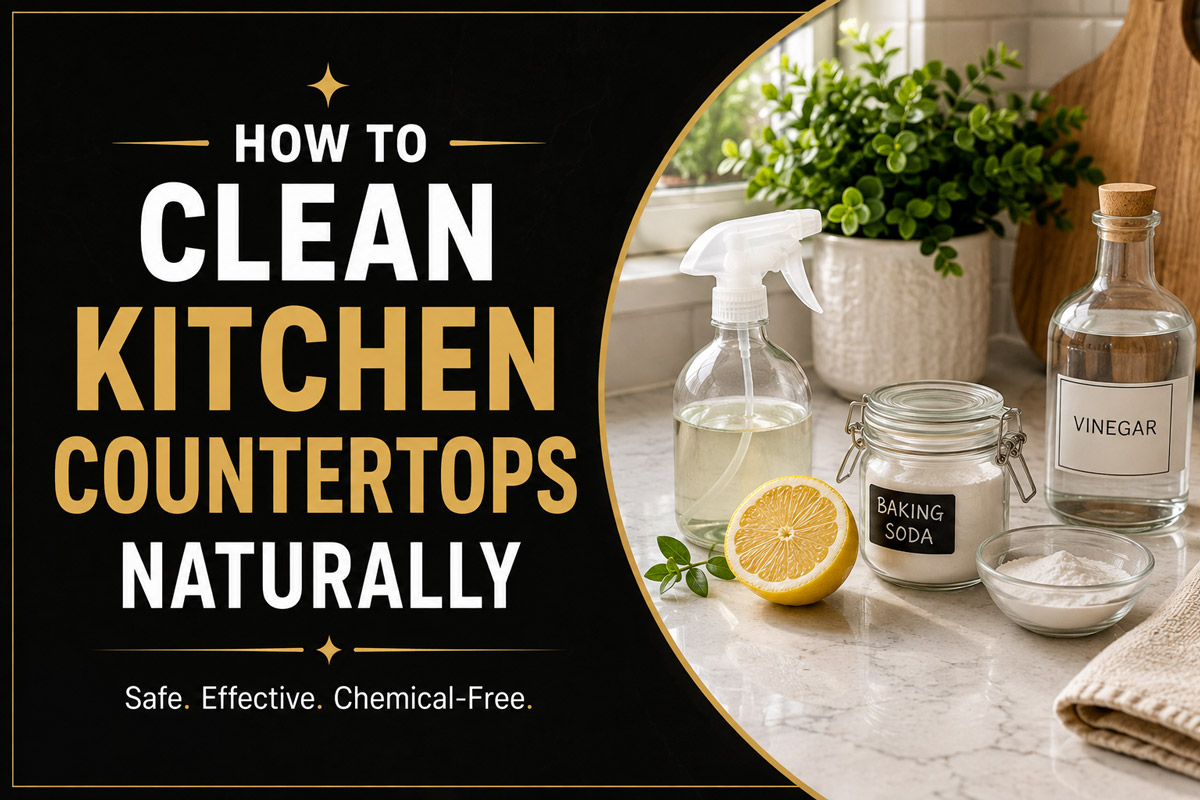
Cleaning kitchen countertops naturally requires matching the right non-toxic surfactant or mild acid to your specific surface material. The safest universal method involves a pH-neutral solution of Castile soap and warm water, followed by a dry microfiber buff to prevent streaks and sanitize the surface.
Key Facts / At a Glance
- Distilled white vinegar has a pH of 2.4 and will permanently etch natural stone surfaces like marble and limestone upon contact.
- Castile soap operates at a pH of 8.9 and effectively breaks down cooking grease through saponification without damaging factory sealants.
- True disinfection with natural ingredients requires a dwell time of 3 to 5 minutes before wiping the surface.
- Combining baking soda and vinegar in a sealed bottle creates rapid carbon dioxide gas expansion and leaves behind inactive saltwater.
- Unsealed butcher block requires a 1:1 vinegar sanitizing spray followed by immediate drying to prevent wood fiber expansion and rot.
The Chemistry of Non-Toxic Surface Cleaning
Natural kitchen cleaners do not rely on synthetic quaternary ammonium compounds to remove pathogens. They rely on mild organic acids, alkaline mineral salts, and plant-derived surfactants to break down organic matter physically and chemically. Understanding how these components work prevents accidental surface damage and ensures food-safe sanitation.
Vinegar contains 5% acetic acid. This acid destroys the cell walls of weak bacteria and easily dissolves hard water mineral deposits. Baking soda (sodium bicarbonate) is a mild alkali. It acts as a mechanical abrasive for stuck-on food and neutralizes acidic odors. Liquid Castile soap uses saponified vegetable oils, usually olive or hemp oil, to lower the surface tension of water. This allows the liquid to surround grease molecules, lifting them away from the countertop so they can be trapped in a cleaning cloth.
Matching the chemical profile of the cleaner to the geological or synthetic profile of the countertop prevents property damage. Acidic cleaners dissolve calcium carbonate, the primary mineral in marble and travertine. Alkaline cleaners safely interact with calcium carbonate but can leave a dulling film if the local tap water contains heavy magnesium deposits.
Before You Start: Preparation and Tools
Executing a successful natural cleaning routine requires specific mechanical tools. Natural chemicals require more physical agitation than synthetic industrial solvents. You will spend 10 to 15 minutes of active cleaning time for a standard 30-square-foot kitchen surface area.
Gather the following tools and ingredients before mixing any solutions:
- Microfiber cloths: Minimum 300 GSM density for lifting dirt, plus two dry 400 GSM cloths for buffing.
- Glass spray bottles: Essential oils degrade plastic bottles over time.
- Liquid Castile soap: Unscented olive oil or almond oil base.
- Distilled white vinegar: Standard 5% acidity formulation.
- Distilled water: Prevents hard water mineral spotting during the drying phase.
- Baking soda: One fresh box for creating stain-lifting poultices.
How to Clean Kitchen Countertops Naturally: The Baseline Method
This baseline process safely sanitizes engineered quartz, laminate, and sealed granite. It takes roughly 15 minutes from preparation to the final buffing stage. Do not skip the drying phase, as standing moisture promotes bacterial growth.
Step 1: Clear the Surface Area
Remove all small appliances, cutting boards, mail, and decorative items. Natural cleaners require an uninterrupted physical wiping motion to lift bacteria effectively. Leaving items on the counter creates moisture traps where soapy residue can pool.
Step 2: Remove Dry Debris
Wipe the entire countertop with a completely dry microfiber cloth. Sweep crumbs, dust, and loose vegetable peels directly into the trash or a catch basin. Applying liquid to a dusty countertop creates a muddy slurry that requires multiple extra passes to remove.
Step 3: Mix the Universal Cleaning Solution
Fill a 16-ounce glass spray bottle with 14 ounces of warm distilled water. Add exactly one tablespoon of liquid Castile soap. Gently roll the bottle back and forth to combine the ingredients. Shaking the bottle vigorously creates excessive foam that limits the amount of liquid you can spray onto the surface.
Step 4: Apply the Solution Liberally
Spray the soapy solution across the countertops, starting from the back edge near the backsplash and working toward the front edge. Ensure the surface is visibly wet but not forming deep puddles.
Step 5: Observe the Dwell Time
Allow the solution to sit undisturbed on the surface for 3 to 5 minutes. Plant-based surfactants require this extended contact time to encapsulate heavy cooking oils and detach bacterial colonies from the surface level.
Step 6: Perform the S-Pattern Wipe
Fold a clean microfiber cloth in half twice to create four distinct wiping surfaces. Starting at a back corner, pull the cloth toward you, loop slightly, and push it back up the counter in a continuous “S” shape. This motion traps dirt in the cloth rather than pushing it around the surface.
Step 7: The Freshwater Rinse
Rinse the cloth thoroughly with hot tap water, wring it out until it is barely damp, and wipe the entire countertop a second time. Castile soap leaves a minor vegetable oil film behind if it is not rinsed with fresh water.
Step 8: Buff the Surface Dry
Immediately wipe the entire surface with a dry, high-density microfiber towel. Buffing removes the final traces of moisture, eliminates hard water spots, and restores the factory shine to polished stone and laminate surfaces. You will know the step is complete when the surface feels frictionless under the towel.
Common Mistakes and How to Fix Them:
- The counter looks cloudy after drying: You used too much soap in your mixture. Spray the area with plain hot water and buff it dry again to remove the excess surfactant.
- The cloth leaves lint behind: You washed your microfiber towels with cotton fabrics or used fabric softener. Boil the towels in water for 10 minutes to strip the fabric softener, then air dry them.
Material-Specific Cleaning Protocols
Never use a one-size-fits-all approach to kitchen maintenance. The structural integrity of your countertops depends heavily on the mineral content and the factory sealants used during fabrication.
Quartz (Engineered Stone)
Quartz consists of 90% crushed stone mixed with 10% polymer resins and pigments. The resin makes the surface non-porous and highly resistant to stains. Use the Castile soap solution for daily maintenance. Never use abrasive baking soda pastes or scouring pads on quartz. Abrasives create micro-scratches in the soft polymer resin, resulting in permanent dull spots that catch the light poorly.
Granite and Quartzite
These natural stones are porous and require chemical sealants to prevent raw meat juices and cooking oils from sinking beneath the surface. Stick to the Castile soap baseline method. Avoid vinegar and lemon juice entirely. Even mild acids strip away the protective chemical sealant, leaving the stone vulnerable to deep oil stains that require professional poultice extraction.
Marble, Limestone, and Soapstone
Marble is composed of calcium carbonate, making it exceptionally soft and highly reactive to changes in pH. You must use only highly diluted Castile soap and distilled water. If you spray vinegar, lemon juice, or tomato juice on marble, the acid instantly dissolves the surface calcium. This reaction creates a permanent cloudy mark called an “etch” in a matter of seconds.
Butcher Block (Wood)
Wood is naturally porous and highly susceptible to water damage and bacterial penetration. Sanitize butcher block using a 1:1 mixture of white vinegar and water. Spray the surface lightly, wait 2 minutes, and wipe it completely dry. Leaving pooled water on a wooden countertop causes the fibers to swell, resulting in warping, splitting, and eventual rot within 48 hours. Condition the wood monthly with food-safe mineral oil to block moisture absorption.
Stainless Steel
Stainless steel requires a specific approach to maintain its grain and prevent streaking. Use a 1:1 vinegar and water solution to cut through heavy grease and fingerprints. Always wipe parallel to the direction of the visible metal grain. Wiping in circles pushes dirt into the microscopic grooves of the steel, resulting in a dull, smudged appearance.
Concrete
Concrete countertops feature a topical sealer or a penetrating sealer to protect the cementitious material. Treat concrete exactly like natural stone. Use only pH-neutral Castile soap. Acidic solutions degrade the sealer and expose the bare concrete to stains, while harsh abrasives wear down the polished surface texture.
Table 1: Natural Cleaner and Material Compatibility Matrix
This table outlines the safe chemical interactions between common natural cleaning agents and specific countertop materials.
| Cleaner Type | Active Ingredient | Safe Countertop Surfaces | Unsafe Countertop Surfaces |
| Diluted Vinegar | Acetic Acid (5%) | Laminate, Glass, Stainless Steel, Wood | Marble, Granite, Quartzite, Concrete |
| Castile Soap | Saponified Plant Oils | Quartz, Granite, Marble, Concrete | Unsealed Wood (causes excessive moisture) |
| Baking Soda Paste | Sodium Bicarbonate | Granite, Tile Grout, Stainless Steel | Quartz, Acrylic, Laminate |
| Rubbing Alcohol | Isopropyl Alcohol (70%) | Laminate, Quartz, Solid Surface | Wood, Painted surfaces |
| Hydrogen Peroxide | Hydrogen Peroxide (3%) | Light-colored Quartz, Grout, Laminate | Dark Granite, Wood, Marble |
How to Make DIY Natural Countertop Cleaners
Mixing your own natural cleaners ensures you control the exact chemical composition applied to your food preparation surfaces. Store all DIY solutions in dark amber glass bottles to prevent light degradation, especially when utilizing essential oils.
Recipe 1: The Daily pH-Neutral Stone Spray
This recipe acts as the primary defense against daily dirt and cooking grease. It is completely safe for marble, granite, and quartz.
- 16 ounces warm distilled water
- 1 tablespoon unscented liquid Castile soap
- 10 drops lavender essential oil (optional, for scent)
- Instructions: Pour the water into the bottle first to prevent bubbling. Add the soap and gently swirl. Shelf life is approximately one month.
Recipe 2: The Heavy-Duty Degreaser
Use this alkaline solution on laminate or stainless steel surfaces surrounding the stovetop where vaporized cooking oils settle.
- 14 ounces hot distilled water
- 1 teaspoon washing soda (sodium carbonate)
- 1 tablespoon liquid Castile soap
- Instructions: Dissolve the washing soda in the hot water completely before adding the soap. Washing soda operates at a pH of 11, making it far superior to baking soda for cutting thick, polymerized grease.
Recipe 3: The Vinegar Glass and Laminate Cleaner
This acidic cleaner cuts through hard water stains and leaves a streak-free finish on non-porous synthetic materials.
- 8 ounces distilled white vinegar
- 8 ounces distilled water
- 15 drops tea tree oil
- Instructions: Combine all ingredients in a spray bottle. According to a 2023 study in the Journal of Antimicrobial Chemotherapy, tea tree oil contains terpinen-4-ol, which disrupts bacterial membranes, adding a secondary sanitation layer to the acetic acid.
Recipe 4: The Oxygenated Stain Poultice
This thick paste draws out deep organic stains from light-colored stones without relying on chemical bleach.
- 2 tablespoons baking soda
- 1 tablespoon hydrogen peroxide (3%)
- Instructions: Mix in a small ceramic bowl until it forms a thick paste resembling peanut butter. Apply directly over the stain, cover with plastic wrap, and let it sit for 24 hours.
Table 2: DIY Cleaner Cost and Yield Breakdown
Making natural cleaners at home reduces ongoing household expenses. Pricing reflects average 2026 retail costs for bulk raw ingredients.
| DIY Recipe | Yield Per Batch | Cost Per Batch | Primary Application |
| pH-Neutral Stone Spray | 16 fluid ounces | $0.45 – $0.60 | Daily crumb and light grease removal |
| Heavy-Duty Degreaser | 16 fluid ounces | $0.55 – $0.75 | Stovetop splatter and polymerized oil |
| Vinegar Laminate Cleaner | 16 fluid ounces | $0.35 – $0.50 | Hard water spots and streak-free finish |
| Oxygenated Poultice | 1 application | $0.80 – $1.10 | Berry, coffee, and wine stain extraction |
What Are the Most Common Natural Cleaning Mistakes?
Many homeowners inadvertently cause permanent structural damage to their kitchens by misunderstanding basic chemical reactions. Avoid these common pitfalls.
Mixing Vinegar and Baking Soda in a Bottle
Countless online guides recommend mixing baking soda and vinegar together in a spray bottle to clean surfaces. This is chemically useless for surface cleaning. The acetic acid (vinegar) reacts with the sodium bicarbonate (baking soda) to release carbon dioxide gas. Once the bubbling stops, the resulting liquid is essentially water containing dissolved sodium acetate (salt). It holds no degreasing power and no disinfecting power.
Using Highly Abrasive Scrubbers
Natural cleaners take time to work. Homeowners often try to speed up the process by using green heavy-duty scouring pads or steel wool to remove dried food. These abrasive tools scratch the clear coat on laminate countertops and physically remove the polish from quartz and granite. Always rely on chemical dwell time rather than physical force. Use a plastic pan scraper to safely pop off dried food debris.
Ignoring Hard Water Saponification
If your home relies on hard tap water containing high levels of calcium and magnesium, mixing it with Castile soap causes a specific chemical reaction. The minerals bond with the soap molecules to form an insoluble substance known as soap scum. Spraying this onto dark granite leaves a thick, white, cloudy haze that is incredibly difficult to remove. Always mix Castile soap with distilled water to prevent this reaction.
How to Troubleshoot Stubborn Kitchen Stains
When standard cleaning fails, target the specific type of stain with an isolated chemical approach. Do not scrub the stain, as this drives the pigment deeper into porous surfaces.
Removing Coffee and Berry Stains (Organic)
Organic stains occur when plant pigments sink into the microscopic pores of the counter. Apply the oxygenated poultice (Recipe 4) directly over the stain. The hydrogen peroxide acts as a natural bleaching agent, oxidizing the pigment molecules and breaking their chemical bonds. Wipe the dried paste away with a damp cloth.
Removing Hard Water Spots (Mineral)
Hard water spots appear as chalky white rings around faucets and dish racks. On laminate or stainless steel, place a paper towel soaked in pure white vinegar over the crusty buildup. Let it sit for 15 minutes to dissolve the calcium carbonate, then wipe it away. For natural stone, you cannot use vinegar. You must gently scrape the mineral deposit away using a fresh razor blade held at a low, flat angle.
Removing Accidental Acid Etches
If someone accidentally sprays vinegar or lemon juice on a marble countertop, the surface will look dull and rough. This is not a stain. The acid has physically eaten away the top layer of stone. For minor dullness, you can apply a natural tin oxide polishing powder to restore the shine. For deep etches that feel rough to the touch, you must hire a professional stone fabricator to perform diamond-grit resurfacing.
Are Commercial Plant-Based Cleaners Better Than DIY?
Commercially bottled plant-based cleaners offer distinct advantages over DIY recipes, primarily in the realm of shelf stability and advanced surfactant chemistry. Commercial products often utilize alkyl polyglucosides (APGs). APGs are non-toxic surfactants derived from corn starch and coconut oil. They possess superior grease-cutting abilities compared to basic Castile soap and do not require a freshwater rinse step to prevent filming.
However, commercial plant-based cleaners frequently include undisclosed artificial fragrances under the label “proprietary scent blend.” They also cost significantly more. A 16-ounce bottle of a commercial natural cleaner ranges from $4 to $8, whereas the equivalent DIY Castile soap spray costs under $0.60. Choose commercial options for convenience, but rely on DIY recipes for absolute chemical transparency and cost reduction.
Expert Recommendations by Kitchen Owner Profile
Tailor your natural cleaning approach based on your budget, schedule, and the specific architecture of your kitchen.
The Budget-Conscious DIYer
Maintain a cleaning caddy stocked with bulk distilled white vinegar, a large box of baking soda, unscented Castile soap, and several glass spray bottles. Use the vinegar solution for sinks, floors, and non-stone surfaces to minimize costs. Reserve the Castile soap spray exclusively for sealed stone counters. This approach reduces overall cleaning product expenditures to less than $15 per year.
The Luxury Stone Owner
If your kitchen features custom marble, high-end quartzite, or exotic granite, banish vinegar and lemon juice from your cleaning cabinet entirely. Stick exclusively to pH-neutral Castile soap mixed with distilled water. Invest heavily in premium 400 GSM microfiber cloths. The physical quality of the towel dictates the final shine of a polished stone surface far more than the liquid cleaner applied to it.
The Busy Household
Homes with high daily cooking volume and limited cleaning time benefit most from concentrated commercial plant-based cleaners. Purchase a concentrated natural cleaner that contains alkyl polyglucosides and citric acid. Dilute the concentrate into a spray bottle. This provides the fast-acting convenience of a traditional chemical spray, cuts grease instantly without a secondary rinse step, and maintains a safe environment for food preparation.
Frequently Asked Questions
How long does natural cleaner take to disinfect?
Natural cleaners require a minimum dwell time of 3 to 5 minutes to effectively destroy bacterial cell walls. Wiping the counter immediately after spraying removes the dirt but leaves the microscopic pathogens completely intact on the surface.
Can I use lemon juice instead of vinegar to clean laminate?
Yes. Lemon juice contains citric acid, which operates similarly to the acetic acid in vinegar. It cuts grease and dissolves hard water spots effectively. However, lemon juice leaves a sticky sugar residue behind, requiring a thorough freshwater rinse that vinegar does not necessitate.
Is it safe to use rubbing alcohol on kitchen countertops?
A solution of 70% isopropyl alcohol and water effectively sanitizes quartz, laminate, and solid surface counters. It evaporates rapidly, leaving no streaks. Do not use alcohol on sealed granite or painted cabinets, as it acts as a solvent and will eventually strip the protective chemical coatings.
Why does my quartz countertop look smeared after cleaning naturally?
Smeared quartz usually indicates a buildup of vegetable oil from an improperly diluted Castile soap solution. To fix this, spray the counter with a very mild solution of warm water and a few drops of rubbing alcohol, then buff the surface vigorously with a dry microfiber cloth to lift the oil residue.
Can natural cleaners remove raw meat bacteria like Salmonella?
Straight white vinegar exhibits moderate antimicrobial activity against some foodborne pathogens, but it is not an EPA-registered hospital-grade disinfectant. According to National Sanitation Foundation (2023) guidelines, you should physically wash the surface thoroughly with soap and hot water to remove the organic proteins before applying any natural sanitizing spray.
The Bottom Line
Understanding how to clean kitchen countertops naturally protects your family from synthetic chemical exposure and preserves the structural integrity of expensive surface materials. Master the baseline method of Castile soap and water for stone, reserve vinegar solutions for durable synthetic surfaces, and respect the required dwell times to ensure your kitchen remains both beautiful and sanitary.