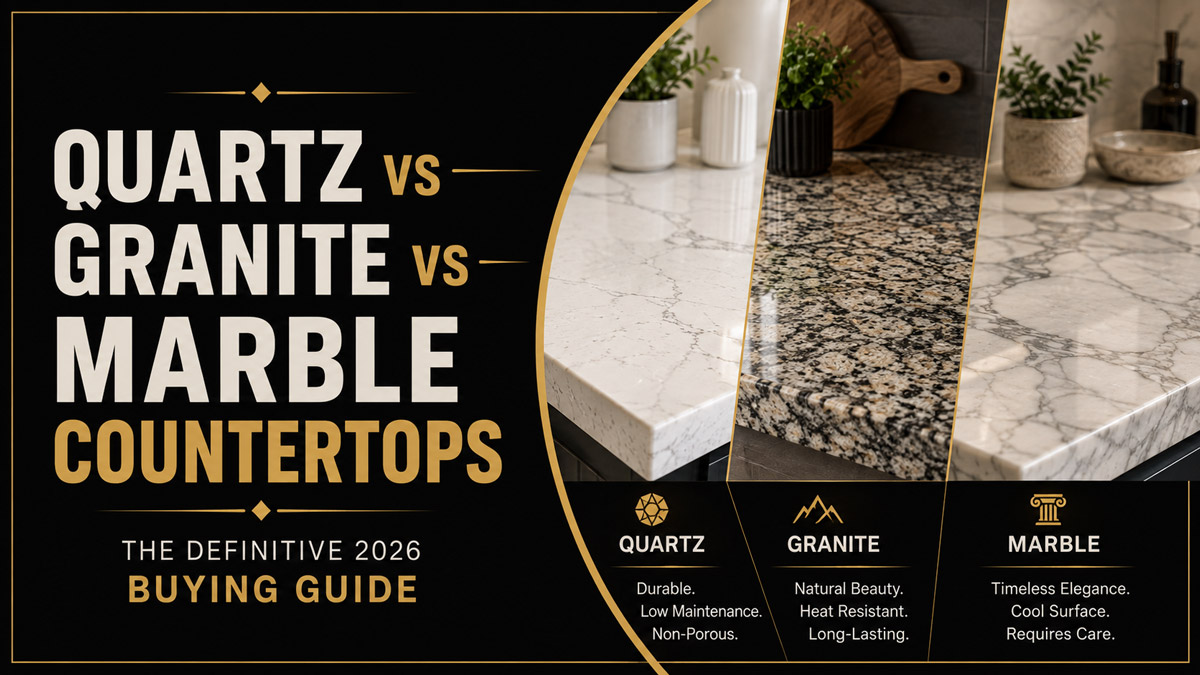
Choosing the right stone surface dictates how you will cook, clean, and live in your kitchen for the next two decades. In the debate between quartz vs granite vs marble countertops, quartz wins for zero-maintenance family homes. Granite delivers the best performance for heavy-duty cooking and outdoor use. Marble provides unmatched historic luxury for buyers willing to embrace natural patina.
Your specific lifestyle dictates which of these three materials will fail and which will thrive. A material that performs perfectly in a quiet showroom can become a daily source of frustration under the stress of a busy household. This guide strips away marketing claims to provide specific data on thermal limits, porosity rates, and real-world lifecycle costs.
Quick Verdict by Situation:
- For busy families: Quartz. It requires absolutely no sealing and blocks bacterial growth.
- For serious home chefs: Granite. It withstands direct contact with 400-degree cast iron skillets.
- For high-end property investors: Marble. It commands premium valuations in luxury real estate markets.
- For outdoor kitchen builders: Granite. It resists UV fading and freeze-thaw cracking entirely.
- For strict budget remodelers: Granite. Entry-level slabs offer the lowest total 15-year lifecycle cost.
Master Material Comparison Data
The table below breaks down the exact physical and economic realities of engineered stone versus quarried natural slabs. This data reflects typical 2026 market averages and standard material science properties.
| Feature | Quartz (Engineered) | Granite (Natural) | Marble (Natural) |
| Material Composition | 90-93% mineral, 7-10% resin | 100% igneous rock | 100% metamorphic rock |
| Upfront Cost (Installed) | $50 to $150 per sq. ft. | $40 to $175 per sq. ft. | $65 to $250 per sq. ft. |
| 10-Year Upkeep Cost | $0 (Needs no sealers) | $150 to $300 (Sealers) | $800+ (Professional honing) |
| Heat Tolerance Limit | ~300°F (Resin scorches) | 1,200°F+ (Thermal shock rare) | 400°F+ (Heat resistant) |
| Mohs Hardness Scale | 7 (High scratch resistance) | 6 to 7 (High scratch resistance) | 3 to 4 (Prone to scratching) |
| Porosity Rate | <0.05% (Effectively non-porous) | 0.1% to 0.4% (Low porosity) | 0.2% to 0.6% (Moderate porosity) |
| UV Resistance (Outdoor) | Poor (Resin yellows in sun) | Excellent (Will not fade) | Moderate to Good |
| Acid Sensitivity | None (Resists etching) | Very Low (Rarely etches) | Extreme (Immediate etching) |
Durability and Daily Impact Resistance
Granite offers the highest overall structural durability among the three materials. Because it is a dense igneous rock formed under intense volcanic pressure, granite resists deep scratches from metal knives and withstands heavy blunt impacts far better than marble. Quartz provides excellent surface scratch resistance, but the material suffers from brittle edge chipping under heavy impacts. Marble is the softest material here, making it highly prone to scratching from everyday kitchen utensils.
The Mohs hardness scale quantifies how easily a mineral can be scratched. Quartz dust sits at a 7 on this scale. The engineered quartz slabs you buy contain this hard mineral, but they bind it together with softer polymer resins. This composite structure means the flat surface deflects knife blades well. However, if you drop a heavy cast iron pan against a square quartz edge, the resin bond often shatters. Fixing a chipped quartz edge requires color-matched epoxy and rarely looks perfect.
Granite consists primarily of natural quartz and feldspar, placing it securely between 6 and 7 on the Mohs scale. You can comfortably cut directly on a granite surface without damaging the stone, though it will dull your expensive chef knives rapidly. Granite absorbs blunt impacts effectively. The stone occasionally features natural fissures. These are distinct from structural cracks and do not compromise the integrity of the slab.
Marble falls to a 3 or 4 on the Mohs hardness scale because it originates from softer limestone. Dragging heavy ceramic bowls or sliding metal appliances across a marble surface will leave microscopic scratches over time. These scratches accumulate, causing polished marble to develop a dull, matte appearance in heavy traffic areas. Fabricators often recommend a honed (matte) finish for marble specifically to hide these inevitable daily abrasions.
Winner for Durability: Granite.
Heat Tolerance and Scorch Risk Analysis
Granite vastly outperforms both quartz and marble in heat resistance. Natural granite easily withstands direct contact with 400-degree pans directly off the stove without scorching or cracking. Quartz fails this test entirely because the synthetic resins binding the stone together will melt and discolor at roughly 300 degrees Fahrenheit. Marble handles high temperatures well but remains susceptible to thermal shock.
Modern engineered quartz manufacturers explicitly warn against placing hot items directly on their surfaces. The Bretonstone manufacturing process, used by premium brands like Silestone and Caesarstone, relies on petroleum-based polymers. When you place a hot baking sheet on quartz, these polymers burn. The resulting scorch mark manifests as a permanent white or yellow cloudy stain. Repairing a scorched quartz slab is impossible. The only remedy involves cutting out the damaged section or replacing the entire counter.
Granite forms deep within the earth’s mantle at temperatures exceeding 1,200 degrees Fahrenheit. A typical home kitchen cannot produce enough heat to melt or scorch granite. You can pull a roasting pan from a 500-degree oven and drop it directly onto a granite island. The stone absorbs and dissipates the heat rapidly.
Marble also forms under heat and pressure. It resists burning beautifully. Bakers specifically seek out marble because the stone maintains a naturally cool ambient temperature, which prevents pastry dough from sticking or butter from melting during lamination. However, rapid temperature changes can cause thermal shock in thinner marble slabs, leading to localized cracking. You should still use trivets under heavy cast iron to be completely safe with marble.
Winner for Heat Tolerance: Granite.
Porosity, Staining, and Chemical Etching
Quartz is the undisputed winner for stain resistance due to its entirely non-porous structure. Engineered stone physically cannot absorb spilled wine, coffee, or bacterial contaminants. Granite possesses a low natural porosity and requires chemical sealing to prevent dark liquid stains. Marble is highly porous and contains calcium carbonate, making it disastrously vulnerable to both deep staining and chemical etching from common household acids.
Understanding the difference between a stain and an etch is fundamental to countertop maintenance. A stain occurs when a liquid penetrates the pores of the stone and deposits pigment below the surface. Red wine and turmeric are notorious stain culprits. An etch is completely different. Etching represents a physical chemical burn on the surface of the stone. When acidic liquids contact calcium carbonate, they eat away the polished top layer.
Because quartz contains synthetic resins, its porosity rate sits below 0.05 percent. You can leave a puddle of hot sauce on a white quartz counter overnight. In the morning, you simply wipe it away with a damp cloth. No pigment penetrates the surface. This non-porous nature also means quartz never requires aftermarket sealers.
Marble reacts violently to acids. A single drop of lemon juice, tomato sauce, or vinegar will permanently etch a polished marble surface within seconds. The etch leaves a dull, chalky mark that looks like a water ring but cannot be washed away. “Marble requires a relationship with your kitchen, as it will age and patina with every meal you cook,” says David Chen, lead fabricator at Apex Stone Solutions. “Granite requires basic maintenance, while quartz is an appliance you install and forget.”
Granite rarely etches because it lacks a high calcium carbonate concentration. It can stain if liquids sit long enough, particularly on lighter-colored granites like Kashmir White. Dark granites, such as Uba Tuba or Absolute Black, are incredibly dense and often reject stains even if you neglect to seal them.
Winner for Stain Resistance: Quartz.
Ongoing Maintenance and Cleaning Protocols
Quartz requires the lowest long-term maintenance of any premium countertop material on the market. You clean quartz with mild dish soap and water, and you never have to apply impregnating sealers. Granite demands periodic resealing every one to three years to maintain its stain resistance. Marble requires constant vigilance, specialized pH-neutral cleaners, and expensive professional honing to repair inevitable etching.
The phrase “low maintenance” gets thrown around loosely in kitchen showrooms. We must quantify exactly what long-term upkeep requires in terms of time, chemicals, and labor.
10-Year Maintenance Schedule Comparison
| Task | Quartz | Granite | Marble |
| Daily Cleaning | Dish soap and water | pH-neutral stone cleaner | Strict pH-neutral stone cleaner |
| Chemical Sealing | Never | Every 1-3 years | Every 6-12 months |
| Stain Removal | Glass cleaner or soft scrub | Chemical poultice application | Chemical poultice application |
| Surface Repair | N/A (Cannot be re-polished) | Rare professional buffing | Professional honing every 3-5 years |
When you purchase granite, you commit to a sealing schedule. Fortunately, applying a modern water-based or solvent-based fluoropolymer sealer is simple. You clear off the countertops, spray the liquid sealer, let it sit for fifteen minutes to penetrate the pores, and buff away the excess. The entire process takes roughly 30 minutes for an average kitchen. You know it is time to reseal when water stops beading up on the surface and instead darkens the stone.
Marble maintenance operates on an entirely different level of severity. You must ban all acidic cleaners, bleach, and abrasive sponges from the room. Because marble will inevitably etch, most homeowners eventually hire stone restoration professionals. These experts come in with diamond-grit orbital sanders to grind down the top fraction of a millimeter of the stone, removing the etches and restoring a uniform finish. This professional service often costs between $800 and $1,500 depending on kitchen size.
Quartz ignores all these rules. You can use standard household surface cleaners safely. The only chemical restriction for quartz involves highly caustic solvents, like oven cleaners or paint strippers, which can degrade the resin binders.
Winner for Maintenance: Quartz.
Upfront Pricing and Lifecycle Material Costs
Granite generally provides the lowest entry-level price point and the most favorable 15-year lifecycle cost. Basic granite colors currently cost less per square foot than entry-level quartz. Quartz pricing remains highly stable and predictable but lacks discount tiers. Marble presents the highest upfront installation cost and demands the most expensive ongoing maintenance budget over the lifespan of the kitchen.
According to the 2024 U.S. Houzz Kitchen Trends Study, countertop upgrades remain the most common kitchen renovation task. The total price tag you pay hinges heavily on material rarity, fabrication complexity, sink cutouts, and edge profiles.
Basic, highly abundant granites from Brazil or India start at roughly $40 to $50 per square foot installed. Exotic granites featuring rare blue mineral deposits, like Blue Bahia, can exceed $150 per square foot. Granite offers immense flexibility for budget-conscious remodelers.
Quartz pricing usually starts around $50 to $65 per square foot for basic speckled patterns. If you want premium quartz that perfectly mimics the long, dramatic veining of natural Calacatta marble, the price quickly jumps to $120 to $150 per square foot. Because quartz is manufactured in controlled factory environments, the pricing is heavily commoditized and predictable.
Marble represents true luxury pricing. Basic Carrara marble might start at $65 per square foot. However, highly sought-after Italian marbles, such as Calacatta Gold or Statuario, frequently demand $200 to $250 per square foot installed.
Lifecycle costs widen this gap significantly. Over a 15-year period, quartz costs exactly what you paid on day one. Granite adds roughly $200 in chemical sealer costs over that decade and a half. Marble can easily add $2,000 in professional restoration and specialized poultice materials over the same period.
Winner for Overall Value: Granite.
Real Estate ROI and Home Resale Value
Marble commands the highest premium in luxury real estate markets due to its undeniable historical prestige. High-net-worth buyers actively look for natural stone and often view engineered materials as inferior. Quartz offers the best broad-market appeal for mid-tier and upper-middle-class homes because modern buyers prioritize low maintenance. Granite remains a strong standard but has lost some of its trendy appeal in newer developments.
When evaluating home resale value, you must match the countertop material to the neighborhood price bracket. Installing a $20,000 Calacatta marble slab in a $300,000 starter home guarantees a terrible return on investment. The future buyer will not pay a premium for it. Conversely, putting entry-level quartz in a five-million-dollar estate can actually depress the sale price.
In the high-end architectural sector, natural materials signal authenticity. Luxury buyers expect marble, quartzite, or premium exotic granite. They understand that marble patinas over time, and they view this aging process as a hallmark of genuine material.
For homes ranging from $400,000 to $1.2 million, quartz is currently the king of ROI. Real estate agents highlight “maintenance-free quartz countertops” in MLS listings because young families explicitly request kitchens they do not have to baby. According to the National Kitchen & Bath Association 2024 Design Trends report, engineered quartz remains the most requested countertop material for broad-market residential remodels.
Granite is no longer the unique status symbol it was in the early 2000s. However, it completely avoids the penalty associated with laminate or tile. Buyers recognize granite as a permanent, high-quality upgrade.
Winner for Broad ROI: Quartz.
Winner for Luxury ROI: Marble.
Aesthetics, Seam Visibility, and Custom Design
Natural stone provides 100 percent unique patterns that cannot be perfectly replicated by factories. Marble delivers unparalleled luminous depth and organic veining that defines classic kitchen design. Granite offers complex, crystalline structures and deep mineral variations. Quartz delivers total consistency and predictable patterns, but it struggles significantly with seam visibility and repetitive designs.
When you purchase granite or marble, you select the exact slab from a local stone yard. The piece you see is the exact piece that goes into your home. This allows fabricators to carefully template your kitchen, placing dramatic mineral veins precisely over your island or avoiding darker spots near the sink. You can also “bookmatch” natural stone. This technique involves taking two sequential slabs from the same block and placing them side-by-side to create a mirrored, symmetrical pattern.
Quartz guarantees uniformity. If you order three slabs of a specific Caesarstone or Cambria color, they will match perfectly. This predictability makes quartz incredibly popular for massive, multi-slab modern kitchens. However, this same uniformity creates a sterile look that some homeowners find artificial. The printed veins on quartz sit near the surface and lack the physical depth of natural crystalline rock.
Seam visibility represents a major aesthetic differentiator. Countertops longer than ten feet typically require a seam. Fabricators can blend granite seams masterfully using color-matched epoxy, hiding the joint within the chaotic natural pattern. Marble seams require high skill but can be minimized effectively.
Quartz presents the toughest challenge for seams. Because quartz is so dense and uniform, a straight line cut through a printed artificial vein is glaringly obvious. The epoxy does not absorb into the non-porous resin edges easily. If you have an L-shaped kitchen requiring a highly visible corner seam, natural stone with a tighter grain pattern will hide the joint better than a white quartz with thick artificial veining.
Winner for Unique Aesthetics: Marble.
Environmental Impact and Fabrication Safety
Granite and marble are natural products that require heavy diesel machinery to quarry and transport globally. Quartz uses up to 10 percent petroleum-based resins and presents a severe, occasionally fatal, silicosis hazard to the workers who cut and fabricate the slabs. None of these three materials can claim a purely green environmental footprint, but natural stone avoids the heavy chemical manufacturing processes.
The environmental footprint of granite and marble is concentrated in extraction and logistics. Quarrying involves explosives, diamond wire saws, and massive excavators. The heavy stone then ships on freight vessels from Brazil, Italy, or India to global markets, burning significant bunker fuel. However, once the stone arrives, fabrication simply requires water and diamond blades. At the end of its life, natural stone can be crushed into gravel and returned to the earth safely.
Engineered quartz presents a much more complex environmental and ethical profile. The manufacturing process mixes crushed stone with synthetic polymer resins, pigments, and chemical catalysts. These polymers derive directly from the fossil fuel industry. Furthermore, quartz cannot be easily recycled at the end of its life due to these embedded plastics.
More urgently, quartz fabrication is facing a global health reckoning. Cutting engineered quartz releases incredibly fine crystalline silica dust. When fabricators inhale this dust without strict wet-cutting and ventilation protocols, it leads to silicosis. Silicosis is an incurable, progressive lung disease. In 2024, Australia became the first country to enact a total ban on the use, supply, and manufacture of engineered stone specifically to protect workers from this hazard.
Winner for Environmental/Ethical Safety: Granite.
Quartz vs granite vs marble countertops: Which Should You Choose?
Identifying your daily cooking habits, aesthetic preferences, and budget tolerance removes the guesswork from this decision. There is no universally superior stone, only the correct stone for your specific lifestyle.
Choose Quartz if You Are a High-Volume Family
Families managing young children, frequent spills, and chaotic schedules should default to quartz. The non-porous structure completely blocks food stains and bacterial growth without ever demanding regular chemical sealing. You can wipe up spilled grape juice hours after it happened without fear of permanent damage. Quartz functions as an architectural appliance: you install it and immediately forget about maintaining it.
Choose Granite if You Are a Serious Home Chef
Homeowners who cook daily, use heavy cast iron pans, and engage in intense food prep should select granite. Slabs easily withstand the thermal shock of scorching pots pulled directly from the stove. The dense natural structure resists deep scratching from dropped utensils. Granite provides a bomb-proof work surface that requires only 30 minutes of simple sealing once every two years to maintain peak performance.
Choose Marble if You Prioritize Authentic Luxury
Design-focused buyers renovating historical homes or luxury estates should choose marble. The classic, luminous aesthetic fits high-end designs where organic material is mandatory. You must be willing to embrace the patina. If you accept that etching is a record of a life well-lived in the kitchen, marble delivers an emotional weight and real estate value that manufactured products cannot replicate.
Choose Granite if You Are Building an Outdoor Kitchen
Homeowners designing outdoor barbecue spaces or patio bars must choose granite. The synthetic resins in engineered quartz will turn yellow, become brittle, and warp under direct ultraviolet sunlight. Marble can degrade under harsh freeze-thaw weather cycles. Granite ignores the elements entirely, remaining structurally sound and colorfast whether exposed to heavy rain, freezing snow, or relentless summer sun.
Honest Limitations: What Showrooms Hide
Salespeople frequently gloss over the harsh realities of countertop materials to close a sale quickly. You must understand the worst-case scenarios before committing thousands of dollars.
Where Quartz Disappoints:
Quartz is entirely unsuitable for outdoor applications or areas exposed to constant, direct sunlight through large, unshaded windows. The UV rays degrade the petroleum resins, causing bright white quartz to develop a permanent, unsightly yellow hue. Additionally, if you own air fryers, slow cookers, or toaster ovens that radiate high heat directly downward, you must place them on thick cutting boards to prevent scorching the resin beneath the appliance.
Where Granite Frustrates:
Granite design trends shift dramatically. The heavily speckled, brown-and-gold granites that dominated the early 2000s now instantly date a kitchen. If you choose a highly chaotic, bossy granite pattern, it limits every other design choice in the room. You will struggle to match backsplashes and cabinet colors to a highly saturated granite slab. Furthermore, lighter granites (like whites and light grays) are significantly more porous than dark granites and will stain if you fail to maintain a strict sealing schedule.
Where Marble Fails:
Marble is a living finish. If you possess a type-A personality and demand pristine, mirror-like perfection from your surfaces, marble will ruin your peace of mind. A stray slice of lime from a cocktail will etch the counter permanently in ten seconds. Showrooms rarely explain how quickly this happens. The first etch on a brand-new marble island is heartbreaking. You have to wait years for the surface to accumulate enough etches to look intentionally aged.
The Alternatives Nobody Mentions:
If you want the heat resistance of granite, the low maintenance of quartz, and the look of marble, look into ultra-compact surfaces. Sintered stones (like Dekton) and large-format porcelain slabs are rapidly gaining market share. These materials are fired at extreme temperatures, making them UV proof, scratch-proof, heat-proof, and stain-proof. However, they are brittle, incredibly difficult for standard fabricators to cut without shattering, and lack color continuity if you chip an edge.
Frequently Asked Questions
Can I install quartz, granite, or marble countertops myself?
DIY installation is strongly discouraged. A standard granite or quartz slab weighs between 15 and 20 pounds per square foot. A typical kitchen island piece easily exceeds 500 pounds. Transporting, cutting, and leveling these slabs requires specialized A-frames, diamond-tipped wet saws, and structural cabinet reinforcement. Improper handling will snap the stone.
How do I clean everyday messes on these countertops safely?
For quartz, use standard mild dish soap and warm water. For granite and marble, you must use a dedicated, pH-neutral stone cleaner. Avoid vinegar, bleach, Windex, and any citrus-based cleaners on natural stone, as they strip the sealers from granite and instantly cause permanent chemical etching on marble.
Which material is the best choice for a kitchen island?
If the island serves as a primary dining and homework area for children, quartz is the safest choice due to stain resistance. If the island features a cooktop where heavy, hot pots are moved frequently, granite is superior. Avoid marble on an island if you cannot tolerate visible wear in highly lit central areas.
What is quartzite, and how does it compare?
Quartzite is a natural metamorphic rock, unlike engineered quartz. It offers the delicate, veined aesthetic of marble but possesses a hardness greater than granite. It provides an excellent middle ground for luxury buyers, but it is highly expensive, difficult to fabricate, and still requires regular sealing to prevent liquid staining.
Does countertop thickness matter for durability?
Yes. The industry standard thickness is 3 centimeters (roughly 1.25 inches). Some budget fabricators offer 2-centimeter slabs to reduce upfront costs. These thinner slabs require a plywood underlayment for structural support and often feature a glued, laminated edge to simulate a thicker profile. Always demand 3-centimeter slabs for long-term durability.