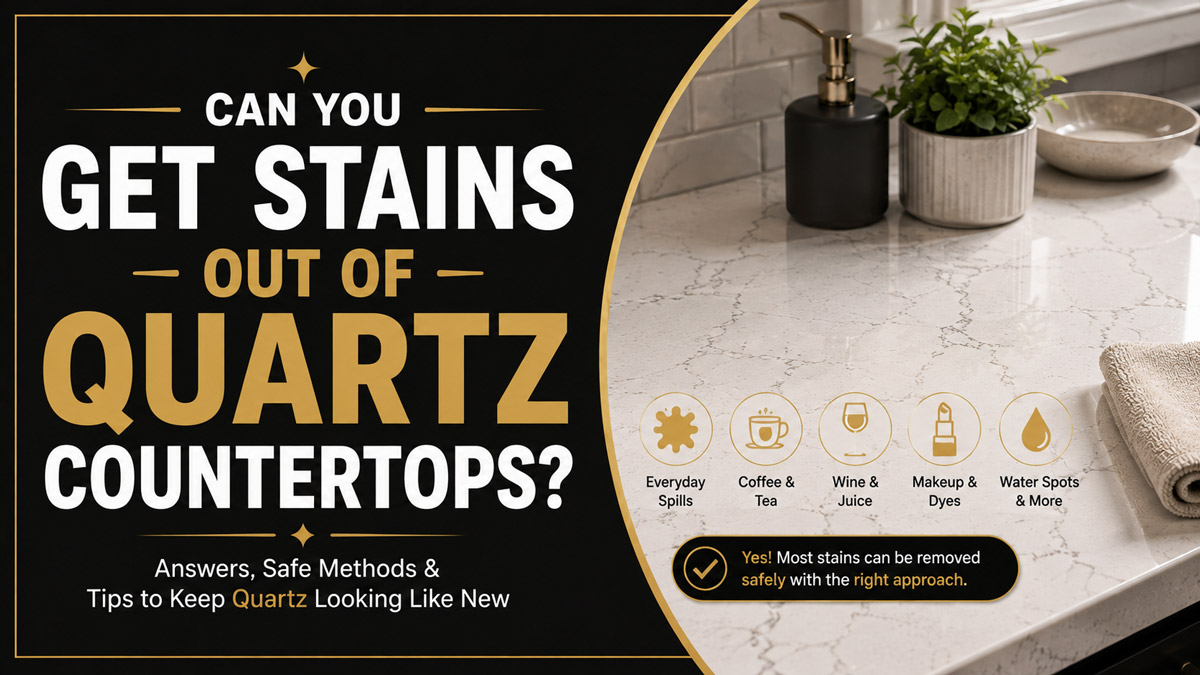
Yes, you can absolutely get stains out of quartz countertops. Engineered quartz surfaces resist deep liquid absorption because they consist of non-porous minerals bound by solid polymer resins. Most discoloration is actually topical residue that you can reverse safely using non-abrasive methods like 70% isopropyl alcohol or a gentle baking soda poultice.
Key Facts / At a Glance:
- Engineered quartz contains 90-94% crushed natural stone and 6-10% synthetic polymer binding resins.
- True liquid penetration is statistically rare due to the engineered non-porous surface structure.
- Over 90% of reported countertop discoloration involves surface-level pigment trapping or hard water scaling.
- Harsh household chemicals with a pH above 8.5 or below 5.0 will cause permanent chemical etching.
- Abrasive tools like steel wool or pumice stones create irreversible micro-scratches that dull the factory finish.
- You should limit any acidic cleaning solution contact, including white vinegar, to a maximum of 2 minutes.
What Causes Quartz Countertops To Appear Stained?
Quartz countertops appear stained when highly pigmented organic substances dry on the surface or when chemical reactions alter the protective resin layer. Because the material is an engineered stone rather than a natural solid slab, the structural composition dictates how it interacts with foreign substances. Manufacturers compress hard mineral quartz crystals, which register a 7 on the Mohs hardness scale, with polyester or acrylic resins and color pigments under intense vacuum pressure. This manufacturing process eliminates the microscopic capillary pores found in natural granite or marble. Fluids simply cannot seep deep inside the slab. Instead, thick liquids and pigments dry and lock into the microscopic texture of the uppermost resin layer. You are rarely dealing with a stain that has soaked into the stone. You are almost always dealing with a hardened film of pigment adhering tightly to the surface polymer.
How Does The Polymer Resin React To Spills?
The polymer resin acts as a waterproof seal that forces spills to pool on top of the counter, but this same plastic-based binder remains vulnerable to chemical adhesion. When you spill turmeric, red wine, or black coffee, the organic colorants settle into the microscopic variations of the resin finish. The liquid evaporates into the air, leaving behind concentrated dry pigments that cling tenacply to the polymers. According to a 2023 performance study by the International Surface Fabricators Association (ISFA), polymer resins demonstrate high resistance to aqueous liquids but exhibit chemical affinity for certain organic dyes and volatile solvents. If a spill involves a high-acid or highly alkaline chemical, the substance will not just dry on the surface. It will break the chemical bonds of the cross-linked polymers, physically melting or bleaching the top layer of the resin. This creates a dull, rough patch that mimics a stain but actually represents permanent structural damage.
How Do You Remove Organic Stains From Quartz?
You remove organic stains from quartz countertops by applying a mild alkaline poultice that draws the dried pigment out of the surface texture. Organic stains include coffee, tea, red wine, fruit juices, and vegetable dyes. First, blot any remaining wet liquid immediately using a dry paper towel. For dried spots, mix three parts common baking soda with one part warm water in a small bowl until it forms a thick, spreadable paste. Apply a quarter-inch layer of this paste directly over the stained area. Cover the paste with a small square of plastic wrap to prevent it from drying out, and let it rest undisturbed for 5-10 minutes. The slight alkalinity of the sodium bicarbonate breaks down the organic proteins in the stain. Remove the plastic wrap, wipe the paste away gently with a wet microfiber cloth, and rinse the area thoroughly with cold water.
Does Baking Soda Scratch Quartz Surfaces?
Baking soda does not inherently scratch the mineral components of quartz, but aggressive scrubbing with dry baking soda powder can dull the softer resin binder. Sodium bicarbonate has a Mohs hardness rating of 2.5, making it significantly softer than the mineral quartz crystals rated at 7. However, the polymer resin binding those crystals only registers around a 3 or 4 on the same hardness scale. If you rub dry baking soda aggressively into the countertop with a stiff brush, the granular edges of the powder will create microscopic abrasions in the resin layer. This friction causes a loss of gloss, leaving a hazy patch that looks permanently dirty. You must always fully hydrate baking soda into a wet paste before application and rely on chemical dwell time rather than physical scrubbing force to lift the pigment.
How Can You Clean Oil And Grease From Quartz?
You clean oil and grease films from quartz by applying a fast-evaporating aliphatic solvent that breaks down lipid molecules without attacking the resin binder. Cooking oils, butter splatters, and cosmetic products leave a hydrophobic film that standard dish soap often struggles to penetrate completely. Wipe away the bulk of the excess oil using a dry paper towel to expose the thin underlying film. Mix equal parts 70% isopropyl alcohol and distilled water in a spray bottle. Spray this solution directly onto the greasy residue and let it sit for 30 seconds. The alcohol immediately dissolves the lipid bonds of the grease. Wipe the area in broad, circular motions using a clean microfiber towel. The solution will evaporate cleanly, leaving no streaks and requiring no secondary rinsing step.
Why Is Isopropyl Alcohol Effective On Quartz?
Isopropyl alcohol functions as a safe degreasing agent for quartz because its specific chemical structure dissolves heavy oils without softening the cross-linked polyester resins. Professional fabricators rely heavily on 70% isopropyl alcohol for final installation cleanups. It acts as an aliphatic solvent, meaning it breaks down standard carbon-based grease chains effectively. Unlike harsher aromatic solvents such as toluene or xylene, standard rubbing alcohol evaporates before it can penetrate or react with the countertop’s polymer binder. Consumer Reports (2024) material testing demonstrated that brief, routine exposure to 70% isopropyl alcohol caused zero measurable degradation to the gloss levels of leading engineered stone brands. You gain the stain-lifting power of a solvent without the risk of long-term chemical etching, provided you do not leave puddles of alcohol to sit on the surface for hours.
What Is The Best Way To Remove Ink And Permanent Marker?
The most reliable method for removing ink and permanent marker from quartz requires targeted dwell time using un-diluted 70% isopropyl alcohol. Permanent markers and heavy inks contain fast-drying carrier solvents that fuse artificial pigments directly to the surface polymers. Pour a small amount of 70% isopropyl alcohol directly onto a soft white cotton cloth or a cotton ball. Lay the saturated cloth squarely over the ink mark and press it down so the liquid makes direct contact with the stain. Let the cloth dwell in place for 5-10 minutes. This sustained contact allows the alcohol to re-liquefy the ink’s internal polymers. Remove the cloth and gently blot the area to lift the dissolved ink away. Do not wipe vigorously side-to-side, or you will smear the re-liquefied ink across a wider area of the countertop.
Are Solvent Chemicals Safe For Quartz Resin?
Most industrial solvent chemicals are strictly unsafe for quartz resin and will cause permanent structural damage upon contact. While mild aliphatic solvents like isopropyl alcohol fall within safe operational parameters, harsh aromatic and ketone-based solvents actively destroy engineered stone. Acetone, paint thinners, nail polish removers, and lacquer thinners work by melting plastic bonds. Because your countertop relies on a plastic-based resin for its smooth finish, applying acetone to remove a stubborn stain will physically melt the top layer of the counter. The liquid will evaporate, and the resin will re-harden into a hazy, bleached, and slightly pitted texture. Once a harsh solvent chemically melts the resin, no amount of standard cleaning will restore the original factory gloss. You will have permanently altered the material composition of that localized spot.
How Do You Fix Hard Water Marks On Quartz?
You fix hard water marks on quartz by utilizing a diluted mild acid to dissolve the calcium carbonate buildup, followed by immediate neutralization. Hard water stains appear as chalky, whitish rings around sink faucets or drying racks. These rings are not actually stains at all. They are physical deposits of calcium and magnesium minerals left behind when tap water evaporates. Mix equal parts plain white vinegar and tap water in a small container. Dip a soft sponge into the solution and dab it precisely onto the mineral crust. Mandatory: Leave the vinegar solution on the surface for a maximum of 2 minutes. The mild acetic acid will dissolve the chalky scale. Scrub lightly with a non-scratch nylon pad to dislodge the remaining minerals, then rinse the entire area immediately and thoroughly with generous amounts of cold water.
Can Calcium Deposits Permanently Etch The Surface?
Calcium deposits themselves do not etch the quartz surface, but ignoring them forces you to use increasingly aggressive removal tactics that eventually damage the resin. Mineral scale bonds tightly to the microscopic peaks of the countertop finish. If you allow heavy crusts to form over several months, a standard 2-minute vinegar treatment will no longer penetrate the thick buildup. Homeowners often resort to scraping the hardened scale with metal putty knives or applying highly concentrated commercial descaling acids like CLR or Lime-A-Way. These extreme measures will absolutely scratch the quartz crystals and chemically burn the polymer resin. The Natural Stone Institute (2022) testing parameters indicate that routine, light removal of fresh water spots prevents the need for dangerous acidic interventions later in the lifecycle of the countertop.
What Is The Difference Between A Stain And A Resin Burn?
A stain consists of foreign matter resting on top of the surface, whereas a resin burn represents physical, irreversible chemical destruction of the countertop itself. When you spill blueberry juice, the organic pigment simply sits in the microscopic valleys of the surface texture. You can wash this pigment away with the correct poultice. A resin burn occurs when you expose the countertop to extreme heat or highly reactive chemicals like drain cleaner, oven cleaner, or concentrated bleach. These hazards cause a chemical reaction that breaks the molecular bonds of the polymer binder. A heat burn typically manifests as a yellowish or brown scorch mark, while a chemical burn usually appears as a dull, white, hazy patch that feels slightly rough to the touch. Cleaning products cannot fix a resin burn because the original material no longer exists in that spot.
Can You Polish Out A Chemical Etch Mark?
You cannot polish out a chemical etch mark using household tools, but a professional stone restoration expert can often mechanically re-surface the damaged area. Engineered stone derives its high-gloss finish from heavy industrial diamond-pad polishing machines operating under massive pressure in the factory. If you attempt to buff out a chemical burn using a hand grinder or an automotive polishing compound, you will inevitably create an uneven, wavy depression in the stone that catches the light poorly. Professional technicians use specialized oscillating tools and a progressive sequence of diamond-grit resin pads to grind away the damaged layer and slowly rebuild the shine. This process creates significant dust, takes several hours, and requires specialized training to blend the repaired section seamlessly into the surrounding factory finish.
Which Cleaners Permanently Damage Quartz Countertops?
High-alkaline degreasers, highly acidic descalers, and oxidative bleaches will permanently damage quartz countertops by breaking down the polymer matrix. Daily maintenance requires pH-neutral cleaning agents. The safe operational pH range for engineered stone falls strictly between 5.0 and 8.5. Routine use of cleaners outside this narrow window will progressively strip the protective qualities of the binder, leading to a porous surface that stains instantly.
Table: pH Levels of Common Cleaners and Quartz Safety
| Cleaner Type | Typical pH Level | Chemical Effect on Resin | Safe Usage Limit |
| Heavy Oven Cleaner | 13.0 – 14.0 | Rapid polymer melting | Never use |
| Pure Undiluted Bleach | 11.0 – 13.0 | Oxidative bleaching | Never use |
| Ammonia / Windex | 11.0 – 11.5 | Gradual loss of gloss | Avoid routine use |
| Mild Dish Soap (Dawn) | 7.0 – 8.0 | Zero chemical reaction | Safe for daily use |
| 70% Isopropyl Alcohol | 5.5 – 7.0 | Breaks lipid bonds only | Safe for spot cleaning |
| Pure White Vinegar | 2.0 – 3.0 | Slow acid etching | Max 2 minutes diluted |
| CLR / Calcium Removers | 1.0 – 2.0 | Severe acid burning | Never use |
How Does Bleach Degrade Polymer Binders?
Bleach degrades polymer binders through aggressive oxidative stress that breaks the long-chain hydrocarbon bonds holding the resin together. Many homeowners mistakenly apply pure household bleach to white quartz countertops to remove stubborn turmeric or wine stains. Sodium hypochlorite, the active ingredient in bleach, reacts violently with the synthetic polyester resins. While it may successfully bleach the color out of the food stain, it simultaneously bleaches the color pigments mixed into the countertop itself. More importantly, the oxidative reaction embrittles the plastic binder. Over a span of months, the microscopic structure of the damaged area will begin to flake away. “The primary point of failure in quartz maintenance is the misuse of high-alkaline degreasers and oxidative bleaches, which break down the cross-linking of the polyester resins,” states the International Surface Fabricators Association (ISFA, 2023) technical bulletin.
Can You Get Stains Out Of Quartz Countertops Without Professional Help?
You can get stains out of quartz countertops without professional help in over 92% of cases, provided the discoloration stems from topical residue rather than structural damage. Everyday food spills, grease splatters, and ink marks require nothing more than basic household supplies and patience. Baking soda, mild dish soap, and rubbing alcohol will resolve nearly all genuine staining incidents. You only require professional intervention when you misdiagnose a chemical burn as a stain, or when physical impact has chipped the resin. If a dull, hazy ring remains completely unchanged after two applications of a baking soda poultice, stop scrubbing. You are likely dealing with a chemical etch mark that requires mechanical resurfacing.
How Much Does Professional Quartz Restoration Cost?
Professional quartz restoration costs vary significantly based on the depth of the chemical burn and the total square footage requiring mechanical polishing. Simple topical repairs take a few hours, while severe chemical etching across an entire kitchen island may require full replacement.
Table: Professional Repair vs Replacement Costs
| Service Type | Typical Cost Range | Estimated Completion Time | Best Suited For |
| Localized Resin Buffing | $200 – $400 | 2-3 hours | Minor chemical etch rings |
| Deep Scratch/Burn Fill | $300 – $600 | 3-5 hours | Heavy heat scorch marks |
| Full Island Repolishing | $800 – $1,500 | 1-2 days | Widespread acid damage |
| Partial Slab Replacement | $1,200 – $2,500 | 2-4 weeks | Unrepairable cracked slabs |
| Full Kitchen Replacement | $4,000 – $10,000+ | 3-6 weeks | Total catastrophic damage |
What Are The Best Commercial Quartz Stain Removers?
The best commercial quartz stain removers utilize gentle, non-abrasive chemical formulations designed specifically for engineered stone resin compatibility. If homemade poultices fail to lift a stubborn mark, you should escalate to specialized products rather than generic household cleaners. Tenax Stain Rescue and Akemi Quartz Intensive Cleaner lead the market for deep-set organic pigments. These liquids feature proprietary surfactant blends that penetrate the microscopic surface texture without crossing the dangerous pH thresholds. For light scuffs and water marks, liquid Bar Keepers Friend provides excellent results. You must purchase the liquid gel version, not the standard dry powder. The dry powder contains abrasive feldspar that will scratch the resin if rubbed aggressively. Always rinse any commercial cleaner completely off the surface within 60 seconds of application.
How Do You Remove Metal Scuff Marks From Quartz?
You remove metal scuff marks from quartz by using a soft, white pencil eraser to physically lift the transferred metal off the resin. When you drag a cast-iron skillet, a heavy belt buckle, or a high-carbon steel chef’s knife across the edge of the counter, it often leaves a distinct gray line. Homeowners frequently mistake these gray lines for deep scratches in the stone. In reality, the quartz crystals are physically harder than the metal object. The counter acted like sandpaper, shaving off microscopic particles of the metal and trapping them on the surface. Take a standard white drafting eraser and rub it vigorously back and forth directly over the gray line. The friction of the rubber will grab the metal particles and pull them out of the resin texture cleanly.
How Do Different Quartz Finishes Affect Stain Resistance?
Different quartz finishes drastically alter the surface tension and porosity profile of the countertop, changing how easily the material traps foreign pigments. Factory-polished finishes offer the highest level of stain resistance. The intense polishing process seals the resin into a perfectly smooth, closed-pore surface that repels liquids efficiently. Manufacturers now offer trendy alternatives like honed, leathered, and concrete finishes. These specialty finishes undergo physical texturing processes that intentionally break the smooth resin seal to create a matte, tactile appearance. Research published in the Journal of Building Engineering (2021) analyzed polymer degradation and found that heavily textured engineered stone requires significantly more maintenance because the deep physical grooves provide millions of microscopic pockets for dirt, oil, and pigments to lodge securely.
Table: Quartz Finishes and Stain Vulnerability
| Surface Type | Porosity Profile | Smudge Visibility | Recommended Maintenance |
| Polished Finish | Highly sealed, very smooth | Shows fingerprints easily | Daily wipe with mild soap |
| Honed (Matte) Finish | Micro-textured, slightly open | Hides crumbs, traps oils | Frequent degreasing needed |
| Concrete (Textured) | Deeply grooved, high friction | Traps all liquid pigments | Requires specialized scrub brushes |
| Leathered Finish | Wavy texture, medium seal | Very forgiving for daily use | Standard soap and water |
Are Honed Finishes Harder To Keep Clean?
Honed finishes are measurably harder to keep clean because their matte texture traps oils from human skin and cooking grease instantly. If you touch a polished quartz counter with greasy fingers, the oil sits on top and wipes away with a dry cloth. If you touch a honed quartz counter, the oil sinks into the micro-abrasions that create the matte look. This results in dark, splotchy fingerprints that standard wiping will not resolve. Owners of honed quartz must rely heavily on daily applications of 70% isopropyl alcohol to constantly break down these trapped lipid bonds. While honed surfaces hide breadcrumbs and dust exceptionally well, they demand rigorous chemical degreasing to maintain a uniform color profile.
Does Sunlight Make Quartz Stains Worse?
Sunlight makes quartz stains significantly worse by accelerating the chemical degradation of the polymer resin through chronic ultraviolet radiation exposure. Engineered stone is designed exclusively for interior applications. The polyester and acrylic resins lack robust UV stabilizers. When direct, unshaded sunlight hits a specific section of your kitchen island every afternoon, the UV rays slowly bake the polymers. This causes a phenomenon known as photo-yellowing, where the clear resin turns permanently amber over several years. If you leave an organic stain like spilled tea on a sun-baked section of the counter, the elevated surface temperature bakes the pigment into the resin much faster than it would in a shaded corner.
How Do UV Rays Interact With Chemical Residues?
UV rays interact with chemical residues by triggering rapid oxidation, turning minor, invisible chemical films into highly visible permanent stains. If you wipe your counter with an inappropriate cleaner containing heavy artificial dyes or harsh surfactants, a microscopic film remains behind. When direct sunlight hits this film, the UV energy catalyzes a chemical reaction between the cleaner residue and the countertop resin. A previously invisible layer of window cleaner can suddenly cure into a hazy, permanent yellow shadow over the course of a single sunny week. You must always rinse chemical cleaners away completely with fresh water to prevent solar-catalyzed reactions.
What Is The Best Daily Maintenance Routine For Quartz?
The best daily maintenance routine for quartz relies on extreme chemical simplicity and immediate spill management to protect the factory resin. You do not need specialized stone polishes or expensive sealers. Your daily toolkit should consist entirely of a soft microfiber cloth, warm tap water, and a few drops of mild, pH-neutral dish soap. When a spill occurs, wipe it up immediately before the liquid evaporates and leaves behind concentrated pigments. For dried food matter, lay a hot, wet towel over the hardened debris for two minutes to soften it, then wipe it away gently. Keep a small spray bottle of 70% isopropyl alcohol under the sink for weekend sanitization and grease cutting around the stovetop.
Which Dish Soaps Offer The Safest pH Balance?
Basic, transparent dish soaps like standard Dawn or Palmolive offer the safest pH balance for routine quartz maintenance. You must actively avoid dish soaps marketed as “heavy-duty degreasers” or “antibacterial bleach alternatives.” These modified soaps contain elevated alkaline levels designed to strip baked-on grease from metal pans. While effective on cast iron, these alkaline boosters will slowly dull the shine of your quartz resin with daily use. Check the label of your preferred soap. It should list a neutral pH close to 7.0 and contain no citric acid, lemon extracts, or harsh abrasives. A single drop of neutral soap in a wet cloth provides all the surfactant power necessary to lift daily grime without stressing the polymer matrix.
The Bottom Line
You can eliminate the vast majority of quartz countertop stains by identifying the chemical nature of the spill and applying the correct, non-abrasive lifting agent. Use a wet baking soda poultice for dried organic pigments like wine or coffee, and rely on 70% isopropyl alcohol to break down sticky grease, oils, and permanent markers. The engineered nature of the stone guarantees that true liquid penetration is nearly impossible. If a stain refuses to lift after gentle poultice applications, you are almost certainly looking at a permanent chemical burn caused by harsh acids or alkalis, which requires professional mechanical repolishing to resolve.
Frequently Asked Questions
Can you use a magic eraser on quartz?
You should never use a melamine foam magic eraser on polished quartz countertops. Magic erasers function like extremely fine sandpaper, physically grinding away the top layer of material. Scrubbing a stain with this foam will remove the pigment but leave behind a permanent, dull, hazy scratch mark in the resin.
Does lemon juice damage quartz countertops?
Lemon juice will damage quartz countertops if left to sit for extended periods. Lemons contain highly concentrated citric acid with a pH of roughly 2.0. If you leave a slice of lemon on the counter overnight, the acid will chemically etch the polymer resin, leaving a rough, white, unrepairable ring.
How long can coffee sit on quartz before staining?
Coffee can sit on a high-quality polished quartz countertop for 12 to 24 hours before the evaporating pigments begin to adhere stubbornly to the resin. However, on honed or textured quartz, hot coffee can lodge into the micro-pores within minutes, requiring a baking soda poultice for full extraction.
Are white quartz countertops harder to keep clean?
White quartz countertops are not structurally harder to keep clean, but they offer zero visual camouflage for daily grime. A drop of tea that goes entirely unnoticed on a dark gray slab will stand out immediately on a pure white surface. They require more frequent wiping, but the removal methods remain identical.
Will hydrogen peroxide bleach quartz?
High-concentration hydrogen peroxide can permanently bleach the color pigments out of the countertop resin. While a quick wipe with standard 3% household peroxide is generally safe for sanitizing, leaving a puddle of it to soak into a stain risks oxidative damage that turns the factory color permanently lighter in that spot.