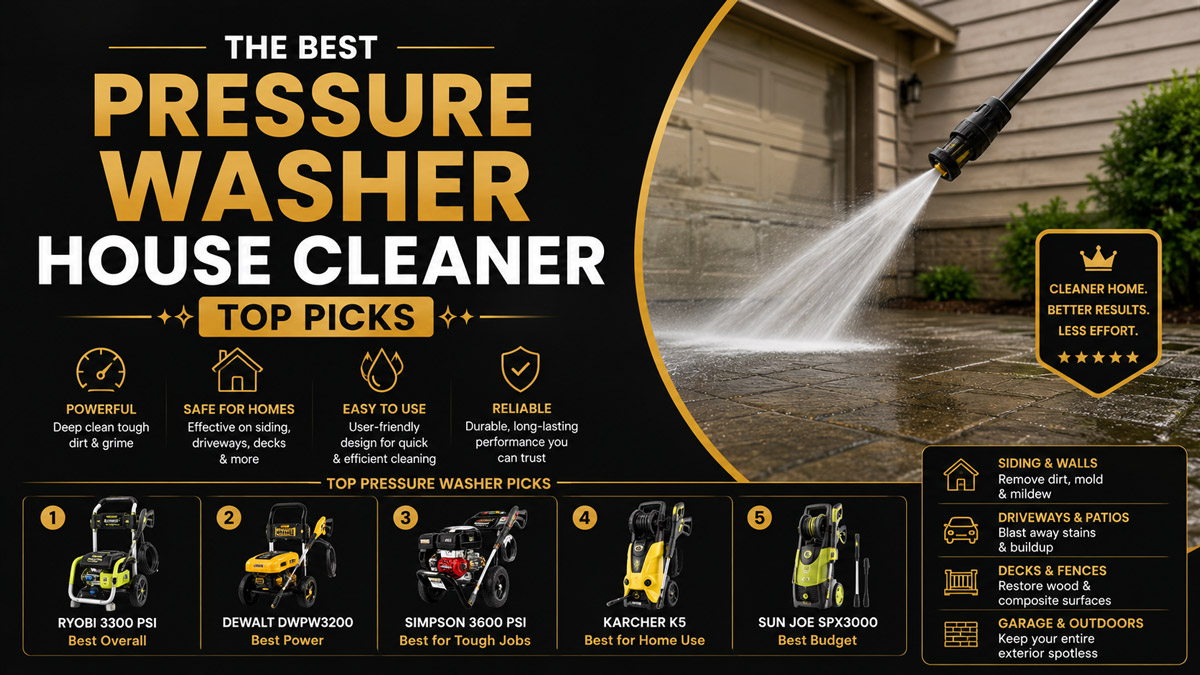
The best pressure washer house cleaner combines a high-volume water flow machine with a downstream chemical injector and a bleach-stable surfactant. This specialized combination relies completely on chemical soft washing action rather than destructive physical force. It strips organic mold safely without destroying exterior siding, window seals, or painted trim.
Key Facts / At a Glance
- Home siding should never be subjected to pressures exceeding 2,500 PSI.
- Cleaning Units (CU), calculated by multiplying PSI by GPM, dictate true cleaning speed.
- Downstream chemical injectors only siphon detergent when a low-pressure soap nozzle is attached.
- Spraying high-pressure water directly upward drives moisture beneath siding laps, leading to structural rot.
- Standard bleach requires the addition of specialized surfactants to cling effectively to vertical surfaces.
What Determines the Best Pressure Washer House Cleaner?
Identifying the ideal house washing setup requires matching the correct mechanical pump configuration with appropriate chemical additives. High-pressure pumps, available in axial or triplex configurations, accelerate water fed from a standard garden hose through a restriction nozzle. Axial pumps spin at high engine speeds and suit residential use, while triplex pumps operate at lower RPMs for commercial longevity.
When cleaning a vertical house facade, operators rely on a downstream chemical injector. This small brass fitting sits after the pump and utilizes the Venturi effect to pull concentrated detergent into the water stream. Because the chemical enters the hose after the pump, corrosive mixtures never touch the delicate internal pump valves. This physical mechanism dictates that you must use a low-pressure nozzle to apply detergent. High-pressure nozzles create internal backpressure, which forces the injector check valve shut and stops the chemical siphon entirely.
Top 5 Equipment and Detergent Picks
Our evaluations prioritize structural safety, component longevity, chemical compatibility, and sustained fluid delivery.
Quick Verdict by User Profile:
- Budget Homeowners: Choose the Westinghouse ePX3500 combined with OdoBan Concentrate.
- Prosumers: Select the Greenworks Pro 3000 paired with Krud Kutter House Wash.
- Commercial Operators: Require 4.0 GPM gas machines paired with raw Sodium Hypochlorite and professional surfactants.
1. Greenworks Pro 3000 PSI 2.0 GPM Cold Water Electric Washer
The Greenworks Pro 3000 delivers commercial-tier flow rates through a completely exhaust-free electric platform. It utilizes an advanced brushless motor that yields cleaning speeds previously restricted to gas-powered hardware.
- Maximum Pressure: 3,000 PSI
- Flow Rate: 2.0 GPM
- Power Requirement: Dedicated 15-Amp circuit
- Total Cleaning Units: 6,000 CU
The primary advantage of the Greenworks Pro is its sustained 2.0 GPM flow rate, which accelerates the rinsing phase of chemical soft washing. The brushless motor eliminates the need for oil changes, spark plug replacements, air filter cleaning, and fuel stabilization.
The machine suffers from a significant weight penalty. It is markedly heavier than standard light-duty electric units, making it difficult to haul up steep landscaping grades. Furthermore, running this unit on an undersized extension cord will instantly trip circuit breakers or damage the stator. Choose this if you manage a large residential estate with extensive concrete driveways and multi-story siding. Skip it if you need a lightweight unit for rapid, five-minute patio spot-cleaning.
2. Westinghouse ePX3500 Electric Pressure Washer
The Westinghouse ePX3500 provides highly stable, portable cleaning power for single-story residential applications. The manufacturer prioritized chassis balance by incorporating an anti-tipping design with four multi-directional caster wheels.
- Maximum Pressure: 2,500 PSI
- Flow Rate: 1.76 GPM
- Power Requirement: Standard 120V outlet
- Total Cleaning Units: 4,400 CU
This unit excels at tight navigation around delicate landscaping and parked vehicles. The low center of gravity prevents the machine from tipping over when you abruptly pull the high-pressure hose. The 2,500 PSI output aligns perfectly with the maximum safe limits for standard vinyl siding.
The proprietary plastic connection points wear out faster over time than standard brass quick-connect fittings. The lower 1.76 GPM flow rate limits vertical reach, making it inadequate for hitting the upper gables on a two-story home without scaffolding. Choose this if you own a single-story home and want a highly maneuverable machine. Skip it if you need to wash structures exceeding twenty feet in height.
3. Sun Joe SPX3000-XT1 Xtream Clean 2200 PSI
The Sun Joe SPX3000-XT1 offers exceptional chemical versatility through its dual-tank detergent system. Operators can toggle between an alkaline degreaser and a bleach-free house wash seamlessly without stopping the motor.
- Maximum Pressure: 2,200 PSI
- Flow Rate: 1.65 GPM
- Detergent Capacity: Two 30.4-ounce removable tanks
- Total Cleaning Units: 3,630 CU
The integrated dual chemical tanks allow homeowners to apply a heavy degreaser to the concrete foundation and immediately switch to a gentle foaming wash for the vinyl siding above it. The machine provides a high baseline value for entry-level users needing immediate all-in-one functionality.
The factory-included high-pressure hose possesses severe memory retention and is highly prone to kinking during operation. Kinks restrict water flow, which forces the pump to overwork and overheat rapidly. Choose this if you require multiple different cleaning solutions for complex exterior projects. Skip it if you demand premium hose quality right out of the box.
4. Krud Kutter House and Siding Pressure Washer Concentrate
Krud Kutter House and Siding Concentrate provides a highly effective, bleach-free chemical solution for safely lifting dirt around sensitive biological environments. The formula relies on heavy surfactants and peroxide engines rather than harsh chlorines.
- Active Chemistry: Sporex (proprietary bleach-free additive)
- Dilution Ratio: 1 Gallon makes up to 25 Gallons
- Coverage Area: 4,000 square feet per bottle
- Safety Profile: Safe for pets, plants, and aquatic life
This solution contains specialized anti-corrosive agents that actively protect the structural O-rings inside pressure washer pumps and injector lines. The peroxide bubbles lift common dirt, bird droppings, and light atmospheric pollution off the siding without burning the grass below.
Because the formula lacks Sodium Hypochlorite, it cannot instantly dissolve heavy, established mold or black algae. The operator must physically scrub deeply set organic stains with a siding brush, drastically increasing total project time. Choose this if you have sensitive landscaping, expensive Koi ponds, or wandering pets. Skip it if you are facing decades of heavy black algae accumulation on porous brick.
5. OdoBan 1 Gallon Pressure Wash Concentrate
OdoBan Pressure Wash Concentrate serves as a highly versatile alkaline detergent capable of stripping grease and grime from a massive variety of exterior substrates. It scales from delicate vinyl up to heavily soiled concrete driveways.
- Active Chemistry: High-alkaline surfactants
- Dilution Ratio: 1 Gallon makes up to 10 Gallons
- Coverage Area: 2,500 square feet per bottle
- Safety Profile: Requires exact dilution to prevent surface etching
The multi-surface compatibility allows a homeowner to wash vinyl siding, asphalt roofing shingles, brick retaining walls, and aluminum gutters using a single jug of chemical. The strong degreasing properties make it exceptional for homes located near busy highways where automotive exhaust soot accumulates on the siding.
The highly alkaline baseline requires exact mixing ratios to stay safe on polished finishes or anodized aluminum window frames. Mixing the solution too hot (too concentrated) can permanently dull the sheen on premium siding products. Choose this if you need a heavy-duty degreaser for exhaust soot or barbecue grease. Skip it if you are uncomfortable measuring precise chemical dilution ratios.
How Do Machine Types Affect Cleaning Performance?
Machine architecture dictates total flow rate, which ultimately determines how fast a detergent can be rinsed away. Evaluating machine types requires looking past top-end pressure and focusing on sustained volume.
| Machine Category | Typical PSI Range | Typical GPM Range | Expected Cleaning Timeframe | Cost Range |
| Corded Electric | 1,500 – 3,000 PSI | 1.1 – 2.0 GPM | 3.5 – 5.0 Hours | $120 – $450 |
| Gas-Powered | 2,800 – 4,400 PSI | 2.3 – 4.0 GPM | 1.5 – 3.0 Hours | $330 – $1,400 |
| Battery-Powered | 300 – 800 PSI | 0.8 – 1.2 GPM | Spot cleaning only | $90 – $300 |
Electric models are lightweight, require zero engine maintenance, and run quietly. They typically pull 13-15 amps and work perfectly for standard residential siding. Gas-powered models excel on expansive properties and multi-story brick homes where high fluid volume is mandatory to push water up to the second story. Battery-powered units remain highly portable for quick spot-cleaning on patio furniture, but they lack the sustained volume required to wash an entire house efficiently.
Which Chemical Formulations Actually Work?
Selecting the correct chemical formulation separates professional results from permanent property damage. Exterior cleaning chemicals fall into two primary categories based on their active mold-killing ingredients.
Bleach-free concentrates rely on proprietary heavy surfactants combined with peroxide engines. These formulas lift dirt mechanically via foaming action and oxygen bubbles. They target atmospheric dirt and light organic grime safely around pets, vegetable gardens, and delicate ornamental plants.
Sodium Hypochlorite (SH) additives represent the commercial standard for exterior cleaning. Professionals combine standard 12.5 percent pool bleach with a bleach-stable surfactant (like Elemonator or Secret Agent) to create a clinging foam. The National Association of Softwash Professionals (2025) states that delivering a 1.0 to 1.5 percent SH concentration to the siding is the optimal metric for destroying heavy mold, mildew, and black algae instantly. The surfactant holds the SH on the vertical wall long enough for the chemical reaction to occur.
What Are the Key Technical Specs for House Washing?
Understanding technical specifications prevents homeowners from destroying their exterior cladding. A machine with excessive pressure and insufficient flow will damage siding while taking twice as long to finish the job.
PSI (Pounds per Square Inch) measures the structural stripping force of the water stream. Siding cleaning should ideally maximize at 1,500 to 2,500 PSI to keep delicate surface layers intact. GPM (Gallons per Minute) measures the volume of water flowing through the unit. High GPM equals faster cleaning, longer spray reach, and easier chemical rinsing. Cleaning Units (CU) provide the true absolute efficiency metric of the machine, calculated by multiplying PSI and GPM.
| Siding Material | Maximum Safe PSI | Ideal Minimum GPM | Required Chemical Profile | Maximum Dwell Time |
| Vinyl Siding | 2,000 PSI | 2.0 GPM | Standard SH or Bleach-Free | 10 Minutes |
| Hardwood / Cedar | 1,200 PSI | 2.5 GPM | Specialized Wood Restorer | 15 Minutes |
| Brick / Masonry | 3,000 PSI | 3.0 GPM | Heavy SH Mix | 20 Minutes |
| Painted Stucco | 1,500 PSI | 3.0 GPM | Mild Alkaline Formula | 5 Minutes |
How Do You Pressure Wash a House Safely?
Executing a house wash requires strict adherence to a sequenced methodology. Deviating from the proper order of operations guarantees chemical burns on landscaping or permanent water damage inside wall cavities.
Before You Start
- Total Time Required: 3-5 Hours for a standard home.
- Difficulty Level: Moderate.
- Prerequisites: Ensure all windows are fully locked and watertight.
- Materials Needed: Concentrated detergent, 5-gallon bucket, plastic sheeting, safety goggles.
Step 1: Prepare the Surrounding Landscape
Begin by closing all home windows and doors tightly. Cover outdoor electrical outlets, exposed light fixtures, and sensitive ornamental plants with heavy plastic sheeting. Pre-wet all surrounding lawns, foundation soil, and flower beds with copious amounts of clean water. You will know this step is complete when the ground is fully saturated, which prevents errant chemical drops from burning the root systems of your plants. A common mistake here is skipping the pre-wetting phase on overcast days, assuming the lack of sun prevents chemical burns.
Step 2: Apply Detergent from Bottom to Top
Pour your chosen chemical concentrate into the machine’s soap reservoir or insert your downstream siphon tube into the jug. Snap a low-pressure 65-degree soap nozzle (the black tip) into your spray wand. Spray the house siding starting from the bottom foundation and deliberately working upward. Working upward prevents clean, concentrated chemical streaks from running down dry, dirty siding, which causes uneven tiger striping. A common mistake during this step is using a high-pressure nozzle, which completely disables the chemical injector vacuum.
Step 3: Monitor the Chemical Dwell Time
Allow the chemical solution to sit untouched on the siding for exactly 5 to 10 minutes. The active surfactants need this precise window to break down the cellular walls of the organic algae. You will know the dwell time is adequate when the green algae turns pale brown or white. Do not let the formula dry completely on the surface under any circumstances. A common mistake is applying detergent to the entire house at once; always wash in manageable 20-foot vertical sections to prevent the sun from baking the soap onto the vinyl.
Step 4: Rinse from Top to Bottom
Remove the black soap tip and switch to a wide high-pressure spray tip, specifically a 40-degree nozzle (the white tip). Keep the end of the wand at least four feet away from the home siding. Spray horizontally or slightly downward, working from the roofline down to the foundation. You will know the rinse is successful when the water running off the lowest siding panel runs completely clear without suds. A common mistake is spraying water at an upward angle, which forces moisture beneath the vinyl laps and breeds toxic mold inside the structural timber.
Step 5: Execute the Final Vegetation Rinse
Remove all plastic sheeting from your plants and electrical fixtures. Saturate your landscaping, lawn, and surrounding soil one final time with fresh water from a standard garden hose. This action dilutes and washes away any drifting detergent overspray that settled during the high-pressure rinse phase.
What Are the Most Common House Washing Mistakes?
Homeowners routinely cause thousands of dollars in property damage by ignoring fundamental pressure washing physics. Understanding these failure modes prevents structural degradation and severe physical injury.
Using the Wrong Nozzles
Never use a 0-degree (red) or 15-degree (yellow) tip on home siding. These specific nozzles generate tightly focused physical forces capable of punching straight through hollow vinyl siding. They will gouge natural wood grains instantly and shatter double-pane window glass upon impact.
Ignoring Paint Oxidation
Vinyl siding and aluminum cladding undergo heavy UV oxidation over time, creating a chalky surface layer. Using high pressure on oxidized siding removes the chalk unevenly in streaks (tiger striping). Always wipe a dark cloth across dry siding before washing; if chalk transfers to the cloth, you must use extremely low pressure and rely entirely on chemical cleaning to avoid permanent striping.
Pressure Washing From a Ladder
The intense recoil force generated by pulling the trigger on a high-pressure spray wand is substantial. This sudden kickback can easily throw an operator off-balance, causing severe falls from ladders. Use telescoping extension wands from the ground instead of risking ladder work.
Neglecting Eye Protection
Many concentrated home cleaners carry severe hazard warnings regarding permanent corneal damage. High-pressure spray creates a fine, drifting aerosol mist that easily blows back into the operator’s face with a slight wind shift. Always wear sealed safety goggles from the moment you open the chemical jug until the machine is powered off.
How Can You Troubleshoot Equipment Failures?
Mechanical failures interrupt the cleaning process and allow chemicals to dry dangerously on the siding. Resolving these issues rapidly requires isolating the water supply, the pump mechanism, and the injection system.
Low Water Pressure
Verify the supply garden hose is completely free of kinks and heavy abrasions. Ensure the outdoor spigot is opened to its maximum capacity. If the supply is clear, check the fine-mesh water inlet filter located on the machine’s pump frame. Minerals and sediment frequently clog this screen, starving the pump of necessary fluid volume.
Detergent Is Not Siphoning
Downstream chemical injectors operate on a strict pressure vacuum principle. Ensure you are using the black low-pressure soap tip. High-pressure tips (green or white) create severe internal backpressure that stops the siphon mechanism entirely. If the correct tip is installed, remove the chemical hose and check the small brass ball-bearing inside the injector valve, as dried soap frequently glues this bearing shut.
Machine Pulsates or Surges
Surging behavior indicates atmospheric air is trapped inside the high-pressure lines or the unloader valve is failing. Turn off the washer motor, keep the garden hose water source running, and pull the spray trigger continuously. Wait until a smooth, steady stream flows out of the wand without sputtering before restarting the engine.
Which Setup Should You Choose for Your Home?
Pairing the right equipment with the right chemical determines the final project cost and the total physical effort required.
| Setup Level | Recommended Hardware Choice | Recommended Chemical Choice | Total Estimated Setup Cost |
| Budget Homeowner | Westinghouse ePX3500 Electric | OdoBan 1 Gallon Concentrate | $150 – $200 |
| Prosumer Estate | Greenworks Pro 3000 Electric | Krud Kutter House Wash | $380 – $450 |
| Commercial Pro | 4.0 GPM Belt-Drive Gas Unit | Sodium Hypochlorite + Surfactant | $1,200 – $1,600 |
The budget homeowner setup provides reliable performance for a standard one-story home without breaking the bank. The prosumer package maximizes electric power to clear extensive estates, heavy fences, and long driveways without the hassle of gas engine maintenance. The commercial professional tier utilizes heavy-duty gas-fueled hardware specifically to maximize fluid flow rates (GPM), which drastically slashes project times and pushes chemical solutions up to three-story rooflines.
Frequently Asked Questions
How often should I pressure wash my vinyl siding?
Most manufacturers recommend washing vinyl siding every 12 to 24 months. Homes located in heavily shaded, damp areas or regions with high tree pollen counts may require annual soft washing to prevent permanent biological staining and mold penetration into the window seals.
Can I use dish soap in my downstream injector?
Do not use standard dish soap in a pressure washer. Dish soaps contain heavy foaming agents that create excessive suds, taking hours of high-volume water to rinse away completely. They also lack the specific chemical properties required to kill organic algae spores at the cellular level.
What happens if sodium hypochlorite dries on window glass?
Allowing a bleach-based chemical to dry on glass leaves severe, baked-on mineral deposits and salt residue. If the sun bakes these chemicals onto the glass, the resulting chemical etch marks often require professional glass polishing or complete window replacement to fix.
Does hot water clean siding faster than cold water?
Hot water systems melt grease, oil, and automotive exhaust soot significantly faster than cold water units. However, applying hot water directly to standard vinyl siding risks warping the plastic panels permanently. Cold water combined with the proper chemical surfactant is the safest approach for residential siding.
How long does concentrated house wash last in storage?
Bleach-free concentrates typically maintain their chemical efficacy for up to two years when stored in a cool, dark environment. Conversely, raw Sodium Hypochlorite degrades rapidly, losing up to half of its active cleaning strength within 60 to 90 days of manufacturing, especially if exposed to sunlight.