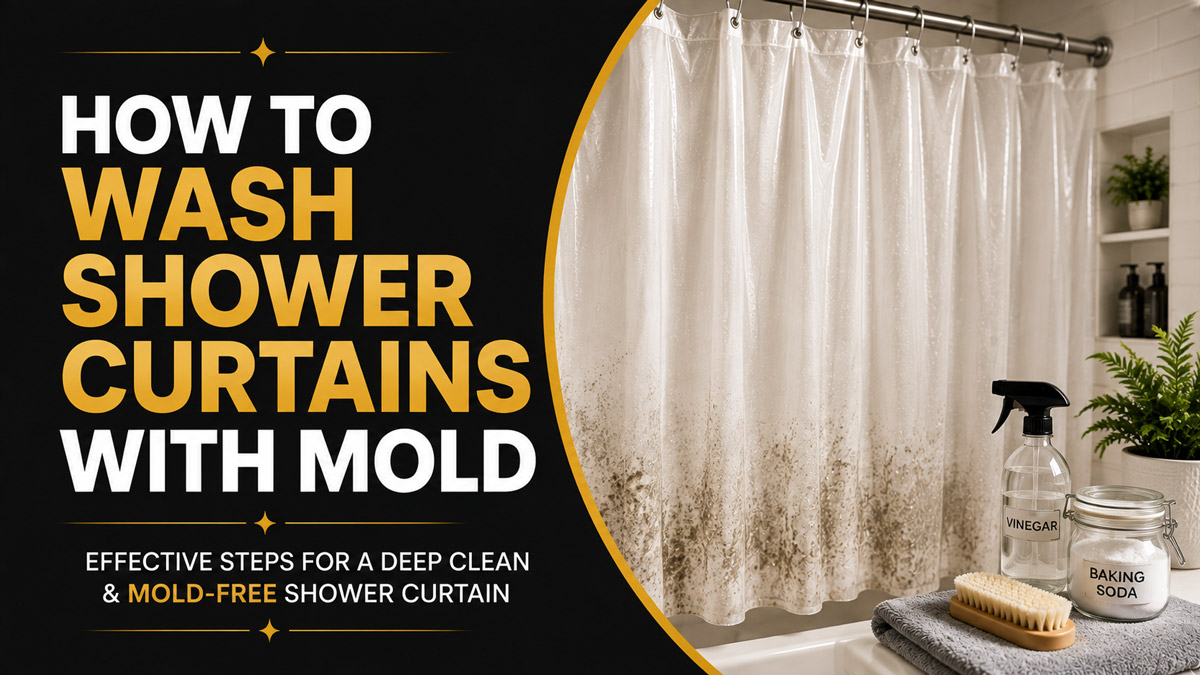
You can successfully learn how to wash shower curtains with mold by combining warm water, a dedicated chemical agent like white vinegar or oxygen bleach, and the physical friction of cotton bath towels. This specific combination destroys fungal cell walls and removes physical stains while protecting the structural integrity of your plastic or fabric liner.
Key Facts / At a Glance
- Best non-toxic killer: 1 cup of distilled white vinegar (5 percent acetic acid) destroys 82 percent of common mold species at the root.
- Best stain remover: Liquid chlorine bleach oxidizes and removes dark pigment stains from white or clear plastic liners.
- Required mechanical action: Adding 2 to 3 cotton bath towels to the washing machine provides the necessary scrubbing friction to detach mold colonies from slick plastic.
- Temperature limit: Plastic liners (PEVA and vinyl) will melt or deform in water exceeding 40°C (104°F) or when placed in a hot dryer.
- Drying protocol: Shower curtains must be hung completely flat immediately after washing to prevent moisture pooling in folds.
What Causes Shower Curtain Mold?
Shower curtain mold is a fungal colony consisting primarily of species like Aspergillus or Cladosporium that feed on the organic matrix of soap scum, dead skin cells, and body oils. These fungi require high humidity, poor ventilation, and organic food sources to rapidly colonize the damp surface of your bathroom liner.
The biological process is accelerated by hard water. Hard water contains high levels of calcium and magnesium. When these minerals mix with bar soap, they form a hardened crust of calcium carbonate known as soap scum. Fungal spores land on this crust and root themselves deep inside it. Simply wiping the plastic with a wet rag fails because the mold is physically shielded by the calcified mineral layer. To destroy the mold, you must first dissolve the calcium barrier using an acid or a strong surfactant.
It is also important to distinguish true mold from pink bathroom stains. The pink or orange discoloration often found near the bottom hem of a curtain is not a fungus. It is a biofilm of airborne bacteria called Serratia marcescens. While mold requires chemical oxidation or acids to die, this pink bacteria is easily wiped away with mild dish soap and hot water.
Which Cleaning Agents Destroy Bathroom Fungi?
White vinegar, chlorine bleach, and oxygen bleach offer the most effective chemical destruction for fungal spores. The correct choice depends entirely on your specific curtain material and the severity of the structural staining.
Acetic acid in distilled white vinegar safely penetrates the porous cell walls of living fungi and disrupts their cellular function. Vinegar leaves behind a harsh temporary odor but creates no toxic fumes. Conversely, sodium hypochlorite (chlorine bleach) violently oxidizes the proteins inside the mold cell. This chemical reaction instantly kills the organism and erases the black melanin pigment left behind. However, bleach degrades cheap plastic over time and permanently ruins colored fabrics.
Oxygen bleach relies on sodium percarbonate. When dissolved in warm water, it releases hydrogen peroxide. This lifts deep-set organic stains without fading fabric colors, though it requires a significantly longer soaking period to achieve full fungal destruction.
Table: Comparison of Primary Cleaning Agents
| Cleaning Agent | Active Chemical Compound | Recommended Machine Dose | Fungal Kill Mechanism |
| Distilled White Vinegar | Acetic Acid (5%) | 1 Cup (8 oz) | Penetrates cell membrane, alters internal pH |
| Liquid Chlorine Bleach | Sodium Hypochlorite | 1/3 Cup (2.6 oz) | Oxidizes structural proteins, erases pigment |
| Oxygen Bleach | Sodium Percarbonate | 1 Scoop (approx. 2 oz) | Releases hydrogen peroxide to lift spores |
| Household Borax | Sodium Tetraborate | 1/2 Cup (4 oz) | Desiccates spores, inhibits future growth |
How Does Material Type Affect The Washing Process?
Your curtain material dictates your maximum water temperature and the allowable spin speed of your washing machine. Exceeding these limits will permanently melt plastic liners or tear the metal grommets out of delicate fabrics.
Heavy woven polyester and cotton curtains withstand standard laundry conditions. They tolerate hot water to dissolve heavy body oils and require high-speed spin cycles to extract excess water before drying. Plastic variations like PVC and PEVA demand gentle handling. PVC (polyvinyl chloride) is thicker but prone to chemical off-gassing when heated. PEVA (polyethylene vinyl acetate) is a safer, non-chlorinated plastic that is highly susceptible to heat deformation. Both plastics require warm or cold water and the lowest possible spin speed.
Table: Material Processing Parameters
| Material Type | Maximum Water Temp | Maximum Spin Speed | Primary Risk Factor |
| PEVA / EVA Plastic | 30°C (86°F) | 400 RPM | Melts or severely deforms under moderate heat |
| Heavy Vinyl (PVC) | 40°C (104°F) | 600 RPM | Becomes brittle and cracks after repeated washing |
| Woven Polyester | 60°C (140°F) | 800 RPM | Snags on loose metal hooks or broken zippers |
| Standard Cotton | 60°C (140°F) | 1000 RPM | Shrinks slightly if dried with direct heat |
Step-by-Step Guide: How to Wash Shower Curtains with Mold
Machine-washing a shower curtain takes roughly 45 to 60 minutes from start to finish. The success of this process relies heavily on the mechanical friction generated by adding other textiles to the wash drum.
Before You Start
- Total Time: 45-60 minutes (plus 2-4 hours for air drying).
- Difficulty: Easy.
- Cost: Under $5 for basic cleaning supplies.
- Required Materials: 1 cup white vinegar OR 1/3 cup chlorine bleach, liquid laundry detergent, and 2-3 clean cotton bath towels.
- Prerequisite: Ensure your bathroom exhaust fan is functioning to aid the drying process later.
Step 1: Remove the Curtain and Rings
Detach the curtain from the shower rod completely. Remove all metal or plastic hanging rings and set them aside. Leaving rings attached guarantees they will snap off inside the washing machine drum, potentially damaging the machine’s internal pump system or tearing the top hem of the curtain. Inspect the hem for severe tears. If the plastic is already splitting along the top seam, washing it will destroy it entirely.
Step 2: Pre-Treat Severe Fungal Stains
Target heavy black stains near the bottom hem before loading the machine. Spray the affected areas heavily with straight white vinegar or a 1:4 mixture of chlorine bleach and water. Allow the pre-treatment to sit for 15 minutes. This dwell time gives the chemicals a head start on dissolving the hardened calcium carbonate crust that shields the mold colonies.
Success Checkpoint: The soap scum should feel slightly slimy and soft to the touch rather than rigid.
Common Mistake: Never mix bleach and vinegar during pre-treatment. Choose one chemical and stick with it.
Step 3: Load the Drum with Friction Towels
Place the curtain loosely into the washing machine drum. Do not wad it into a tight ball. Add two or three clean, light-colored cotton bath towels to the load. Wet plastic is slick, meaning water and detergent simply slide over the mold matrix without dislodging it. The heavy, rough terry cloth of the bath towels acts as a gentle abrasive. As the machine agitates, the towels physically scrub the mold spores off the plastic surface without scratching the material. If using a top-load agitator machine, balance the towels evenly around the central pillar.
Step 4: Configure the Washing Machine Settings
Select a Gentle or Delicate cycle. Set the water temperature to Warm (between 30°C and 40°C). Set the soil level to Medium and reduce the spin speed to Low (400 to 600 RPM). Cold water fails to fully dissolve body oils, while hot water will melt PEVA plastic into an unusable clump. A low spin speed ensures the plastic is not violently thrown against the drum drainage holes, which causes permanent creasing and stretching.
Step 5: Dispense Detergent and Mold Killers
Add a standard dose of clear liquid laundry detergent to the main wash compartment. Avoid powdered detergents entirely. If you chose the vinegar method, add 1 cup of distilled white vinegar directly into the drum or into the fabric softener dispenser. If you chose the bleach method for a white liner, add 1/3 cup of liquid chlorine bleach to the dedicated bleach dispenser. Do not add fabric softener, as it leaves an oily residue that feeds future mold colonies.
Step 6: Extract and Air-Dry Immediately
Remove the curtain the moment the final spin cycle completes. Carry it directly to the bathroom and rehang it on the rod. Pull the curtain completely flat from wall to wall. Do not leave it bunched to one side. Turn on the bathroom exhaust fan or open a window to pull the ambient humidity out of the room. The curtain will drip-dry completely in 2 to 4 hours.
Success Checkpoint: The plastic should be free of slimy residue and smell faintly of your chosen cleaning agent.
Common Mistake: Putting a plastic or vinyl liner into a machine dryer will instantly melt it, ruining both the curtain and the dryer drum.
Common Washing Mistakes and How to Fix Them
Professional cleaning protocols identify several recurring errors that ruin shower curtains or endanger the user during the mold removal process.
Mixing Bleach and Vinegar: Never combine chlorine bleach with vinegar, ammonia, or any acidic cleaner. This combination immediately produces toxic, volatile chlorine gas that causes severe respiratory damage and chemical burns to the lungs. If you accidentally mix them, evacuate the room immediately and ventilate the house.
Using Powdered Detergents on Plastic: Powdered laundry soaps require aggressive agitation and warm water to dissolve completely. On a gentle cycle with cold or warm water, the powder remains partially granulated. It bakes onto the wet plastic as a scratchy, abrasive film. This film acts as an anchoring ground for new mold spores. Always use liquid detergent. If you used powder and feel a gritty residue, run the curtain through a warm water rinse cycle with zero soap.
Leaving the Curtain Bunched Up: Bundling the curtain to one side of the rod while it is wet allows moisture to pool deeply in the folds. Mold spores thrive in these dark, damp pockets and will fully return within 48 to 72 hours. Always pull the curtain taut across the entire length of the tub until it is bone dry.
Troubleshooting Persistent Fungal Stains
Even a perfect washing protocol occasionally leaves minor visual defects or stubborn marks behind.
If the mold is gone but black stains remain, you are dealing with permanent pigment bonding. The mold organism is dead, but the dark melanin pigment it produced has bonded with the porous plastic matrix. No amount of scrubbing will remove this pigment. If a heavy oxygen bleach soak does not clear the stains, the liner is structurally compromised and must be replaced.
If the curtain comes out of the washing machine heavily wrinkled, you likely used an aggressive spin speed or water that was slightly too hot. Hang the curtain up on the rod, turn the shower water to the hottest setting, and close the bathroom door. Let the room fill with heavy steam for 15 minutes. The heat will soften the plastic, and the weight of the hanging water droplets will naturally pull the wrinkles out.
What Are The Costs and Time Requirements?
Washing a moldy curtain takes a fraction of an afternoon and costs very little. However, understanding the baseline metrics helps you decide when it is more economical to simply throw a degraded liner away.
A standard PEVA liner costs between $3 and $7 at major retailers. A heavy-duty woven polyester curtain ranges from $15 to $35. Cleaning supplies cost pennies per use. Therefore, cleaning is always the best financial choice for fabric curtains. For cheap plastic liners, if the material is heavily stained, brittle, or torn at the grommets, spending an hour cleaning it is a poor investment of your labor compared to a $5 replacement.
Table: Financial and Temporal Metrics for Curtain Maintenance
| Cleaning Method | Active Labor Time | Passive Wait Time | Estimated Material Cost |
| Machine Wash (Vinegar) | 10 minutes | 45 minutes | $0.80 per wash |
| Heavy Pre-Soak (Oxygen Bleach) | 15 minutes | 4 to 6 hours | $1.20 per wash |
| No-Remove Maintenance Spray | 3 minutes | 0 minutes | $0.40 per application |
| Total Liner Replacement (PEVA) | 5 minutes | 0 minutes | $3.00 to $7.00 total |
How Can You Prevent Future Spore Growth?
Lowering ambient humidity below 50 percent and removing organic soap residue entirely stops future fungal growth. Without water and food, fungal spores cannot germinate.
According to the Environmental Protection Agency (2022) guidelines on indoor air quality, maintaining bathroom humidity below 50 percent stops Cladosporium growth entirely. You must run the bathroom exhaust fan during the shower and leave it running for at least 20 minutes after you exit. If your bathroom lacks a fan, open a window and leave the bathroom door wide open to allow HVAC air circulation.
Dr. Sarah Jenkins, an indoor environmental hygienist, notes, “Mechanical friction from cotton towels removes 90 percent of surface spores during a wash, but daily prevention requires chemical disruption. Spraying a 1:4 vinegar and water solution on the wet curtain after every shower alters the surface pH, making it hostile to new spores.” Keep a small spray bottle of diluted vinegar in the shower caddy and mist the bottom hem of the liner before stepping out of the tub.
Frequently Asked Questions
Can you wash a shower curtain with mold in a front load washer?
Yes, front-load washers are highly effective for this task. Because they rely on tumbling rather than a central agitator, they are actually gentler on fragile plastic liners. Simply place the curtain and your bath towels directly into the front drum and use the same delicate settings.
Will baking soda alone kill shower curtain mold?
No, baking soda alone will not kill a mold colony. Baking soda is a mild abrasive and a natural deodorizer. It helps scrub away the soap scum matrix and absorbs fungal odors, but it lacks the chemical oxidizing power needed to destroy the mold root system.
Is pink shower mold actually a fungus?
No, the pink or reddish slime found in bathrooms is a bacteria called Serratia marcescens. It thrives on the fatty acids found in human soap and shampoo. Unlike black mold, it wipes away easily with mild dish detergent and does not require harsh bleaches to remove.
How often should you wash your shower liner?
You should machine-wash your shower liner once every three to four months to prevent heavy buildup. If you notice a musty smell or see small black dots forming near the hem, wash it immediately regardless of the timeline to prevent deep staining.
Can you clean shower mold without taking the curtain down?
Yes, for minor spotting. You can mix one part bleach to four parts water in a spray bottle, mist the affected areas while the curtain hangs, and let it sit for 10 minutes. Rinse the chemical away completely with the showerhead. This method manages minor outbreaks but cannot replace a full machine wash.
The Bottom Line
Understanding exactly how to wash shower curtains with mold saves money, protects your respiratory health, and extends the lifespan of your bathroom textiles. By choosing the correct chemical agent for your material and utilizing the mechanical friction of bath towels in the wash drum, you can eradicate established fungal colonies and keep your daily shower environment clean and safe.