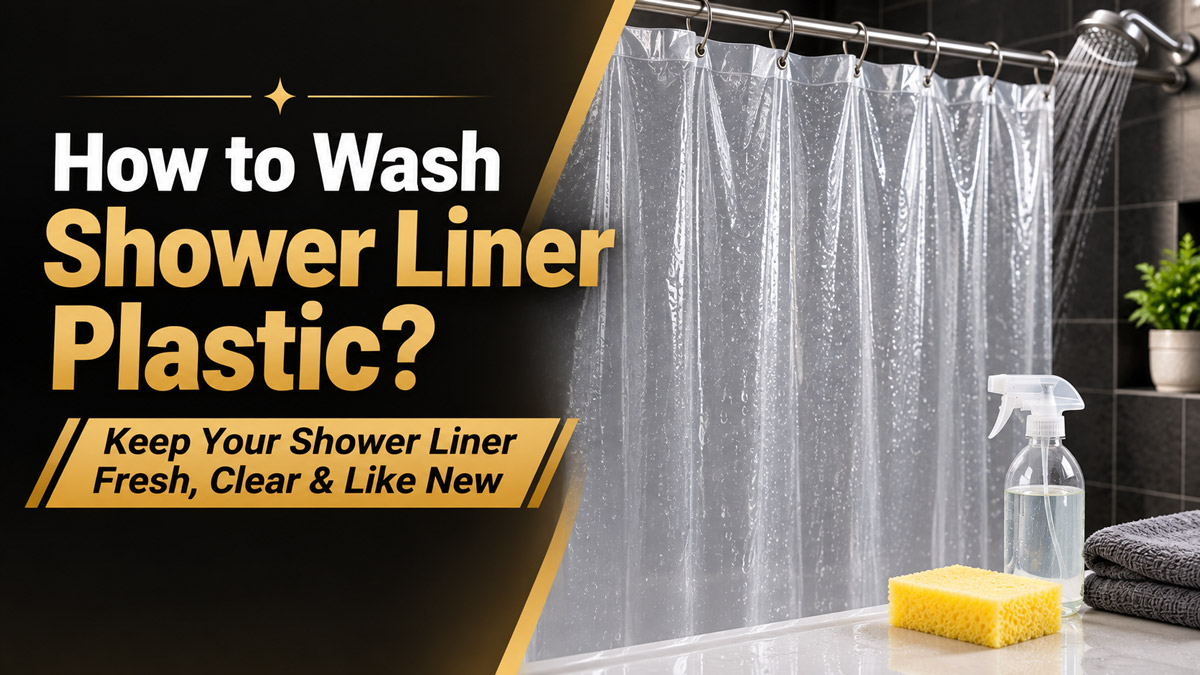
You can wash a plastic shower liner efficiently in a standard washing machine using warm water, a mild liquid laundry detergent, and two bath towels for scrubbing friction. Set the machine to a delicate cycle with a low spin speed. Alternatively, soak delicate liners in a bathtub with vinegar and dish soap.
At a Glance
- Standard plastic liners withstand gentle machine washing with warm water between 85°F and 105°F.
- Two bath towels placed in the drum prevent the plastic from tearing while providing necessary scrubbing friction.
- Baking soda removes soap scum, while liquid chlorine bleach targets severe mold and mildew.
- Mixing bleach and vinegar creates toxic chlorine gas and is strictly prohibited.
- Plastic liners must air dry on the shower rod because dryer heat will instantly melt the material.
- Replace the shower liner immediately if black mold penetrates the microscopic seams.
How do PVC, PEVA, and Vinyl liners differ in washing durability?
Polyvinyl chloride (PVC), polyethylene vinyl acetate (PEVA), and standard vinyl differ significantly in their ability to withstand repeated wash cycles. PVC liners are highly durable and handle machine washing well, but they can release volatile organic compounds when exposed to hot water. PEVA liners are chlorine-free and structurally thinner. You must wash PEVA liners using a gentle manual soak to prevent the material from tearing in a machine drum.
The Environmental Protection Agency (2023) notes that heated PVC releases volatile organic compounds into enclosed spaces, making PEVA a safer choice for households prioritizing indoor air quality. However, that safety comes at the cost of durability. Standard heavy-duty vinyl often measures 10-gauge or thicker and survives dozens of machine washes. Typical housekeeping industry standards dictate replacing commercial vinyl liners after 150 wash cycles due to plasticizer degradation. When selecting a cleaning method, always check the manufacturing tag. Treat anything labeled PEVA or EVA as a delicate textile.
What are the exact washing machine settings for standard liners?
You must wash a standard plastic shower liner using a delicate or gentle cycle, warm water, and a low spin speed. The delicate cycle minimizes the rotational force inside the drum. This reduction in kinetic energy prevents the plastic sheet from stretching, catching on the agitator, or tearing at the seams.
Warm water softens the plastic just enough to release bonded dirt without melting the polymer structure. A low or no-spin setting prevents the liner from pressing tightly against the drum walls. High spin speeds create deep, permanent creases in the plastic that cannot be ironed out later. Front-loading washing machines are generally safer for shower liners because they rely on gravity rather than a central plastic agitator to move the laundry.
| Machine Setting | Recommended Parameter | Purpose |
| Water Temperature | Warm (85°F to 105°F) | Softens soap scum without melting plastic |
| Wash Cycle | Delicate / Gentle | Reduces physical stress on liner seams |
| Spin Speed | Low / No-Spin | Prevents permanent wrinkling and stretching |
| Load Size | Small | Allows the liner and towels room to agitate |
What detergents and additives work best for washing shower liners?
The most effective cleaning combination is one-half cup of standard liquid laundry detergent paired with one targeted chemical additive. You should add one-half cup of baking soda directly into the drum to neutralize odors and act as a mild abrasive against soap scum. If the liner has visible mold, pour one-half cup of liquid chlorine bleach into the machine dispenser instead.
Detergent lifts the oils left behind by human skin and bath products. The additives handle the specific biological or mineral buildup. According to the American Cleaning Institute (2024), washing standard shower liners in a machine extends their usable life by up to 70 percent when using the correct detergent ratios. Do not use powdered laundry detergents. Powdered detergents often fail to dissolve completely in delicate warm-water cycles, leaving a gritty residue on the surface of the plastic liner.
Should you use hot or cold water when washing plastic liners?
You should always use warm water between 85°F and 105°F (30°C to 40°C) when washing plastic liners. Hot water will permanently deform, melt, or shrink the plastic material. Cold water is too thermally rigid to dissolve the hardened animal fats and waxes found in bar soaps.
The thermodynamics of cleaning require a precise balance. Soap scum is essentially a waxy barrier of calcium stearate. Cold water forces this wax to remain solid, rendering detergents highly ineffective. Warm water softens the stearate barrier, allowing the surfactants in your liquid laundry detergent to break the chemical bonds holding the scum to the plastic. If your washing machine lacks a specific temperature control, select the warm setting and manually verify the water is comfortable to the touch before submerging the liner.
How do you clean ultra-thin PEVA liners or liners with metal grommets?
You must clean ultra-thin PEVA liners and liners equipped with metal grommets by placing them inside a large mesh laundry bag before machine washing. If a mesh bag is unavailable, you must wash these delicate items exclusively by hand in a bathtub. Ultra-thin liners measuring under 3-gauge thickness will easily wrap around a machine agitator and shred into pieces.
Metal grommets present a secondary hazard. The heavy metal rings can strike the walls of a washing machine drum with enough force to chip the enamel coating. Furthermore, exposing metal grommets to liquid chlorine bleach for extended periods accelerates rust formation. The rust then bleeds into the plastic, causing permanent orange stains. Enclosing the liner in a mesh laundry bag limits the violent movement of the grommets while still allowing water and detergent to flow freely through the material.
How do you wash heavy-duty commercial plastic liners?
You can wash heavy-duty commercial plastic liners in a washing machine, but you must manually pause the cycle before the final rinse to reposition the material. Heavy-duty liners (10-gauge or thicker) become stiff when exposed to water and tend to trap large pockets of soapy liquid inside their folds.
Because the thick vinyl does not drape easily, the washing machine cannot effectively rinse the inner layers of the folded plastic. Pausing the machine allows you to manually open the bunched plastic, releasing the trapped dirty water. This ensures the clean rinse water reaches every square inch of the liner. If you skip this manual intervention, you will remove the liner only to find it coated in a sticky film of concentrated detergent and suspended dirt.
How to manually wash a plastic shower liner without a washing machine?
You can manually wash a plastic shower liner by submerging it in a bathtub filled with four to six inches of warm water, one cup of distilled white vinegar, and one-quarter cup of liquid dish soap. You must let the liner soak completely undisturbed for thirty minutes before scrubbing it.
The thirty-minute soak is mandatory. The acetic acid in the white vinegar slowly dissolves hard water mineral deposits, while the dish soap breaks down the lipid bonds in soap scum. After the soaking period concludes, use a microfiber cloth or a soft-bristled brush to gently scrub the stained areas. Work from the top grommets down to the weighted bottom hem. Finally, drain the bathtub and rinse the plastic liner thoroughly using the cold water setting on a handheld showerhead.
How do you properly dry a plastic shower liner?
You must air dry a plastic shower liner by hanging it directly back onto the shower rod immediately after washing. Spread the liner out completely along the rod so that no folds touch each other, and allow it to dry for two to four hours.
Never place a plastic shower liner inside a clothes dryer under any circumstances. Even on the lowest heat setting, the concentrated thermal energy inside a tumbling dryer will melt the plastic. This ruins the liner and leaves melted polymer residue permanently bonded to the inside of your dryer drum. To accelerate the air-drying process, open the bathroom windows or run the bathroom exhaust fan. Adequate ventilation removes the ambient humidity, allowing the water droplets on the plastic surface to evaporate efficiently.
How to remove pink slime (Serratia marcescens) from a shower liner?
You must remove pink slime by spraying the affected areas of the shower liner with a solution of one part liquid chlorine bleach to ten parts water. Allow the bleach solution to sit on the plastic for ten minutes before rinsing it away thoroughly with cold water.
Pink slime is not a mold or a hard water stain. It is a common airborne bacteria called Serratia marcescens that thrives in damp, phosphorus-rich environments. Standard laundry detergents and white vinegar will wash away the visible pink pigment, but they will not kill the underlying bacterial colony. The bacteria will return within days. A study on domestic biofilms by the National Institutes of Health (2022) demonstrated that Serratia marcescens requires at least a 1:10 sodium hypochlorite (bleach) dilution for complete eradication. Always wear gloves and ensure proper bathroom ventilation when applying this chemical mixture.
What is the safest way to treat embedded black mold in liner seams?
You cannot safely or effectively treat black mold once it becomes deeply embedded in the microscopic seams and tears of a plastic shower liner. When this occurs, you must remove the shower liner from your home and replace it with a new one.
Surface mold responds well to bleach or vinegar treatments. However, aged plastic liners develop microscopic fissures that are invisible to the naked eye. Mold spores migrate into these porous gaps and establish root systems deep inside the polymer matrix. Surface washing merely bleaches the top layer of the mold while leaving the internal root system intact. Within a week of a deep clean, the black spots will push back through to the surface. Mold embedded inside the structural integrity of the plastic cannot be sanitized, making immediate replacement the only hygienic option.
Can you fix permanent hard water etching on plastic liners?
You cannot fix permanent hard water etching, and the clouded plastic shower liner must be replaced if pure white vinegar fails to dissolve the haze. You can determine if the cloudiness is reversible by applying undiluted vinegar to a small section and waiting five minutes.
If the white film wipes away, you are dealing with standard soap scum or light calcium deposits. If the plastic remains cloudy, a chemical bonding process has occurred. The Water Quality Association (2025) reports that households with water hardness above 7 grains per gallon will experience irreversible etching on soft plastics within six months. The calcium carbonate physically pits the surface of the plastic, altering how light passes through the material. No amount of scrubbing will restore clarity to an etched plastic liner.
Are there eco-friendly alternatives to bleach for heavily soiled liners?
You can clean heavily soiled plastic liners using an eco-friendly paste made from three percent hydrogen peroxide and baking soda. Mix the two ingredients until they form a thick slurry, apply it directly to the mold or mildew stains, and let it sit for thirty minutes before scrubbing.
Hydrogen peroxide is a powerful oxidizing agent that breaks down the cellular walls of mold and bacteria without releasing harsh chemical fumes into your bathroom. When combined with the mild abrasive properties of baking soda, it provides a cleaning mechanism nearly as effective as chlorine bleach. Once the hydrogen peroxide finishes oxidizing the organic matter, it breaks down naturally into water and oxygen. This leaves zero toxic residue on your shower liner or in your local municipal water supply.
What happens if you mix vinegar and bleach while washing a liner?
Mixing vinegar and liquid chlorine bleach together creates lethal chlorine gas immediately upon contact. You must never combine these two chemicals under any circumstances when washing a shower liner or cleaning a bathroom.
Many people mistakenly believe that combining an acid (vinegar) with a powerful sanitizer (bleach) will create a superior cleaning solution for tough mold. Instead, the acetic acid in the vinegar triggers a violent chemical reaction with the sodium hypochlorite in the bleach. This reaction releases pure chlorine gas into the surrounding air. Inhaling chlorine gas causes severe respiratory distress, fluid buildup in the lungs, and can be fatal in small, unventilated spaces like bathrooms. You must choose only one chemical additive per wash cycle.
What is the cost difference between washing and replacing plastic liners?
Washing a moderately priced shower liner every three months saves the average household approximately $45 to $80 over a three-year period compared to routinely replacing it. While plastic liners are relatively inexpensive, frequent replacements incur compounding financial and environmental costs.
Most standard liners cost between $10 and $20. A single machine wash uses pennies worth of water and detergent. If you replace a $15 liner every six months instead of washing it, you spend $90 over three years. If you wash that same liner quarterly and extend its life to three years, your total maintenance cost remains under $5. Beyond the financial impact, routine washing keeps non-biodegradable polyvinyl chloride out of local landfills.
| Maintenance Strategy | Frequency | 3-Year Total Cost | Environmental Impact |
| Wash and Maintain | Every 3 months | $3 – $5 (Supplies) | Very Low (1 liner used) |
| Replace When Dirty | Every 6 months | $60 – $120 | High (6 liners landfilled) |
| Replace When Dirty | Every 12 months | $30 – $60 | Moderate (3 liners landfilled) |
How do you remove wrinkles from a plastic liner after washing?
You can remove wrinkles from a washed plastic liner by hanging it on the shower rod and running a hot, steamy shower for ten to fifteen minutes. The ambient steam softens the polymer structure, allowing gravity to pull the wrinkles out naturally.
Machine washing often leaves plastic liners severely creased, especially if you accidentally use a high spin speed. You must never attempt to iron a plastic liner, even with a towel placed over it, as the direct conductive heat will instantly warp the material. Convective heat from shower steam is gentle and distributed evenly across the surface area. For stubborn creases near the top hem, you can point a hair dryer on its lowest, coolest setting at the plastic from a distance of at least twelve inches while gently pulling the bottom hem downward.
How often should you wash your shower liner to prevent severe buildup?
You should machine wash or deep clean your plastic shower liner once every three months to prevent severe mineral and biological buildup. To extend the time between deep cleanings, you must spray the liner weekly with a one-to-one mixture of water and white vinegar.
Consistent maintenance prevents mold spores from establishing deep root systems in the plastic. The weekly vinegar spray alters the pH level on the surface of the liner, creating an acidic environment hostile to both Serratia marcescens and common black mold. Furthermore, routine washing prevents heavy soap scum from hardening. Once soap scum accumulates for longer than three months, it requires intense mechanical scrubbing that can permanently stretch or damage the plastic material.
Can you use a melamine foam eraser on a plastic shower liner?
You can use a damp melamine foam eraser to spot clean small patches of stubborn soap scum, but you should avoid using it across the entire surface of the plastic liner. Melamine foam acts as microscopic sandpaper that physically scratches the plastic.
While a magic eraser quickly removes surface grime, the abrasive foam leaves behind thousands of microscopic abrasions in the smooth polymer finish. These tiny scratches create the perfect textured environment for future bacteria, mold, and soap scum to anchor themselves. The next time the liner gets dirty, the stains will penetrate deeper into the scratched plastic, making them exponentially harder to remove. Reserve melamine foam exclusively for spot-treating heavily calcified areas near the bottom hem.
When exactly should you throw away a plastic shower liner?
You should throw away a plastic shower liner when it develops visible physical tears, when the metal grommets rust onto the plastic, or when black mold remains visible after a full bleach wash. Under normal usage conditions, most standard plastic liners require replacement every six to twelve months.
Physical damage compromises the primary function of the liner. Tears allow water to escape the shower enclosure and damage your bathroom flooring. Missing magnetic weights cause the liner to blow inward during a shower, clinging uncomfortably to wet skin. Once rust heavily stains the plastic or mold embeds itself into the structural seams, the liner becomes an unsanitary biological hazard. At this stage, no amount of chemical cleaning can restore the liner to a safe condition.
The Bottom Line
Maintaining a clean plastic shower liner requires balancing the mechanical force of a washing machine with the chemical power of targeted additives. You can safely machine wash most standard liners using warm water, two bath towels for friction, and a delicate cycle to prevent tearing. While baking soda effectively dissolves soap scum and bleach destroys surface mold, you must replace the liner entirely if mold penetrates the plastic seams or if hard water permanently etches the surface. By washing your liner quarterly and avoiding damaging heat from clothes dryers, you will maximize its lifespan and maintain a hygienic bathroom environment.