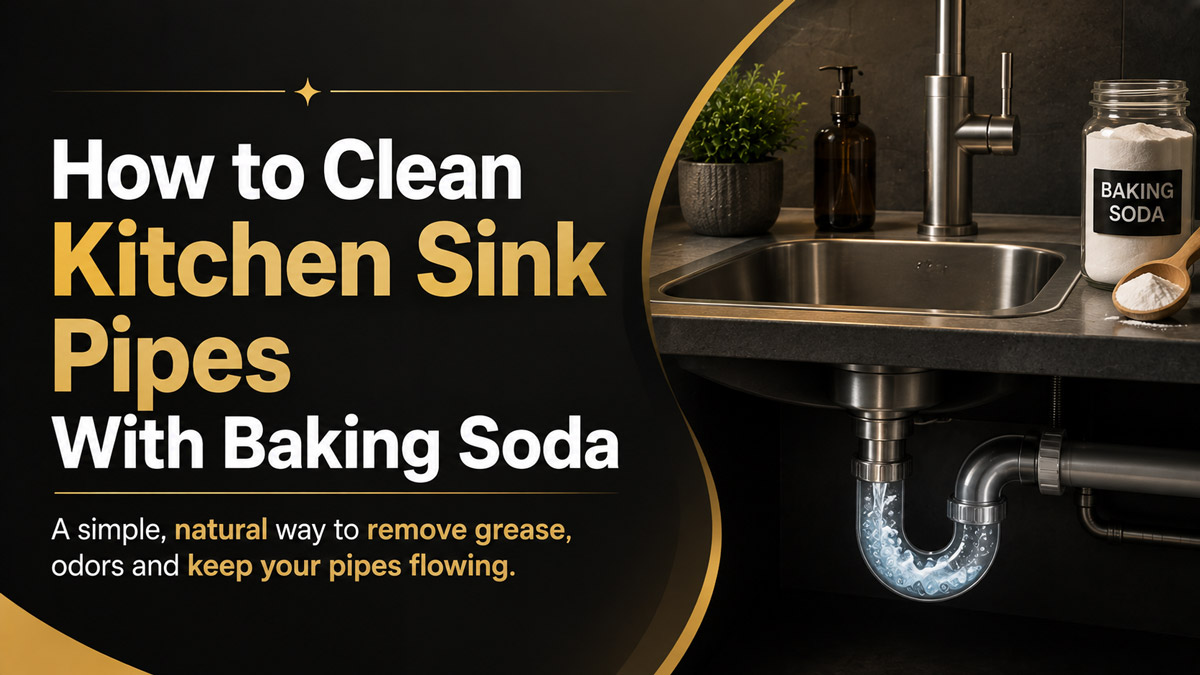
To clean kitchen sink pipes with baking soda, pour half a cup of dry baking soda directly into the drain, followed by one cup of white vinegar. Plug the drain immediately, let the mixture fizz for 15 minutes, and flush the pipes with four cups of hot water to clear organic buildup.
At a Glance:
- The optimal cleaning ratio is one part baking soda to two parts white vinegar by volume.
- Boiling water (212°F / 100°C) damages PVC and PEX pipes; use 140°F (60°C) tap water instead.
- The chemical reaction physically dislodges light sludge but cannot chemically dissolve solid fatbergs or hair.
- Mixing baking soda with bleach creates a severe risk of toxic gas release.
- Preventative drain maintenance with baking soda should be performed every two to four weeks.
The Science and Exact Measurements
What is the ideal ratio of baking soda to vinegar?
The ideal ratio for cleaning sink pipes is one part baking soda to two parts white vinegar (1:2). For a standard residential kitchen sink, this translates to 1/2 cup (120 ml) of baking soda and 1 cup (240 ml) of white vinegar.
This specific ratio ensures that the chemical reaction runs to completion. Baking soda (sodium bicarbonate) is a base, while white vinegar (dilute acetic acid) is an acid. When mixed in a 1:2 volume ratio, the acidic liquid fully saturates the dry powder. This complete saturation maximizes the production of carbon dioxide gas, which provides the mechanical scouring pressure needed to clean the pipe walls. Using too much baking soda leaves a paste-like residue in the P-trap, while using too much vinegar wastes the acidic cleaning agent without generating additional gas pressure.
Does baking soda actually dissolve grease in pipes?
No, baking soda and vinegar do not chemically dissolve grease in plumbing systems. Instead, the mixture physically dislodges light grease and organic sludge through the mechanical action of expanding carbon dioxide gas.
Chemically dissolving grease requires a process called saponification, which turns fat into water-soluble soap. Saponification requires a highly caustic substance, such as lye (sodium hydroxide) or commercial enzymatic drain cleaners. Baking soda is a very weak base, and neutralizing it with vinegar creates water and sodium acetate, neither of which can melt hardened fat. Therefore, this natural method works by aggressively bubbling against the interior walls of the pipe, loosening the sticky, superficial biofilm and light cooking oils so that the subsequent hot water flush can carry the debris out to the municipal sewer line.
How long should baking soda sit in the sink drain?
Baking soda and vinegar should sit in the sink drain for exactly 15 to 20 minutes. This duration allows the chemical reaction to reach its maximum expansion while giving the resulting carbon dioxide bubbles enough time to agitate the organic matter clinging to the pipe walls.
Leaving the mixture in the drain for less than 15 minutes interrupts the mechanical scrubbing process, leaving sludge behind. Conversely, allowing the mixture to sit for more than 20 minutes is counterproductive. Once the fizzing stops, the remaining liquid is simply a stagnant pool of salty water (sodium acetate). If left for hours or overnight without a hot water flush, the loosened sludge and organic matter will settle back onto the pipe walls, potentially hardening into a denser blockage than before the cleaning process began.
Step-by-Step Cleaning Instructions
What are the exact steps to clear the drain?
To properly clear a kitchen drain using baking soda, follow a precise seven-step sequence to trap the expanding gas and force the blockage downward.
- Clear the standing water. Ensure the sink basin is completely empty. Bail out any pooled water with a cup to ensure the chemicals can reach the clog directly.
- Pour the powder. Push 1/2 cup of dry baking soda directly into the drain opening. Use a spoon or funnel if the powder sits on the flange.
- Add the acid. Pour 1 cup of white vinegar down the drain immediately after the powder.
- Seal the drain. Plug the drain immediately with a rubber stopper or a wet cloth. This forces the expanding carbon dioxide gas downward against the clog instead of venting up into the sink.
- Wait for the reaction. Let the mixture sit undisturbed for exactly 15 to 20 minutes.
- Heat the water. Bring 4 cups of water to the appropriate temperature for your pipe material (boiling for metal, hot tap water for plastic).
- Flush the system. Remove the stopper and rapidly pour the hot water down the drain to wash away the dislodged debris.
Plumbing and Material Edge Cases
Is boiling water safe to pour down PVC plumbing?
No, boiling water is never safe for plastic PVC (Polyvinyl Chloride) or flexible PEX (Cross-linked Polyethylene) pipes. PVC pipes are generally rated to withstand maximum temperatures of 140°F (60°C).
Pouring water that has reached a rolling boil (212°F / 100°C) directly into a plastic plumbing system introduces severe risks. The extreme heat can soften the structural integrity of the plastic, causing the pipes to warp or sag. More critically, boiling water can melt or degrade the PVC cement used to fuse the pipe joints together. When the glue fails, the P-trap or surrounding joints will develop catastrophic leaks under the sink. If the plumbing under the sink consists of white or black plastic pipes, substitute the boiling water flush with standard hot tap water, which maxes out at safe temperatures.
Can you put baking soda and vinegar in a garbage disposal?
Yes, you can clean a garbage disposal with baking soda and vinegar, but the application method requires major adjustments to prevent damaging the appliance.
Dumping large amounts of dry baking soda directly into the disposal chamber is risky because the powder can bypass the grinding mechanisms and cake tightly around the impeller blades and the bottom seal. To safely clean the unit, pour the baking soda onto the rubber splash guard and slowly trickle the vinegar over it. After allowing the mixture to fizz for 15 minutes, turn on the cold water tap and switch on the garbage disposal for 10 seconds. The spinning action combined with the water flow ensures the dislodged food particles and remaining baking soda are thoroughly flushed through the system, preventing the powder from hardening into a cement-like paste inside the motor housing.
Will white vinegar damage a porcelain sink finish?
Yes, white vinegar can permanently damage older or chipped porcelain sink finishes if left in direct contact with the surface. White vinegar contains a 4% to 6% concentration of acetic acid.
While this mild acid is harmless to stainless steel and modern composite sinks, it is corrosive to older porcelain enamel. If concentrated vinegar pools around the drain flange of a vintage porcelain sink, the acid will slowly etch and dull the glossy glaze, leaving a matte, porous surface that stains easily. To protect porcelain finishes, use a plastic kitchen funnel inserted directly into the drain hole. This directs both the baking soda and the vinegar straight into the plumbing, entirely bypassing the sensitive porcelain basin and protecting the sink’s aesthetic finish.
When the Method Fails and Troubleshooting
When does the baking soda and vinegar method fail?
The baking soda and vinegar method fails completely when a sink has standing water, solid blockages, or heavy fatbergs. This chemical mixture is a light maintenance rinse, not a heavy-duty mechanical unclogger.
If a sink is completely backed up with an inch of standing water, pouring baking soda into the basin is useless. The baking soda will dilute in the standing water before reaching the clog, and adding vinegar will simply create a fizzy reaction at the surface of the sink basin. Furthermore, the mixture cannot dissolve solid physical obstructions like thick tree roots, plastic wrappers, bottle caps, or hardened mineral scale. Finally, if the pipe is choked by a fatberg (a massive accumulation of congealed cooking grease cooled deep inside the plumbing), the weak gas pressure generated by the mixture will not possess enough force to break the solid mass apart.
Does baking soda dissolve hair clumps in drains?
No, baking soda and vinegar will not dissolve hair clumps in any drain. Human and pet hair consists of keratin, a highly durable structural protein that easily resists weak household acids and bases.
When a kitchen or bathroom sink is clogged by a matted hairball, the baking soda mixture will simply fizz around the exterior of the blockage without breaking down the protein strands. Chemical dissolution of hair requires highly toxic, caustic commercial drain cleaners containing sodium hydroxide (lye) or sulfuric acid, which chemically burn through the keratin. Because the baking soda method relies purely on light gas pressure, a hair clump will remain firmly lodged in the P-trap. The only effective, non-toxic way to resolve a hair clog is physical extraction using a manual hand auger, a barbed zip-it tool, or by disassembling the P-trap by hand.
Why is the sink more clogged after using baking soda?
A sink often becomes more clogged after using baking soda because the chemical reaction dislodged a thick chunk of organic sludge without fully breaking it apart.
When the expanding carbon dioxide gas acts upon a layer of grime lining the upper pipe walls, it can break off a solid slab of debris. As this heavy chunk slides downward, it can wedge itself tightly into a narrower pipe joint, a 90-degree elbow, or the bottom curve of the P-trap. Because the baking soda mixture lacks the chemical power to liquefy this chunk, the debris acts like a plug, turning a slow-draining sink into a completely stopped-up system. When this occurs, further applications of baking soda will not help. A plunger or a mechanical plumbing snake is required to manually push or pull the lodged debris through the bottleneck.
Alternative Mixtures and Safety Risks
Can you use apple cider vinegar instead of white vinegar?
Yes, apple cider vinegar can be used instead of white vinegar to clear sink pipes, but it is not the recommended choice for professional plumbing maintenance.
Any weak household acid will react with baking soda to create carbon dioxide gas. However, distilled white vinegar is vastly preferred for two reasons: cost and purity. White vinegar is significantly cheaper per ounce, making it economical for pouring down a drain. More importantly, white vinegar is distilled and leaves zero residue. Unpasteurized apple cider vinegar often contains “the mother” (strands of proteins, enzymes, and friendly bacteria) and natural fruit sugars. Pouring these sticky organic compounds down a drain can leave a subtle film on the pipe walls, which may actually attract new grease and food particles over time.
Can you mix baking soda with salt for stronger cleaning?
Yes, mixing baking soda with salt creates a significantly stronger cleaning action by introducing a mechanical abrasive to the chemical reaction.
For heavy-duty maintenance, mix 1/2 cup of baking soda with 1/2 cup of coarse kosher salt or rock salt before pouring it down the drain. When the vinegar is subsequently added, the resulting carbon dioxide gas violently agitates the mixture. Because the coarse salt crystals do not dissolve instantly in the vinegar, they act like liquid sandpaper. As the gas pressure pushes the mixture rapidly through the plumbing, the hard edges of the salt crystals physically scour the sticky residue and hardened biofilm off the interior pipe walls, providing a much deeper clean than the soft baking soda powder alone.
Is it safe to mix baking soda with bleach?
No, it is absolutely never safe to mix baking soda with bleach, or to use the baking soda and vinegar method if bleach is already present in the drain.
While baking soda itself (sodium bicarbonate) does not dangerously react with bleach, the drain-cleaning process requires adding an acid (vinegar). Mixing bleach (sodium hypochlorite) with any acid, including mild white vinegar, instantly triggers a severe chemical reaction that releases toxic chlorine gas. Inhalation of chlorine gas causes severe respiratory distress, coughing, fluid in the lungs, and can be fatal in unventilated spaces. If you have recently poured bleach or a commercial chemical cleaner down the clogged sink, you must wait at least 24 hours and flush the system with copious amounts of cold water before attempting the baking soda and vinegar method.
Routine Maintenance
How often should you maintain pipes with this method?
You should clean your kitchen sink pipes with baking soda and vinegar once every two to four weeks for optimal preventative maintenance.
This regular schedule is the exact frequency required to prevent the accumulation of biofilm—the sticky, bacterial slime that naturally forms inside wet plumbing. By scouring the pipes bi-weekly, the expanding gas removes light grease and food micro-particles before they have the chance to harden into dense, immovable obstructions. For households that cook frequently with oils, process high volumes of food scraps through a garbage disposal, or have older cast-iron plumbing with rough interior walls, performing this maintenance every two weeks is highly recommended to prevent foul odors and unexpected backups.
The Bottom Line
Cleaning kitchen sink pipes with baking soda and vinegar is a highly effective, natural maintenance strategy that relies on the mechanical expansion of carbon dioxide gas to clear light organic sludge. To execute it properly, use a 1:2 ratio of baking soda to white vinegar, seal the drain to direct the pressure downward, and always flush with hot water tailored to your pipe material—avoiding boiling water on plastic PVC. While this method excels at routine bi-weekly maintenance and odor control, it cannot dissolve solid physical obstructions like hair or hardened fatbergs, which ultimately require manual extraction with a plumbing snake or P-trap removal.